
Mali
Mali is a landlocked republic in Africa, home to 16 million people, with its capital at Bamako.
Contents
12 chapters
Foundations
01–03
At a glance
- Area
- 1.2Mkm²#24 World#8 Africa
- Population
- 16.5M#66 World#21 Africa
- GDP (market)
- $11.4B
- GDP (PPP)
- $18.9B#137 World#29 Africa
- GDP per capita
- $1.1K#217 World#46 Africa
The whole brief
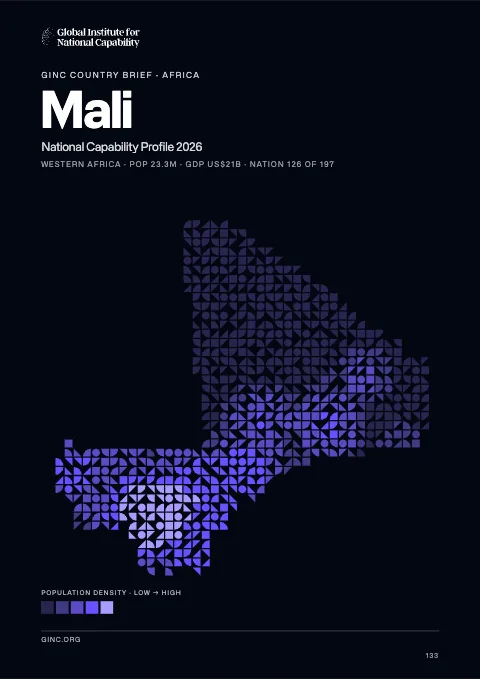
Mali National Capability Profile 2026
Foundations · Chapter 01
Historical Context
🇲🇱 Mali’s understanding the origins and evolution of the modern nation
BackgroundBack to top ↑
The Sudanese Republic and Senegal became independent of France in 1960 as the Mali Federation. When Senegal withdrew after only a few months, what formerly made up the Sudanese Republic was renamed Mali. Rule by dictatorship was brought to a close in 1991 by a military coup that ushered in a period of democratic rule. President Alpha KONARE won Mali's first two democratic presidential elections in 1992 and 1997. In keeping with Mali's two-term constitutional limit, he stepped down in 2002 and was succeeded by Amadou Toumani TOURE, who was elected to a second term in 2007 elections that were widely judged to be free and fair. Malian returnees from Libya in 2011 exacerbated tensions in northern Mali, and Tuareg ethnic militias started a rebellion in January 2012. Low- and mid-level soldiers, frustrated with the poor handling of the rebellion overthrew TOURE on 22 March. Intensive mediation efforts led by the Economic Community of West African States (ECOWAS) returned power to a civilian administration in April with the appointment of interim President Dioncounda TRAORE. The post-coup chaos led to rebels expelling the Malian military from the three northern regions of the country and allowed Islamic militants to set up strongholds. Hundreds of thousands of northern Malians fled the violence to southern Mali and neighboring countries, exacerbating regional food insecurity in host communities. An international military intervention to retake the three northern regions began in January 2013 and within a month most of the north had been retaken. In a democratic presidential election conducted in July and August of 2013, Ibrahim Boubacar KEITA was elected president in the second round.
IndependenceBack to top ↑
22 September 1960 (from France)
National holidayBack to top ↑
Independence Day, 22 September (1960)
Foundations · Chapter 02
Geography
🇲🇱 Mali’s territory, resources and strategic position
Location and areaBack to top ↑
interior Western Africa, southwest of Algeria, north of Guinea, Cote d'Ivoire, and Burkina Faso, west of Niger
17 00 N, 4 00 W
Africa
slightly less than twice the size of Texas
0 km (landlocked)
none (landlocked)
Terrain and resourcesBack to top ↑
mostly flat to rolling northern plains covered by sand; savanna in south, rugged hills in northeast
gold, phosphates, kaolin, salt, limestone, uranium, gypsum, granite, hydropower
2,358 sq km (2003)
Settlement and hazardsBack to top ↑
hot, dust-laden harmattan haze common during dry seasons; recurring droughts; occasional Niger River flooding
landlocked; divided into three natural zones: the southern, cultivated Sudanese; the central, semiarid Sahelian; and the northern, arid Saharan
OtherBack to top ↑
100 cu km (2011)
deforestation; soil erosion; desertification; inadequate supplies of potable water; poaching
Foundations · Chapter 03
Environment
🇲🇱 Mali’s environmental conditions, resources and national resilience
ClimateBack to top ↑
subtropical to arid; hot and dry (February to June); rainy, humid, and mild (June to November); cool and dry (November to February)
Emissions and pollutionBack to top ↑
Water, waste and foodBack to top ↑
Resources and agreementsBack to top ↑
GINC Capability Domains · Chapter 04
Critical Technology
🇲🇱 Mali’s technology frontiers and the pursuit of national advantage
Two counts are set side by side for 2015–2024: on the left, the papers researchers in Mali published; on the right, the patent families that began there and were filed in more than one country. First by capability group, then group by group with each group’s capabilities. The badge on a card is the nation’s place among all nations. Papers are from GINC Research Analytics, patent families from GINC Patents.
Research by capability group
#133 WorldPapers published, 2015–2024
Patents by capability group
International patent families, 2015–2024
No international patent families on record for 2015–2024.
Advanced Materials & ManufacturingBack to top ↑
Research
#155 WorldPapers published, 2015–2024
Patents
International patent families, 2015–2024
No international patent families on record for 2015–2024.
Energy TechnologiesBack to top ↑
Research
#133 WorldPapers published, 2015–2024
Patents
International patent families, 2015–2024
No international patent families on record for 2015–2024.
Semiconductors & Advanced ComputingBack to top ↑
- Semiconductor Design & EDA
- Advanced Semiconductor Fabrication
- Semiconductor Equipment & Materials
- Advanced Packaging & Heterogeneous Integration
- Compound & Power Semiconductors
- High-Performance & AI Computing
Artificial IntelligenceBack to top ↑
Research
#156 WorldPapers published, 2015–2024
Patents
International patent families, 2015–2024
No international patent families on record for 2015–2024.
Quantum TechnologiesBack to top ↑
Research
#125 WorldPapers published, 2015–2024
Patents
International patent families, 2015–2024
No international patent families on record for 2015–2024.
Connectivity, Cyber & Trust TechnologiesBack to top ↑
Research
#139 WorldPapers published, 2015–2024
Patents
International patent families, 2015–2024
No international patent families on record for 2015–2024.
Sensing, Timing & NavigationBack to top ↑
- Precision Timing & Atomic Clocks
- Resilient Positioning & Navigation
- Advanced Imaging & Photonic Sensing
- Radar & Radiofrequency Sensing
- Acoustic & Undersea Sensing
Robotics & Autonomous SystemsBack to top ↑
Research
#160 WorldPapers published, 2015–2024
No research topic: Human-Machine Interfaces
Patents
International patent families, 2015–2024
No international patent families on record for 2015–2024.
Biotechnology & Health TechnologiesBack to top ↑
Research
#94 WorldPapers published, 2015–2024
Patents
International patent families, 2015–2024
No international patent families on record for 2015–2024.
Medicine and BioTech
Clinical research and life-science invention, drawn from the same series that drive the metric pages. Each card opens the full cross-country comparison.
Space TechnologiesBack to top ↑
Research
#95 WorldPapers published, 2015–2024
Patents
International patent families, 2015–2024
No international patent families on record for 2015–2024.
GINC Capability Domains · Chapter 05
Strategic Infrastructure
🇲🇱 Mali’s energy, connectivity and the material foundations of capability
Resource InfrastructureBack to top ↑
0 bbl/day (2012 est.)
0 bbl/day (2010 est.)
0 bbl/day (2010 est.)
0 bbl (1 January 2013 est.)
0 bbl/day (2010 est.)
4,994 bbl/day (2011 est.)
0 bbl/day (2010 est.)
4,698 bbl/day (2010 est.)
0 cu m (2011 est.)
0 cu m (2010 est.)
0 cu m (2011 est.)
0 cu m (2011 est.)
0 cu m (1 January 2013 est.)
Agriculture & Food InfrastructureBack to top ↑
- Irrigation & Agricultural Water
- Livestock & Veterinary
- Fisheries & Aquaculture
- Storage, Cold Chain & Markets
Energy InfrastructureBack to top ↑
- Thermal Generation
- Nuclear Generation
- Nuclear Fuel Cycle & Radioactive Waste
- Hydropower
- Renewable Generation
- Transmission & Distribution
- System Control & Dispatch
- Storage & Fuel Supply
304,000 kW (2010 est.)
520 million kWh (2010 est.)
483.6 million kWh (2010 est.)
0 kWh (2012 est.)
0 kWh (2012 est.)
48.4% of total installed capacity (2010 est.)
0% of total installed capacity (2010 est.)
51.6% of total installed capacity (2010 est.)
0% of total installed capacity (2010 est.)
742,300 Mt (2011 est.)
Water, Sanitation & Waste InfrastructureBack to top ↑
- Dams, Reservoirs & Flood Defence
- Water Supply & Treatment
- Bulk Water Transfer & Desalination
- Wastewater & Sanitation
- Solid Waste & Recycling
Advanced ManufacturingBack to top ↑
- Materials & Inputs
- Chemicals & Hazardous Process Industry
- Production Systems
- Supply Chain & Ecosystem
- Workforce & Innovation
Transport InfrastructureBack to top ↑
- Seaports & Terminals
- Air Infrastructure
- Air Navigation & Traffic Management
- Inland Waterways & Ferries
- Rail Infrastructure
- Roads & Bridges
- Logistics, Multimodal & Border Infrastructure
- Postal & Parcel
25 (2013)
2 (2013)
1,800 km (downstream of Koulikoro; low water levels on the River Niger cause problems in dry years; in the months before the rainy season the river is not navigable by commercial vessels) (2011)
Communications & Digital InfrastructureBack to top ↑
- Subsea Cables & International Gateways
- Core & Backbone Networks
- Mobile & Wireless Networks
- Spectrum & Broadcasting
- Data Centres, Compute & Cloud
- Data Resources
- AI Tools & Applications
112,000 (2012)
14.613 million (2012)
249,800 (2009)
437 (2012)
.ml
Financial InfrastructureBack to top ↑
- Currency & Reserves
- Payments & Settlement Systems
- Markets, Exchanges & Depositories
- Banks, Insurers & Systemic Institutions
Social InfrastructureBack to top ↑
- Health Infrastructure
- Public Health & Laboratories
- Medical Supply & Stockpiles
- Education & Skills Infrastructure
- Research & Scientific Facilities
- Housing, Community & Social Services
- Government & Public Administration
- Cultural, Community & Recreational Infrastructure
- Justice & Corrections
- Emergency Services & Civil Protection
- Hydrometeorology & Early Warning
Space, Aerospace & Defence InfrastructureBack to top ↑
GINC Capability Domains · Chapter 06
National Security
🇲🇱 Mali’s force, intelligence and the defence of the nation
Disputes and terrorismBack to top ↑
demarcation is underway with Burkina Faso
Force Generation & MobilisationBack to top ↑
Malian Armed Forces: Army (Armee de Terre), Republic of Mali Air Force (Force Aerienne de la Republique du Mali, FARM), National Guard (Garde National du Mali) (2013)
18 years of age for selective compulsory and voluntary military service; conscript service obligation - 2 years (2012)
1.44% of GDP (2012)//1.51% of GDP (2011)//1.44% of GDP (2010)
Forces under arms
Active-duty strength on the Correlates of War series, which reaches back to 1816 and so carries a nation’s whole record of mobilisation rather than its present establishment. The card opens the full cross-country comparison.
Intelligence & AssessmentBack to top ↑
- Imagery & Geospatial Intelligence
- Signals & Cyber Intelligence
- Technical & Measurement Intelligence
- Open-Source & Financial Intelligence
- Human Intelligence & Counterintelligence
- All-Source Analysis & Warning
Joint Command, Projection & SustainmentBack to top ↑
- Command, Control & Communications
- Strategic Lift & Mobility
- Expeditionary & Peace Operations
- Operational Sustainment & War Reserves
- Defence Industrial Mobilisation
- CBRN Defence
Land PowerBack to top ↑
- Combined Arms Manoeuvre
- Land Fires
- Battlefield Aviation & Uncrewed Systems
- Special Operations & Irregular Warfare
Maritime PowerBack to top ↑
- Maritime Security & Constabulary
- Sea Denial & Undersea Warfare
- Sea Control
- Amphibious & Expeditionary Operations
Air PowerBack to top ↑
- Air Sovereignty & Policing
- Control of the Air
- Air Strike & Interdiction
- Airborne ISR, Early Warning & Battle Management
Strategic Strike & Missile DefenceBack to top ↑
Space OperationsBack to top ↑
Cyber & Electromagnetic OperationsBack to top ↑
Nuclear DeterrenceBack to top ↑
GINC Capability Domains · Chapter 07
Human Capital
🇲🇱 Mali’s population, health and the skills that sustain capability
DemographyBack to top ↑
16,455,903 (July 2014 est.)
3% (2014 est.)
45.53 births/1,000 population (2014 est.)
13.22 deaths/1,000 population (2014 est.)
6.16 children born/woman (2014 est.)
18.6
8.2% (2006)
Migration and urbanisationBack to top ↑
-2.33 migrant(s)/1,000 population (2014 est.)
BAMAKO (capital) 2.037 million (2011)
Welfare and equityBack to top ↑
36.1% (2005 est.)
40.1 (2001)//50.5 (1994)
DisplacementBack to top ↑
Early Childhood DevelopmentBack to top ↑
27.9% (2006)
Foundational EducationBack to top ↑
4.8% of GDP (2011)
Advanced EducationBack to top ↑
Technical & Vocational SkillsBack to top ↑
Digital & AI CompetenceBack to top ↑
Generative AI adoption
Modelled share of working-age adults using generative AI, from Microsoft telemetry scaled to each country’s 15–64 population. A measure of how fast a workforce is absorbing the technology rather than of how much of it a nation builds. The card opens the full cross-country comparison.
Lifelong Learning & ReskillingBack to top ↑
Research Talent & Knowledge CreationBack to top ↑
Population HealthBack to top ↑
540 deaths/100,000 live births (2010)
4.3% (2008)
0.9% (2012 est.)
100,300 (2012 est.)
4,900 (2012 est.)
Health System CapabilityBack to top ↑
6.8% of GDP (2011)
0.08 physicians/1,000 population (2010)
0.1 beds/1,000 population (2010)
GINC Capability Domains · Chapter 08
Governance and Integrity
🇲🇱 Mali’s institutions, law and the integrity of the state
State structureBack to top ↑
republic
8 regions (regions, singular - region), 1 district*; District de Bamako*, Gao, Kayes, Kidal, Koulikoro, Mopti, Segou, Sikasso, Tombouctou (Timbuktu)
several previous; latest drafted August 1991, approved by referendum 12 January 1992, effective 25 February 1992; amended 1999; note - suspended briefly in 2012 (2012)
18 years of age; universal
Political Institutions & Civic ParticipationBack to top ↑
- Electoral Management & Integrity
- Legislature & Deliberative Institutions
- Citizen Participation & Civic Space
unicameral National Assembly or Assemblee Nationale (160 seats: 147 seats elected in single seat constituencies and 13 seats elected by Malians abroad; members elected by popular vote to serve five-year terms)
African Solidarity for Democracy and Independence or SADI [Oumar MARIKO, secretary general]//Alliance for Democracy or ADEMA [Dionconda TRAORE]//Alliance for Democracy and Progress or ADP (a coalition of political parties including ADEMA and URD formed in December 2006 to support the presidential candidacy of Amadou TOURE)//Alliance for Democratic Change (political group comprised mainly of Tuareg from Mali's northern region)//Alliance for the Solidarity of Mali-Convergence of Patriotic Forces or ASMA-CFP [Soumeylou Boubeye MAIGA]//Alternative Forces for Renewal and Emergence or FARE [Modibo SIDIBE]//Convergence for the development of Mali or CODEM [Housseyni GUINDO]//Economic and Social Development Party or PDES [Jamille BITTAR]//Front for Democracy and the Republic or FDR (a coalition of political parties including RPM and PARENA formed to oppose the presidential candidacy of Amadou TOURE)//Movement for a Common Destiny or MODEC [Koniba SIDIBE]//National Congress for Democratic Initiative or CNID [Mountaga TALL]//Party for Democracy and Progress or PDP [Mady KONATE]//Party for National Renewal or PARENA [Tiebile DRAME]//Patriotic Movement for Renewal or MPR [Choguel Kokalla MAIGA]//Rally for Democracy and Labor or RDT [Amadou Ali NIANGADOU]//Rally for Mali or RPM [Ibrahim Boubacar KEITA]//Sudanese Union/African Democratic Rally or US/RDA [Mamadou Bamou TOURE]//Union for Democracy and Development or UDD [Tieman Hubert COULIBALY]//Union for Republic and Democracy or URD [Younoussi TOURE]//Yelema [Moussa Mara]
Justice System & Fundamental RightsBack to top ↑
- Judicial Independence & Court Capability
- Access to Justice & Legal Services
- Fundamental Rights Protection
- Human Rights Institutions & Equality Bodies
civil law system based on the French civil law model and influenced by customary law; judicial review of legislative acts in Constitutional Court
has not submitted an ICJ jurisdiction declaration; accepts ICCt jurisdiction
Internal Security & OrderBack to top ↑
Regulatory Governance & Strategic ControlsBack to top ↑
- Regulatory Quality & Better Regulation
- Regulatory Delivery & Independent Regulators
- Strategic Controls & Economic Security Administration
Government Effectiveness & Public AdministrationBack to top ↑
- Centre of Government & Policy Coordination
- Civil Service & Public Workforce
- Digital Government & Service Delivery
- Legal Identity & Civil Registration
- Statistical & Data Capability
Public Integrity & Anti-CorruptionBack to top ↑
Transparency, Oversight & AccountabilityBack to top ↑
- Right to Information & Open Government
- Independent Oversight & Supreme Audit
- Independent Media & Journalist Safety
National Resilience & Crisis ManagementBack to top ↑
GINC Capability Domains · Chapter 09
Information and Influence
🇲🇱 Mali’s identity, media and the projection of influence
Identity and cultureBack to top ↑
French (official), Bambara 46.3%, Peul/foulfoulbe 9.4%, Dogon 7.2%, Maraka/soninke 6.4%, Malinke 5.6%, Sonrhai/djerma 5.6%, Minianka 4.3%, Tamacheq 3.5%, Senoufo 2.6%, unspecified 0.6%, other 8.5%
Muslim 94.8%, Christian 2.4%, Animist 2%, none 0.5%, unspecified 0.3% (2009 Census)
Mande 50% (Bambara, Malinke, Soninke), Peul 17%, Voltaic 12%, Songhai 6%, Tuareg and Moor 10%, other 5%
three equal vertical bands of green (hoist side), yellow, and red
Diplomatic Statecraft & Global NetworksBack to top ↑
- Diplomatic Network & Consular Reach
- Multilateral Leadership & Norm Setting
- Agenda-Setting & Convening
- Mediation & Crisis Diplomacy
ACP, AfDB, AU, CD, ECOWAS, EITI (compliant country), FAO, FZ, G-77, IAEA, IBRD, ICAO, ICRM, IDA, IDB, IFAD, IFC, IFRCS, ILO, IMF, Interpol, IOC, IOM, IPU, ISO, ITSO, ITU, ITUC (NGOs), MIGA, MONUSCO, NAM, OIC, OIF, OPCW, UN, UNAMID, UNCTAD, UNESCO, UNIDO, UNMIL, UNMISS, UNWTO, UPU, WADB (regional), WAEMU, WCO, WFTU (NGOs), WHO, WIPO, WMO, WTO
Alliances & Security CooperationBack to top ↑
Development Cooperation & Global AssistanceBack to top ↑
Culture, Language & Education DiplomacyBack to top ↑
- Cultural & Language Institutes
- Creative Industries & Cultural Export Reach
- Heritage & Cultural Institutions
- Education Diplomacy & Alumni Networks
- Sports & Major Events
Diaspora & Global CommunitiesBack to top ↑
Information Environment & Strategic CommunicationBack to top ↑
- Strategic Communications & Public Diplomacy
- International Media & Broadcasting
- Information Defence & Counter-Interference
national public TV broadcaster; 2 privately owned companies provide subscription services to foreign multi-channel TV packages; national public radio broadcaster supplemented by a large number of privately owned and community broadcast stations; transmissions of multiple international broadcasters are available (2007)
GINC Capability Domains · Chapter 10
Financial Strength
🇲🇱 Mali’s fiscal depth, reserves and the capacity to act
Monetary & Currency CapabilityBack to top ↑
- Monetary Policy & Price Stability
- Exchange Rate & External Account Management
- Currency Issuance & Digital Money
0.1% (2013 est.)//5.4% (2012 est.)
Communaute Financiere Africaine francs (XOF) per US dollar -//500.7 (2013 est.)//510.53 (2012 est.)//495.28 (2010 est.)//472.19 (2009)//447.81 (2008)
16% (31 December 2010 est.)//4.25% (31 December 2009 est.)
9.3% (31 December 2013 est.)//9.3% (31 December 2012 est.)
$2.848 billion (31 December 2013 est.)//$2.583 billion (31 December 2012 est.)
$3.942 billion (31 December 2013 est.)//$3.446 billion (31 December 2012 est.)
Fiscal Capacity & Public FinanceBack to top ↑
- Revenue Mobilisation & Tax Administration
- Public Expenditure & Budget Management
- Sovereign Debt & Treasury Management
- Public Investment Management
25.2% of GDP (2013 est.)
-0.7% of GDP (2013 est.)
30.5% of GDP (2013 est.)//27.5% of GDP (2012 est.)
calendar year
Financial System Depth & AccessBack to top ↑
- Banking System Capacity
- Capital Markets Depth & Development
- Long-Term & Institutional Capital
- Financial Inclusion & Household Access
- Development & Policy Finance
$2.234 billion (31 December 2013 est.)//$2.102 billion (31 December 2012 est.)
$NA
15.8% of GDP (2013 est.)//21.6% of GDP (2012 est.)//12.1% of GDP (2011 est.)
Financial Regulation & IntegrityBack to top ↑
- Prudential Regulation & Supervision
- Financial Integrity & Illicit Finance Control
- Market Conduct & Consumer Protection
- Payment & Market Infrastructure Oversight
Financial Stability & Crisis ManagementBack to top ↑
- Macroprudential & Systemic Oversight
- Crisis Management, Resolution & Deposit Insurance
- External Liquidity & Financial Safety Nets
Sovereign Capital & External Financial PowerBack to top ↑
- Official Reserves Management
- Sovereign Wealth & Public Asset Management
- Currency Internationalisation & Reserve Status
- Capital Account & Flow Management
- International Financial Centre Capability
$3.349 billion (31 December 2013 est.)//$3.041 billion (31 December 2012 est.)
GINC Capability Domains · Chapter 11
Production and Innovation
🇲🇱 Mali’s output, industry and the engine of prosperity
Economic Output & ProductivityBack to top ↑
Among the 25 poorest countries in the world, Mali is a landlocked country that depends on gold mining and agricultural exports for revenue. Economic activity is largely confined to the riverine area irrigated by the Niger River and about 65% of its land area is desert or semidesert. About 10% of the population is nomadic and about 80% of the labor force is engaged in farming and fishing. Mali remains dependent on foreign aid. The country's fiscal status fluctuates with gold and agricultural commodity prices and the harvest; cotton and gold exports make up around 80% of export earnings. Industrial activity is concentrated on processing farm commodities. Mali is developing its iron ore extraction industry to diversify foreign exchange earnings away from gold. Mali has invested in tourism but security issues hurt the industry. Mali experienced economic growth of about 5% per year between 1996-2011, but the global recession, a military coup, and terrorist activity in the north of the country caused a decline in output in 2012; growth resumed at a slow pace in 2013. The main threat to Mali’s economy is a return to physical insecurity. Other long term threats to the economy include high population growth, corruption, a weak infrastructure, and low levels of human capital.
$18.9 billion (2013 est.)//$18.03 billion (2012 est.)//$18.25 billion (2011 est.)
4.8% (2013 est.)//-1.2% (2012 est.)//2.7% (2011 est.)
$1,100 (2013 est.)//$1,100 (2012 est.)//$1,200 (2011 est.)
$11.37 billion (2013 est.)
Labour & EmploymentBack to top ↑
- Employment & Labour Force Participation
- Labour Market Institutions & Wage Setting
- Employment Services & Skills Matching
- Labour Adjustment, Transition & Formalisation
3.241 million (2007 est.)
30% (2004 est.)
Industrial & Sectoral BaseBack to top ↑
- Manufacturing & Advanced Industry
- Foundational & Process Industries
- Agrifood & Primary Production
- Services Economy
cotton, millet, rice, corn, vegetables, peanuts; cattle, sheep, goats
food processing; construction; phosphate and gold mining
7% (2013 est.)
Structural Transformation & ComplexityBack to top ↑
Business Dynamism & EntrepreneurshipBack to top ↑
- Entrepreneurship & Firm Creation
- Risk Capital & Scale-Up Finance
- Firm Growth, Exit & Renewal
- Competition & Market Contestability
Innovation & CommercialisationBack to top ↑
- Business Innovation Capability
- Research Commercialisation & Knowledge Transfer
- Intellectual Property & Intangible Assets
- Innovation Ecosystems & Clusters
Technology Adoption & DiffusionBack to top ↑
GINC Capability Domains · Chapter 12
Trade and Investment
🇲🇱 Mali’s markets, capital and the terms of global exchange
Overall tradeBack to top ↑
$1.26B of exports to 107 partners and $6.14B of imports from 88 in 2024, a deficit of $4.87B.
- Exports
- $1.26B107 partners
- Imports
- $6.14B88 partners
- Balance
- −$4.87Bdeficit
- Total trade
- $7.40B2024
ExportsBack to top ↑
Where its exports go
The largest partners in 2024, with each one's share of the nation's exports.
| Partner | Value | Share | |
|---|---|---|---|
| Uganda | $361M | 29% | |
| Australia | $217M | 17% | |
| India | $181M | 14% | |
| Nigeria | $124M | 9.8% | |
| Switzerland | $121M | 9.6% | |
| China | $73.4M | 5.8% | |
| Burkina Faso | $24.1M | 1.9% | |
| France | $13.7M | 1.1% | |
| Central African Republic | $12.9M | 1.0% | |
| Ivory Coast | $12.7M | 1.0% | |
| Togo | $11.5M | 0.9% | |
| Indonesia | $10.5M | 0.8% | |
| Turkey | $10.3M | 0.8% | |
| Malaysia | $6.86M | 0.5% | |
| Mauritania | $6.82M | 0.5% | |
| Senegal | $6.76M | 0.5% | |
| Bahrain | $6.50M | 0.5% | |
| Netherlands | $5.76M | 0.5% | |
| Canada | $5.20M | 0.4% | |
| El Salvador | $5.16M | 0.4% |
What it exports
The largest categories in 2024.
| Category | Value | Share | |
|---|---|---|---|
| Pearls, precious stones, metals, coins | $705M | 56% | |
| Cotton | $159M | 13% | |
| Mineral fuels, oils, distillation products | $128M | 10% | |
| Oil seed, oleaginous fruits, grain, seed, fruits | $48.5M | 3.8% | |
| Ores slag and ash | $44.5M | 3.5% | |
| Lac, gums, resins | $36.0M | 2.9% | |
| Vehicles other than railway, tramway | $20.0M | 1.6% | |
| Edible fruits, nuts, peel of citrus fruit, melons | $19.5M | 1.5% | |
| Fertilizers | $17.2M | 1.4% | |
| Vegetable, fruit, nut food preparations | $10.1M | 0.8% | |
| Plastics | $7.03M | 0.6% | |
| Lead | $6.79M | 0.5% | |
| Machinery, nuclear reactors, boilers | $6.57M | 0.5% | |
| Electrical, electronic equipment | $6.24M | 0.5% | |
| Animal, vegetable fats and oils, cleavage products | $5.99M | 0.5% |
ImportsBack to top ↑
Where its imports come from
The largest partners in 2024, with each one's share of the nation's imports.
| Partner | Value | Share | |
|---|---|---|---|
| Ivory Coast | $1.67B | 27% | |
| Senegal | $1.31B | 21% | |
| China | $1.00B | 16% | |
| France | $338M | 5.5% | |
| Austria | $175M | 2.9% | |
| Morocco | $172M | 2.8% | |
| Burkina Faso | $130M | 2.1% | |
| India | $105M | 1.7% | |
| Togo | $104M | 1.7% | |
| Netherlands | $103M | 1.7% | |
| Belgium | $87.3M | 1.4% | |
| Hong Kong | $87.2M | 1.4% | |
| Turkey | $84.5M | 1.4% | |
| Germany | $75.6M | 1.2% | |
| South Africa | $74.3M | 1.2% | |
| Spain | $57.7M | 0.9% | |
| United States | $49.4M | 0.8% | |
| Ireland | $43.2M | 0.7% | |
| Italy | $42.9M | 0.7% | |
| Poland | $42.1M | 0.7% |
What it imports
The largest categories in 2024.
| Category | Value | Share | |
|---|---|---|---|
| Mineral fuels, oils, distillation products | $2.08B | 34% | |
| Electrical, electronic equipment | $593M | 9.7% | |
| Machinery, nuclear reactors, boilers | $493M | 8.0% | |
| Vehicles other than railway, tramway | $340M | 5.5% | |
| Salt, sulphur, earth, stone, plaster, lime and cement | $269M | 4.4% | |
| Cotton | $216M | 3.5% | |
| Pharmaceutical products | $209M | 3.4% | |
| Plastics | $168M | 2.7% | |
| Miscellaneous edible preparations | $155M | 2.5% | |
| Cereal, flour, starch, milk preparations and products | $143M | 2.3% | |
| Cereals | $117M | 1.9% | |
| Animal, vegetable fats and oils, cleavage products | $97.3M | 1.6% | |
| Articles of iron or steel | $92.5M | 1.5% | |
| Fish, crustaceans, molluscs, aquatics invertebrates | $91.8M | 1.5% | |
| Iron and steel | $77.2M | 1.3% |
In a list, the bar runs to the largest in that list. The line is each figure’s history from 2000, drawn to its own peak: it shows the shape of the years, and the value shows the size.
External balanceBack to top ↑
-$918 million (2013 est.)//-$737.5 million (2012 est.)
Trade Facilitation & LogisticsBack to top ↑
Trade Policy & Market AccessBack to top ↑
- Trade Policy & Negotiation Capability
- Market Access & Agreements Network
- Trade Law & Enforcement
- Standards, Conformity & Quality Infrastructure
Digital & Services TradeBack to top ↑
- Services Trade Capability
- Digital Trade & E-Commerce
- Data Flows & Digital Trade Governance
- Tourism & Visitor Economy
Investment Attraction & ProjectionBack to top ↑
- Investment Attraction & Facilitation
- Investment Absorption & Linkages
- Outward Investment & Global Corporate Presence
$2.75 billion (31 December 2013 est.)//$2.545 billion (31 December 2012 est.)
$NA (31 December 2013 est.)//$848.2 million (31 December 2012 est.)
Export Capability & SophisticationBack to top ↑
$2.577 billion (2013 est.)//$2.756 billion (2012 est.)
China 52.9%, Malaysia 11%, Indonesia 5.3%, India 4.1% (2012)
cotton, gold, livestock
Global Value Chain PositionBack to top ↑
- Value Chain Participation & Integration
- Value Chain Position & Upgrading
- Regional Integration & Hub Anchoring
Economic Leverage & DependenceBack to top ↑
- Strategic Supply Security
- Concentration Risk & Revenue Stabilisation
- Economic Leverage & Coercion Resistance
$2.895 billion (2013 est.)//$2.794 billion (2012 est.)
France 11.2%, Senegal 9.9%, Cote dIvoire 8.7%, China 8.6% (2012)
petroleum, machinery and equipment, construction materials, foodstuffs, textiles
Mali · you are in
Historical Context
Foundations
GINC Capability Domains
Find in this brief · Mali