
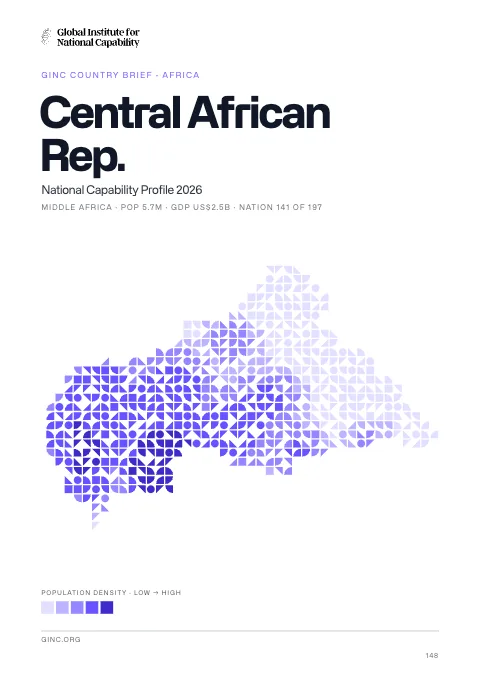
Central African Republic
Central African Republic is a landlocked republic in Africa, home to 5.3 million people, with its capital at Bangui.
Contents
12 chapters
Foundations
01–03
At a glance
- Area
- 623Kkm²#45 World#20 Africa
- Population
- 5.3M#117 World#37 Africa
- GDP (market)
- $2B
- GDP (PPP)
- $3.3B#178 World#47 Africa
- GDP per capita
- $700#223 World#51 Africa
The whole brief
Central African Republic National Capability Profile 2026
Foundations · Chapter 01
Historical Context
🇨🇫 the Central African Republic’s understanding the origins and evolution of the modern nation
BackgroundBack to top ↑
The former French colony of Ubangi-Shari became the Central African Republic upon independence in 1960. After three tumultuous decades of misrule - mostly by military governments - civilian rule was established in 1993 and lasted for one decade. In March, 2003 President Ange-Felix PATASSE was deposed in a military coup led by General Francois BOZIZE, who established a transitional government. Elections held in 2005 affirmed General BOZIZE as president; he was reelected in 2011 in voting widely viewed as flawed. The government still does not fully control the countryside, where pockets of lawlessness persist. The militant group the Lord's Resistance Army continues to destabilize southeastern Central African Republic, and several rebel groups joined together in early December 2012 to launch a series of attacks that left them in control of numerous towns in the northern and central parts of the country. The rebels - who are unhappy with BOZIZE's government - participated in peace talks in early January 2013 which resulted in a coalition government including the rebellion's leadership. In March 2013, the coalition government dissolved, rebels seized the capital, and President BOZIZE fled the country. Rebel leader Michel DJOTODIA assumed the presidency, reappointed Nicolas TIANGAYE as Prime Minister, and established a transitional government on 31 March. On 13 April 2013, the National Transitional Council affirmed DJOTODIA as President.
IndependenceBack to top ↑
13 August 1960 (from France)
National holidayBack to top ↑
Republic Day, 1 December (1958)
Foundations · Chapter 02
Geography
🇨🇫 the Central African Republic’s territory, resources and strategic position
Location and areaBack to top ↑
Central Africa, north of Democratic Republic of the Congo
7 00 N, 21 00 E
Africa
slightly smaller than Texas
0 km (landlocked)
none (landlocked)
Terrain and resourcesBack to top ↑
vast, flat to rolling, monotonous plateau; scattered hills in northeast and southwest
diamonds, uranium, timber, gold, oil, hydropower
1.35 sq km (2003)
Settlement and hazardsBack to top ↑
hot, dry, dusty harmattan winds affect northern areas; floods are common
landlocked; almost the precise center of Africa
OtherBack to top ↑
144.4 cu km (2011)
tap water is not potable; poaching has diminished the country's reputation as one of the last great wildlife refuges; desertification; deforestation
Foundations · Chapter 03
Environment
🇨🇫 the Central African Republic’s environmental conditions, resources and national resilience
ClimateBack to top ↑
tropical; hot, dry winters; mild to hot, wet summers
Emissions and pollutionBack to top ↑
Water, waste and foodBack to top ↑
Resources and agreementsBack to top ↑
GINC Capability Domains · Chapter 04
Critical Technology
🇨🇫 the Central African Republic’s technology frontiers and the pursuit of national advantage
Two counts are set side by side for 2015–2024: on the left, the papers researchers in the Central African Republic published; on the right, the patent families that began there and were filed in more than one country. First by capability group, then group by group with each group’s capabilities. The badge on a card is the nation’s place among all nations. Papers are from GINC Research Analytics, patent families from GINC Patents.
Research by capability group
#177 WorldPapers published, 2015–2024
Patents by capability group
International patent families, 2015–2024
No international patent families on record for 2015–2024.
Advanced Materials & ManufacturingBack to top ↑
Research
#160 WorldPapers published, 2015–2024
Patents
International patent families, 2015–2024
No international patent families on record for 2015–2024.
Energy TechnologiesBack to top ↑
- Batteries & Energy Storage
- Hydrogen, Ammonia & Sustainable Fuels
- Next-Generation Solar & Renewables
- Advanced Nuclear & Fusion
- Directed Energy Technologies
Semiconductors & Advanced ComputingBack to top ↑
- Semiconductor Design & EDA
- Advanced Semiconductor Fabrication
- Semiconductor Equipment & Materials
- Advanced Packaging & Heterogeneous Integration
- Compound & Power Semiconductors
- High-Performance & AI Computing
Artificial IntelligenceBack to top ↑
Quantum TechnologiesBack to top ↑
Connectivity, Cyber & Trust TechnologiesBack to top ↑
Research
#168 WorldPapers published, 2015–2024
Patents
International patent families, 2015–2024
No international patent families on record for 2015–2024.
Sensing, Timing & NavigationBack to top ↑
- Precision Timing & Atomic Clocks
- Resilient Positioning & Navigation
- Advanced Imaging & Photonic Sensing
- Radar & Radiofrequency Sensing
- Acoustic & Undersea Sensing
Robotics & Autonomous SystemsBack to top ↑
Research
#160 WorldPapers published, 2015–2024
No research topic: Human-Machine Interfaces
Patents
International patent families, 2015–2024
No international patent families on record for 2015–2024.
Biotechnology & Health TechnologiesBack to top ↑
Research
#158 WorldPapers published, 2015–2024
Patents
International patent families, 2015–2024
No international patent families on record for 2015–2024.
Medicine and BioTech
Clinical research and life-science invention, drawn from the same series that drive the metric pages. Each card opens the full cross-country comparison.
Space TechnologiesBack to top ↑
- Space Launch & Reusable Systems
- Advanced Propulsion & Hypersonic Systems
- Satellite & Constellation Technologies
GINC Capability Domains · Chapter 05
Strategic Infrastructure
🇨🇫 the Central African Republic’s energy, connectivity and the material foundations of capability
Resource InfrastructureBack to top ↑
0 bbl/day (2012 est.)
0 bbl/day (2010 est.)
0 bbl/day (2010 est.)
0 bbl (1 January 2013 est.)
0 bbl/day (2010 est.)
3,175 bbl/day (2011 est.)
0 bbl/day (2010 est.)
2,318 bbl/day (2010 est.)
0 cu m (2011 est.)
0 cu m (2010 est.)
0 cu m (2011 est.)
0 cu m (2011 est.)
0 cu m (1 January 2013 est.)
Agriculture & Food InfrastructureBack to top ↑
- Irrigation & Agricultural Water
- Livestock & Veterinary
- Fisheries & Aquaculture
- Storage, Cold Chain & Markets
Energy InfrastructureBack to top ↑
- Thermal Generation
- Nuclear Generation
- Nuclear Fuel Cycle & Radioactive Waste
- Hydropower
- Renewable Generation
- Transmission & Distribution
- System Control & Dispatch
- Storage & Fuel Supply
44,000 kW (2010 est.)
160 million kWh (2010 est.)
148.8 million kWh (2010 est.)
0 kWh (2012 est.)
0 kWh (2012 est.)
43.2% of total installed capacity (2010 est.)
0% of total installed capacity (2010 est.)
56.8% of total installed capacity (2010 est.)
0% of total installed capacity (2010 est.)
293,900 Mt (2011 est.)
Water, Sanitation & Waste InfrastructureBack to top ↑
- Dams, Reservoirs & Flood Defence
- Water Supply & Treatment
- Bulk Water Transfer & Desalination
- Wastewater & Sanitation
- Solid Waste & Recycling
Advanced ManufacturingBack to top ↑
- Materials & Inputs
- Chemicals & Hazardous Process Industry
- Production Systems
- Supply Chain & Ecosystem
- Workforce & Innovation
Transport InfrastructureBack to top ↑
- Seaports & Terminals
- Air Infrastructure
- Air Navigation & Traffic Management
- Inland Waterways & Ferries
- Rail Infrastructure
- Roads & Bridges
- Logistics, Multimodal & Border Infrastructure
- Postal & Parcel
39 (2013)
2,800 km (the primary navigable river is the Ubangi, which joins the River Congo; it was the traditional route for the export of products because it connected with the Congo-Ocean railway at Brazzaville; because of the warfare on both sides of the River Congo from 1997, however, routes through Cameroon became preferred by importers and exporters) (2011)
Communications & Digital InfrastructureBack to top ↑
- Subsea Cables & International Gateways
- Core & Backbone Networks
- Mobile & Wireless Networks
- Spectrum & Broadcasting
- Data Centres, Compute & Cloud
- Data Resources
- AI Tools & Applications
5,600 (2012)
1.07 million (2012)
22,600 (2009)
20 (2012)
.cf
Financial InfrastructureBack to top ↑
- Currency & Reserves
- Payments & Settlement Systems
- Markets, Exchanges & Depositories
- Banks, Insurers & Systemic Institutions
Social InfrastructureBack to top ↑
- Health Infrastructure
- Public Health & Laboratories
- Medical Supply & Stockpiles
- Education & Skills Infrastructure
- Research & Scientific Facilities
- Housing, Community & Social Services
- Government & Public Administration
- Cultural, Community & Recreational Infrastructure
- Justice & Corrections
- Emergency Services & Civil Protection
- Hydrometeorology & Early Warning
Space, Aerospace & Defence InfrastructureBack to top ↑
GINC Capability Domains · Chapter 06
National Security
🇨🇫 the Central African Republic’s force, intelligence and the defence of the nation
Disputes and terrorismBack to top ↑
periodic skirmishes over water and grazing rights among related pastoral populations along the border with southern Sudan persist
Force Generation & MobilisationBack to top ↑
Central African Armed Forces (Forces Armees Centrafricaines, FACA): Ground Forces (includes Military Air Service), General Directorate of Gendarmerie Inspection (DGIG), National Police (2011)
18 years of age for selective military service; 2-year conscript service obligation (2012)
Forces under arms
Active-duty strength on the Correlates of War series, which reaches back to 1816 and so carries a nation’s whole record of mobilisation rather than its present establishment. The card opens the full cross-country comparison.
Intelligence & AssessmentBack to top ↑
- Imagery & Geospatial Intelligence
- Signals & Cyber Intelligence
- Technical & Measurement Intelligence
- Open-Source & Financial Intelligence
- Human Intelligence & Counterintelligence
- All-Source Analysis & Warning
Joint Command, Projection & SustainmentBack to top ↑
- Command, Control & Communications
- Strategic Lift & Mobility
- Expeditionary & Peace Operations
- Operational Sustainment & War Reserves
- Defence Industrial Mobilisation
- CBRN Defence
Land PowerBack to top ↑
- Combined Arms Manoeuvre
- Land Fires
- Battlefield Aviation & Uncrewed Systems
- Special Operations & Irregular Warfare
Maritime PowerBack to top ↑
- Maritime Security & Constabulary
- Sea Denial & Undersea Warfare
- Sea Control
- Amphibious & Expeditionary Operations
Air PowerBack to top ↑
- Air Sovereignty & Policing
- Control of the Air
- Air Strike & Interdiction
- Airborne ISR, Early Warning & Battle Management
Strategic Strike & Missile DefenceBack to top ↑
Space OperationsBack to top ↑
Cyber & Electromagnetic OperationsBack to top ↑
Nuclear DeterrenceBack to top ↑
GINC Capability Domains · Chapter 07
Human Capital
🇨🇫 the Central African Republic’s population, health and the skills that sustain capability
DemographyBack to top ↑
5,277,959
2.13% (2014 est.)
35.45 births/1,000 population (2014 est.)
14.11 deaths/1,000 population (2014 est.)
4.46 children born/woman (2014 est.)
19% (2006)
Migration and urbanisationBack to top ↑
0 migrant(s)/1,000 population (2014 est.)
BANGUI (capital) 740,000 (2011)
Welfare and equityBack to top ↑
NA%
61.3 (1993)
DisplacementBack to top ↑
Early Childhood DevelopmentBack to top ↑
28% (2006)
Foundational EducationBack to top ↑
1.2% of GDP (2011)
Advanced EducationBack to top ↑
Technical & Vocational SkillsBack to top ↑
Digital & AI CompetenceBack to top ↑
Generative AI adoption
Modelled share of working-age adults using generative AI, from Microsoft telemetry scaled to each country’s 15–64 population. A measure of how fast a workforce is absorbing the technology rather than of how much of it a nation builds. The card opens the full cross-country comparison.
Lifelong Learning & ReskillingBack to top ↑
Research Talent & Knowledge CreationBack to top ↑
Population HealthBack to top ↑
890 deaths/100,000 live births (2010)
3.5% (2008)
4.7% (2009 est.)
130,000 (2009 est.)
11,000 (2009 est.)
Health System CapabilityBack to top ↑
3.8% of GDP (2011)
0.05 physicians/1,000 population (2009)
1 beds/1,000 population (2011)
GINC Capability Domains · Chapter 08
Governance and Integrity
🇨🇫 the Central African Republic’s institutions, law and the integrity of the state
State structureBack to top ↑
republic
14 prefectures (prefectures, singular - prefecture), 2 economic prefectures* (prefectures economiques, singular - prefecture economique), and 1 commune**; Bamingui-Bangoran, Bangui**, Basse-Kotto, Haute-Kotto, Haut-Mbomou, Kemo, Lobaye, Mambere-Kadei, Mbomou, Nana-Grebizi*, Nana-Mambere, Ombella-Mpoko, Ouaka, Ouham, Ouham-Pende, Sangha-Mbaere*, Vakaga
several previous; latest ratified by referendum 5 December 2004, effective 27 December 2004; amended 2010; note - the transitional parliament has begun work on a new constitution which should be ready for citizens feedback in early 2015 (2010)
18 years of age; universal
Political Institutions & Civic ParticipationBack to top ↑
- Electoral Management & Integrity
- Legislature & Deliberative Institutions
- Citizen Participation & Civic Space
unicameral National Transitional Council to act as the National Assembly or Assemblee Nationale (105 seats; members are elected by popular vote to serve five-year terms)
Alliance for Democracy and Progress or ADP [Clement BELIBANGA]//Central African Democratic Rally or RDC [Louis-Pierre GAMBA]//Civic Forum or FC//Democratic Forum for Modernity or FODEM [Saturnin NDOMBY]//Liberal Democratic Party or PLD//Londo Association or LONDO//Movement for Democracy and Development or MDD//MaMovement for the Liberation of the Central African People or MLPC [Martin ZIGUELE ]//National Convergence or KNK [Francois BOZIZE]//National Unity Party or PUN//New Alliance for Progress or NAP [Jean-Jacques DEMAFOUTH]//Patriotic Front for Progress or FPP [Alexandre Philippe GOUMBA]//People's Union for the Republic or UPR [Pierre Sammy MAKFOY]//Social Democratic Party or PSD [Enoch LAKOUE]
NA
Justice System & Fundamental RightsBack to top ↑
- Judicial Independence & Court Capability
- Access to Justice & Legal Services
- Fundamental Rights Protection
- Human Rights Institutions & Equality Bodies
civil law system based on the French model
has not submitted an ICJ jurisdiction declaration; accepts ICCt jurisdiction
Internal Security & OrderBack to top ↑
Regulatory Governance & Strategic ControlsBack to top ↑
- Regulatory Quality & Better Regulation
- Regulatory Delivery & Independent Regulators
- Strategic Controls & Economic Security Administration
Government Effectiveness & Public AdministrationBack to top ↑
- Centre of Government & Policy Coordination
- Civil Service & Public Workforce
- Digital Government & Service Delivery
- Legal Identity & Civil Registration
- Statistical & Data Capability
Public Integrity & Anti-CorruptionBack to top ↑
Transparency, Oversight & AccountabilityBack to top ↑
- Right to Information & Open Government
- Independent Oversight & Supreme Audit
- Independent Media & Journalist Safety
National Resilience & Crisis ManagementBack to top ↑
GINC Capability Domains · Chapter 09
Information and Influence
🇨🇫 the Central African Republic’s identity, media and the projection of influence
Identity and cultureBack to top ↑
French (official), Sangho (lingua franca and national language), tribal languages
indigenous beliefs 35%, Protestant 25%, Roman Catholic 25%, Muslim 15%
Baya 33%, Banda 27%, Mandjia 13%, Sara 10%, Mboum 7%, M'Baka 4%, Yakoma 4%, other 2%
elephant
four equal horizontal bands of blue (top), white, green, and yellow with a vertical red band in center; a yellow five-pointed star to the hoist side of the blue band; banner combines the Pan-African and French flag colors; red symbolizes the blood spilled in the struggle for independence, blue represents the sky and freedom, white peace and dignity, green hope and faith, and yellow tolerance; the star represents aspiration towards a vibrant future
Diplomatic Statecraft & Global NetworksBack to top ↑
- Diplomatic Network & Consular Reach
- Multilateral Leadership & Norm Setting
- Agenda-Setting & Convening
- Mediation & Crisis Diplomacy
ACP, AfDB, AU, BDEAC, CEMAC, EITI (compliant country), FAO, FZ, G-77, IAEA, IBRD, ICAO, ICRM, IDA, IFAD, IFC, IFRCS, ILO, IMF, Interpol, IOC, IOM, ITSO, ITU, ITUC (NGOs), MIGA, NAM, OIC, OIF, OPCW, UN, UNCTAD, UNESCO, UNIDO, UNWTO, UPU, WCO, WHO, WIPO, WMO, WTO
Alliances & Security CooperationBack to top ↑
Development Cooperation & Global AssistanceBack to top ↑
Culture, Language & Education DiplomacyBack to top ↑
- Cultural & Language Institutes
- Creative Industries & Cultural Export Reach
- Heritage & Cultural Institutions
- Education Diplomacy & Alumni Networks
- Sports & Major Events
Diaspora & Global CommunitiesBack to top ↑
Information Environment & Strategic CommunicationBack to top ↑
- Strategic Communications & Public Diplomacy
- International Media & Broadcasting
- Information Defence & Counter-Interference
government-owned network, Radiodiffusion Television Centrafricaine, provides domestic TV broadcasting; licenses for 2 private TV stations are pending; state-owned radio network is supplemented by a small number of privately owned broadcast stations as well as a few community radio stations; transmissions of at least 2 international broadcasters are available (2007)
GINC Capability Domains · Chapter 10
Financial Strength
🇨🇫 the Central African Republic’s fiscal depth, reserves and the capacity to act
Monetary & Currency CapabilityBack to top ↑
- Monetary Policy & Price Stability
- Exchange Rate & External Account Management
- Currency Issuance & Digital Money
7% (2013 est.)//5.8% (2012 est.)
Cooperation Financiere en Afrique Centrale francs (XAF) per US dollar -//500.7 (2013 est.)//510.53 (2012 est.)//495.28 (2010)//472.19 (2009)//447.81 (2008)
4.25% (31 December 2009)//4.75% (31 December 2008)
15% (31 December 2013 est.)//15% (31 December 2012 est.)
$308.3 million (31 December 2013 est.)//$337.7 million (31 December 2012 est.)
$376.4 million (31 December 2013 est.)//$421.6 million (31 December 2012 est.)
Fiscal Capacity & Public FinanceBack to top ↑
- Revenue Mobilisation & Tax Administration
- Public Expenditure & Budget Management
- Sovereign Debt & Treasury Management
- Public Investment Management
9.1% of GDP (2013 est.)
-4.1% of GDP (2013 est.)
calendar year
Financial System Depth & AccessBack to top ↑
- Banking System Capacity
- Capital Markets Depth & Development
- Long-Term & Institutional Capital
- Financial Inclusion & Household Access
- Development & Policy Finance
$478.7 million (31 December 2013 est.)//$507.7 million (31 December 2012 est.)
$NA
2.4% of GDP (2013 est.)//3.8% of GDP (2012 est.)//3.7% of GDP (2011 est.)
Financial Regulation & IntegrityBack to top ↑
- Prudential Regulation & Supervision
- Financial Integrity & Illicit Finance Control
- Market Conduct & Consumer Protection
- Payment & Market Infrastructure Oversight
Financial Stability & Crisis ManagementBack to top ↑
- Macroprudential & Systemic Oversight
- Crisis Management, Resolution & Deposit Insurance
- External Liquidity & Financial Safety Nets
Sovereign Capital & External Financial PowerBack to top ↑
- Official Reserves Management
- Sovereign Wealth & Public Asset Management
- Currency Internationalisation & Reserve Status
- Capital Account & Flow Management
- International Financial Centre Capability
$634.2 million (31 December 2013 est.)//$632.7 million (31 December 2012 est.)
GINC Capability Domains · Chapter 11
Production and Innovation
🇨🇫 the Central African Republic’s output, industry and the engine of prosperity
Economic Output & ProductivityBack to top ↑
Subsistence agriculture, together with forestry and mining, remains the backbone of the economy of the Central African Republic (CAR), with about 60% of the population living in outlying areas. The agricultural sector generates more than half of GDP. Timber and diamonds account for most export earnings, followed by cotton. Important constraints to economic development include the CAR's landlocked position, a poor transportation system, a largely unskilled work force, and a legacy of misdirected macroeconomic policies. Factional fighting between the government and its opponents remains a drag on economic revitalization. Since 2009 the IMF has worked closely with the government to institute reforms that have resulted in some improvement in budget transparency, but other problems remain. The government's additional spending in the run-up to the election in 2011 worsened CAR's fiscal situation. Distribution of income is extraordinarily unequal. Grants from France and the international community can only partially meet humanitarian needs. In 2012 the World Bank approved $125 million in funding for transport infrastructure and regional trade, focused on the route between CAR's capital and the port of Douala in Cameroon. After a two year lag in donor support, the IMF's first review of CAR's extended credit facility for 2012-15 praised improvements in revenue collection but warned of weak management of spending.
$3.336 billion (2013 est.)//$3.902 billion (2012 est.)//$3.748 billion (2011 est.)
-14.5% (2013 est.)//4.1% (2012 est.)//3.3% (2011 est.)
$700 (2013 est.)//$900 (2012 est.)//$800 (2011 est.)
$2.05 billion (2013 est.)
Labour & EmploymentBack to top ↑
- Employment & Labour Force Participation
- Labour Market Institutions & Wage Setting
- Employment Services & Skills Matching
- Labour Adjustment, Transition & Formalisation
2.082 million (2011 est.)
8% (2001 est.)
Industrial & Sectoral BaseBack to top ↑
- Manufacturing & Advanced Industry
- Foundational & Process Industries
- Agrifood & Primary Production
- Services Economy
cotton, coffee, tobacco, cassava (manioc, tapioca), yams, millet, corn, bananas; timber
gold and diamond mining, logging, brewing, sugar refining
-11% (2013 est.)
Structural Transformation & ComplexityBack to top ↑
Business Dynamism & EntrepreneurshipBack to top ↑
- Entrepreneurship & Firm Creation
- Risk Capital & Scale-Up Finance
- Firm Growth, Exit & Renewal
- Competition & Market Contestability
Innovation & CommercialisationBack to top ↑
- Business Innovation Capability
- Research Commercialisation & Knowledge Transfer
- Intellectual Property & Intangible Assets
- Innovation Ecosystems & Clusters
Technology Adoption & DiffusionBack to top ↑
GINC Capability Domains · Chapter 12
Trade and Investment
🇨🇫 the Central African Republic’s markets, capital and the terms of global exchange
Overall tradeBack to top ↑
$245M of exports to 91 partners and $872M of imports from 114 in 2024, a deficit of $627M.
- Exports
- $245M91 partners
- Imports
- $872M114 partners
- Balance
- −$627Mdeficit
- Total trade
- $1.12B2024
ExportsBack to top ↑
Where its exports go
The largest partners in 2024, with each one's share of the nation's exports.
| Partner | Value | Share | |
|---|---|---|---|
| Pakistan | $62.7M | 26% | |
| Tunisia | $40.1M | 16% | |
| China | $33.1M | 13% | |
| Sri Lanka | $28.1M | 11% | |
| Egypt | $11.8M | 4.8% | |
| Portugal | $10.8M | 4.4% | |
| Belgium | $10.3M | 4.2% | |
| Turkey | $7.79M | 3.2% | |
| India | $6.66M | 2.7% | |
| United States | $6.03M | 2.5% | |
| United Arab Emirates | $5.88M | 2.4% | |
| Mauritania | $5.13M | 2.1% | |
| France | $2.85M | 1.2% | |
| Germany | $2.35M | 1.0% | |
| Poland | $2.34M | 1.0% | |
| Morocco | $1.64M | 0.7% | |
| Japan | $932K | 0.4% | |
| Italy | $900K | 0.4% | |
| Malaysia | $809K | 0.3% | |
| United Kingdom | $739K | 0.3% |
What it exports
The largest categories in 2024.
| Category | Value | Share | |
|---|---|---|---|
| Aircraft, spacecraft | $115M | 47% | |
| Wood and articles of wood, wood charcoal | $52.9M | 22% | |
| Pearls, precious stones, metals, coins | $21.7M | 8.8% | |
| Miscellaneous articles of base metal | $20.5M | 8.4% | |
| Vehicles other than railway, tramway | $14.2M | 5.8% | |
| Electrical, electronic equipment | $11.6M | 4.7% | |
| Ceramic products | $1.91M | 0.8% | |
| Machinery, nuclear reactors, boilers | $1.73M | 0.7% | |
| Cotton | $814K | 0.3% | |
| Optical, photo, technical, medical apparatus | $732K | 0.3% | |
| Iron and steel | $585K | 0.2% | |
| Beverages, spirits and vinegar | $446K | 0.2% | |
| Works of art, collectors' pieces and antiques | $275K | 0.1% | |
| Edible fruits, nuts, peel of citrus fruit, melons | $275K | 0.1% | |
| Oil seed, oleaginous fruits, grain, seed, fruits | $266K | 0.1% |
ImportsBack to top ↑
Where its imports come from
The largest partners in 2024, with each one's share of the nation's imports.
| Partner | Value | Share | |
|---|---|---|---|
| Cameroon | $206M | 24% | |
| China | $193M | 22% | |
| France | $68.4M | 7.8% | |
| United States | $48.1M | 5.5% | |
| Japan | $37.6M | 4.3% | |
| India | $34.0M | 3.9% | |
| United Arab Emirates | $27.5M | 3.1% | |
| Belgium | $15.9M | 1.8% | |
| Morocco | $15.3M | 1.8% | |
| Netherlands | $15.2M | 1.7% | |
| Uganda | $14.4M | 1.7% | |
| Mali | $12.9M | 1.5% | |
| Italy | $12.8M | 1.5% | |
| Denmark | $11.7M | 1.3% | |
| Equatorial Guinea | $10.9M | 1.2% | |
| Spain | $9.90M | 1.1% | |
| Egypt | $9.88M | 1.1% | |
| Poland | $8.71M | 1.0% | |
| Ivory Coast | $8.41M | 1.0% | |
| Brazil | $7.28M | 0.8% |
What it imports
The largest categories in 2024.
| Category | Value | Share | |
|---|---|---|---|
| Mineral fuels, oils, distillation products | $216M | 25% | |
| Vehicles other than railway, tramway | $97.5M | 11% | |
| Electrical, electronic equipment | $91.2M | 10% | |
| Pharmaceutical products | $61.4M | 7.0% | |
| Machinery, nuclear reactors, boilers | $58.7M | 6.7% | |
| Dairy products, eggs, honey, edible products | $48.9M | 5.6% | |
| Meat and edible meat offal | $25.1M | 2.9% | |
| Tobacco and manufactures tobacco substitutes | $18.7M | 2.1% | |
| Plastics | $18.5M | 2.1% | |
| Optical, photo, technical, medical apparatus | $17.5M | 2.0% | |
| Miscellaneous edible preparations | $17.4M | 2.0% | |
| Articles of iron or steel | $10.4M | 1.2% | |
| Furniture, lighting signs, prefabricated buildings | $10.1M | 1.2% | |
| Milling products, malt, starches, inulin, wheat gluten | $10.1M | 1.2% | |
| Edible vegetables and certain roots and tubers | $9.92M | 1.1% |
In a list, the bar runs to the largest in that list. The line is each figure’s history from 2000, drawn to its own peak: it shows the shape of the years, and the value shows the size.
External balanceBack to top ↑
-$133.8 million (2013 est.)//-$197.6 million (2012 est.)
Trade Facilitation & LogisticsBack to top ↑
Trade Policy & Market AccessBack to top ↑
- Trade Policy & Negotiation Capability
- Market Access & Agreements Network
- Trade Law & Enforcement
- Standards, Conformity & Quality Infrastructure
Digital & Services TradeBack to top ↑
- Services Trade Capability
- Digital Trade & E-Commerce
- Data Flows & Digital Trade Governance
- Tourism & Visitor Economy
Investment Attraction & ProjectionBack to top ↑
- Investment Attraction & Facilitation
- Investment Absorption & Linkages
- Outward Investment & Global Corporate Presence
Export Capability & SophisticationBack to top ↑
$138.9 million (2013 est.)//$207.7 million (2012 est.)
Belgium 31.7%, China 27.9%, Democratic Republic of the Congo 7.8%, Indonesia 5.2%, France 4.5% (2012)
diamonds, timber, cotton, coffee
Global Value Chain PositionBack to top ↑
- Value Chain Participation & Integration
- Value Chain Position & Upgrading
- Regional Integration & Hub Anchoring
Economic Leverage & DependenceBack to top ↑
- Strategic Supply Security
- Concentration Risk & Revenue Stabilisation
- Economic Leverage & Coercion Resistance
$218.6 million (2013 est.)//$333.7 million (2012 est.)
Netherlands 20.3%, France 9.7%, Cameroon 9.1%, South Korea 9.1% (2012)
food, textiles, petroleum products, machinery, electrical equipment, motor vehicles, chemicals, pharmaceuticals
Central African Republic · you are in
Historical Context
Foundations
GINC Capability Domains
Find in this brief · Central African Republic