
Jamaica
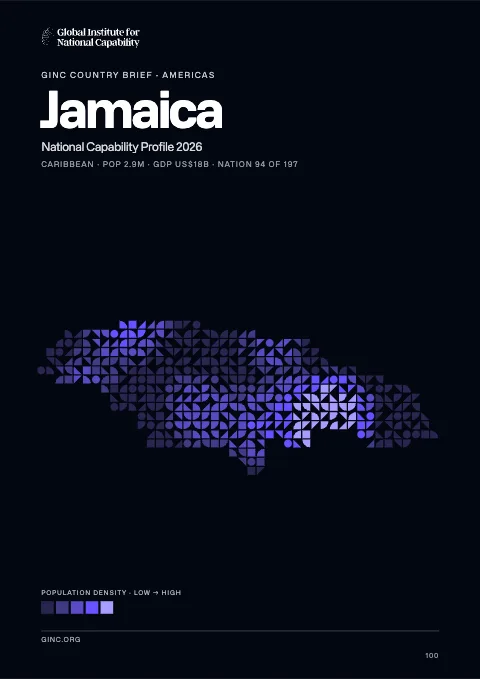
Jamaica is a constitutional parliamentary democracy and a Commonwealth realm in Central America and the Caribbean, home to 2.9 million people, with its capital at Kingston.
Contents
12 chapters
Foundations
01–03
At a glance
- Area
- 11Kkm²#167 World#13 C. America
- Population
- 2.9M#139 World#11 C. America
- GDP (market)
- $14.4B
- GDP (PPP)
- $25.1B#125 World#11 C. America
- GDP per capita
- $9K#127 World#24 C. America
The whole brief
Jamaica National Capability Profile 2026
Foundations · Chapter 01
Historical Context
🇯🇲 Jamaica’s understanding the origins and evolution of the modern nation
BackgroundBack to top ↑
The island - discovered by Christopher COLUMBUS in 1494 - was settled by the Spanish early in the 16th century. The native Taino, who had inhabited Jamaica for centuries, were gradually exterminated and replaced by African slaves. England seized the island in 1655 and established a plantation economy based on sugar, cocoa, and coffee. The abolition of slavery in 1834 freed a quarter million slaves, many of whom became small farmers. Jamaica gradually increased its independence from Britain. In 1958 it joined other British Caribbean colonies in forming the Federation of the West Indies. Jamaica gained full independence when it withdrew from the Federation in 1962. Deteriorating economic conditions during the 1970s led to recurrent violence as rival gangs affiliated with the major political parties evolved into powerful organized crime networks involved in international drug smuggling and money laundering. Violent crime, drug trafficking, and poverty pose significant challenges to the government today. Nonetheless, many rural and resort areas remain relatively safe and contribute substantially to the economy.
IndependenceBack to top ↑
6 August 1962 (from the UK)
National holidayBack to top ↑
Independence Day, 6 August (1962)
Foundations · Chapter 02
Geography
🇯🇲 Jamaica’s territory, resources and strategic position
Location and areaBack to top ↑
Caribbean, island in the Caribbean Sea, south of Cuba
18 15 N, 77 30 W
Central America and the Caribbean
slightly smaller than Connecticut
0 km
1,022 km
measured from claimed archipelagic straight baselines
Terrain and resourcesBack to top ↑
mostly mountains, with narrow, discontinuous coastal plain
bauxite, gypsum, limestone
252.2 sq km (2003)
Settlement and hazardsBack to top ↑
hurricanes (especially July to November)
strategic location between Cayman Trench and Jamaica Channel, the main sea lanes for the Panama Canal
OtherBack to top ↑
9.4 cu km (2011)
heavy rates of deforestation; coastal waters polluted by industrial waste, sewage, and oil spills; damage to coral reefs; air pollution in Kingston from vehicle emissions
Foundations · Chapter 03
Environment
🇯🇲 Jamaica’s environmental conditions, resources and national resilience
ClimateBack to top ↑
tropical; hot, humid; temperate interior
Emissions and pollutionBack to top ↑
Water, waste and foodBack to top ↑
Resources and agreementsBack to top ↑
GINC Capability Domains · Chapter 04
Critical Technology
🇯🇲 Jamaica’s technology frontiers and the pursuit of national advantage
Two counts are set side by side for 2015–2024: on the left, the papers researchers in Jamaica published; on the right, the patent families that began there and were filed in more than one country. First by capability group, then group by group with each group’s capabilities. The badge on a card is the nation’s place among all nations. Papers are from GINC Research Analytics, patent families from GINC Patents.
Research by capability group
#136 WorldPapers published, 2015–2024
Patents by capability group
#110 WorldInternational patent families, 2015–2024
Advanced Materials & ManufacturingBack to top ↑
Research
#167 WorldPapers published, 2015–2024
Patents
International patent families, 2015–2024
No international patent families on record for 2015–2024.
Energy TechnologiesBack to top ↑
Research
#146 WorldPapers published, 2015–2024
Patents
#98 WorldInternational patent families, 2015–2024
Semiconductors & Advanced ComputingBack to top ↑
Research
#97 WorldPapers published, 2015–2024
No research topic: Semiconductor Design & EDA · Advanced Semiconductor Fabrication · Semiconductor Equipment & Materials · Advanced Packaging & Heterogeneous Integration
Patents
International patent families, 2015–2024
No international patent families on record for 2015–2024.
Artificial IntelligenceBack to top ↑
Research
#115 WorldPapers published, 2015–2024
Patents
International patent families, 2015–2024
No international patent families on record for 2015–2024.
Quantum TechnologiesBack to top ↑
Research
#111 WorldPapers published, 2015–2024
Patents
International patent families, 2015–2024
No international patent families on record for 2015–2024.
Connectivity, Cyber & Trust TechnologiesBack to top ↑
Research
#130 WorldPapers published, 2015–2024
Patents
#93 WorldInternational patent families, 2015–2024
Sensing, Timing & NavigationBack to top ↑
Research
#147 WorldPapers published, 2015–2024
Patents
International patent families, 2015–2024
No international patent families on record for 2015–2024.
Robotics & Autonomous SystemsBack to top ↑
Research
#134 WorldPapers published, 2015–2024
No research topic: Human-Machine Interfaces
Patents
International patent families, 2015–2024
No international patent families on record for 2015–2024.
Biotechnology & Health TechnologiesBack to top ↑
Research
#146 WorldPapers published, 2015–2024
Patents
#94 WorldInternational patent families, 2015–2024
Medicine and BioTech
Clinical research and life-science invention, drawn from the same series that drive the metric pages. Each card opens the full cross-country comparison.
Space TechnologiesBack to top ↑
- Space Launch & Reusable Systems
- Advanced Propulsion & Hypersonic Systems
- Satellite & Constellation Technologies
GINC Capability Domains · Chapter 05
Strategic Infrastructure
🇯🇲 Jamaica’s energy, connectivity and the material foundations of capability
Resource InfrastructureBack to top ↑
2,120 bbl/day (2012 est.)
0 bbl/day (2010 est.)
22,940 bbl/day (2010 est.)
0 bbl (1 January 2013 est.)
23,120 bbl/day (2010 est.)
78,520 bbl/day (2011 est.)
0 bbl/day (2010 est.)
32,920 bbl/day (2010 est.)
0 cu m (2011 est.)
0 cu m (2010 est.)
0 cu m (2011 est.)
0 cu m (2011 est.)
0 cu m (1 January 2013 est.)
Agriculture & Food InfrastructureBack to top ↑
- Irrigation & Agricultural Water
- Livestock & Veterinary
- Fisheries & Aquaculture
- Storage, Cold Chain & Markets
Energy InfrastructureBack to top ↑
- Thermal Generation
- Nuclear Generation
- Nuclear Fuel Cycle & Radioactive Waste
- Hydropower
- Renewable Generation
- Transmission & Distribution
- System Control & Dispatch
- Storage & Fuel Supply
1.175 million kW (2010 est.)
3.957 billion kWh (2010 est.)
3.066 billion kWh (2010 est.)
0 kWh (2012 est.)
0 kWh (2012 est.)
94.8% of total installed capacity (2010 est.)
0% of total installed capacity (2010 est.)
2.1% of total installed capacity (2010 est.)
3% of total installed capacity (2010 est.)
9.557 million Mt (2011 est.)
Water, Sanitation & Waste InfrastructureBack to top ↑
- Dams, Reservoirs & Flood Defence
- Water Supply & Treatment
- Bulk Water Transfer & Desalination
- Wastewater & Sanitation
- Solid Waste & Recycling
Advanced ManufacturingBack to top ↑
- Materials & Inputs
- Chemicals & Hazardous Process Industry
- Production Systems
- Supply Chain & Ecosystem
- Workforce & Innovation
Transport InfrastructureBack to top ↑
- Seaports & Terminals
- Air Infrastructure
- Air Navigation & Traffic Management
- Inland Waterways & Ferries
- Rail Infrastructure
- Roads & Bridges
- Logistics, Multimodal & Border Infrastructure
- Postal & Parcel
28 (2013)
Communications & Digital InfrastructureBack to top ↑
- Subsea Cables & International Gateways
- Core & Backbone Networks
- Mobile & Wireless Networks
- Spectrum & Broadcasting
- Data Centres, Compute & Cloud
- Data Resources
- AI Tools & Applications
265,000 (2011)
2.665 million (2012)
1.581 million (2009)
3,906 (2012)
.jm
Financial InfrastructureBack to top ↑
- Currency & Reserves
- Payments & Settlement Systems
- Markets, Exchanges & Depositories
- Banks, Insurers & Systemic Institutions
Social InfrastructureBack to top ↑
- Health Infrastructure
- Public Health & Laboratories
- Medical Supply & Stockpiles
- Education & Skills Infrastructure
- Research & Scientific Facilities
- Housing, Community & Social Services
- Government & Public Administration
- Cultural, Community & Recreational Infrastructure
- Justice & Corrections
- Emergency Services & Civil Protection
- Hydrometeorology & Early Warning
Space, Aerospace & Defence InfrastructureBack to top ↑
GINC Capability Domains · Chapter 06
National Security
🇯🇲 Jamaica’s force, intelligence and the defence of the nation
Disputes and terrorismBack to top ↑
none
Force Generation & MobilisationBack to top ↑
Jamaica Defense Force: Ground Forces, Coast Guard, Air Wing (2010)
17 1/2 is the legal minimum age for voluntary military service; no conscription (2012)
0.86% of GDP (2012)//0.92% of GDP (2011)//0.86% of GDP (2010)
Forces under arms
Active-duty strength on the Correlates of War series, which reaches back to 1816 and so carries a nation’s whole record of mobilisation rather than its present establishment. The card opens the full cross-country comparison.
Intelligence & AssessmentBack to top ↑
- Imagery & Geospatial Intelligence
- Signals & Cyber Intelligence
- Technical & Measurement Intelligence
- Open-Source & Financial Intelligence
- Human Intelligence & Counterintelligence
- All-Source Analysis & Warning
Joint Command, Projection & SustainmentBack to top ↑
- Command, Control & Communications
- Strategic Lift & Mobility
- Expeditionary & Peace Operations
- Operational Sustainment & War Reserves
- Defence Industrial Mobilisation
- CBRN Defence
Land PowerBack to top ↑
- Combined Arms Manoeuvre
- Land Fires
- Battlefield Aviation & Uncrewed Systems
- Special Operations & Irregular Warfare
Maritime PowerBack to top ↑
- Maritime Security & Constabulary
- Sea Denial & Undersea Warfare
- Sea Control
- Amphibious & Expeditionary Operations
Air PowerBack to top ↑
- Air Sovereignty & Policing
- Control of the Air
- Air Strike & Interdiction
- Airborne ISR, Early Warning & Battle Management
Strategic Strike & Missile DefenceBack to top ↑
Space OperationsBack to top ↑
Cyber & Electromagnetic OperationsBack to top ↑
Nuclear DeterrenceBack to top ↑
GINC Capability Domains · Chapter 07
Human Capital
🇯🇲 Jamaica’s population, health and the skills that sustain capability
DemographyBack to top ↑
2,930,050 (July 2014 est.)
0.69% (2014 est.)
18.41 births/1,000 population (2014 est.)
6.67 deaths/1,000 population (2014 est.)
2.05 children born/woman (2014 est.)
21.2
69% (2002/03)
Migration and urbanisationBack to top ↑
-4.83 migrant(s)/1,000 population (2014 est.)
KINGSTON (capital) 571,000 (2011)
Welfare and equityBack to top ↑
16.5% (2009 est.)
45.5 (2004)//37.9 (2000)
Early Childhood DevelopmentBack to top ↑
3.2% (2010)
Foundational EducationBack to top ↑
6.1% of GDP (2012)
Advanced EducationBack to top ↑
Technical & Vocational SkillsBack to top ↑
Digital & AI CompetenceBack to top ↑
Generative AI adoption
Modelled share of working-age adults using generative AI, from Microsoft telemetry scaled to each country’s 15–64 population. A measure of how fast a workforce is absorbing the technology rather than of how much of it a nation builds. The card opens the full cross-country comparison.
Lifelong Learning & ReskillingBack to top ↑
Research Talent & Knowledge CreationBack to top ↑
Population HealthBack to top ↑
110 deaths/100,000 live births (2010)
24.1% (2008)
1.7% (2012 est.)
28,400 (2012 est.)
1,300 (2012 est.)
Health System CapabilityBack to top ↑
5.2% of GDP (2010)
0.41 physicians/1,000 population (2008)
1.8 beds/1,000 population (2010)
GINC Capability Domains · Chapter 08
Governance and Integrity
🇯🇲 Jamaica’s institutions, law and the integrity of the state
State structureBack to top ↑
constitutional parliamentary democracy and a Commonwealth realm
14 parishes; Clarendon, Hanover, Kingston, Manchester, Portland, Saint Andrew, Saint Ann, Saint Catherine, Saint Elizabeth, Saint James, Saint Mary, Saint Thomas, Trelawny, Westmoreland
several previous (preindependence); latest drafted 1961-62, submitted to British Parliament 24 July 1962, entered into force 6 August 1962 (at independence); amended many times, last in 2011 (2011)
18 years of age; universal
Political Institutions & Civic ParticipationBack to top ↑
- Electoral Management & Integrity
- Legislature & Deliberative Institutions
- Citizen Participation & Civic Space
bicameral Parliament consists of the Senate (a 21-member body appointed by the governor general on the recommendations of the prime minister and the leader of the opposition; ruling party is allocated 13 seats, and the opposition is allocated 8 seats) and the House of Representatives (63 seats; members elected by popular vote to serve five-year terms)
Jamaica Labor Party or JLP [Andrew HOLNESS]//People's National Party or PNP [Portia SIMPSON-MILLER]//National Democratic Movement or NDM [Michael WILLIAMS]
New Beginnings Movement or NBM//Rastafarians
Justice System & Fundamental RightsBack to top ↑
- Judicial Independence & Court Capability
- Access to Justice & Legal Services
- Fundamental Rights Protection
- Human Rights Institutions & Equality Bodies
common law system based on the English model
has not submitted an ICJ jurisdiction declaration; non-party state to the ICCt
Internal Security & OrderBack to top ↑
transshipment point for cocaine from South America to North America and Europe; illicit cultivation and consumption of cannabis; government has an active manual cannabis eradication program; corruption is a major concern; substantial money-laundering activity; Colombian narcotics traffickers favor Jamaica for illicit financial transactions
Regulatory Governance & Strategic ControlsBack to top ↑
- Regulatory Quality & Better Regulation
- Regulatory Delivery & Independent Regulators
- Strategic Controls & Economic Security Administration
Government Effectiveness & Public AdministrationBack to top ↑
- Centre of Government & Policy Coordination
- Civil Service & Public Workforce
- Digital Government & Service Delivery
- Legal Identity & Civil Registration
- Statistical & Data Capability
Public Integrity & Anti-CorruptionBack to top ↑
Transparency, Oversight & AccountabilityBack to top ↑
- Right to Information & Open Government
- Independent Oversight & Supreme Audit
- Independent Media & Journalist Safety
National Resilience & Crisis ManagementBack to top ↑
GINC Capability Domains · Chapter 09
Information and Influence
🇯🇲 Jamaica’s identity, media and the projection of influence
Identity and cultureBack to top ↑
English, English patois
Protestant 64.8% (includes Seventh Day Adventist 12.0%, Pentecostal 11.0%, Other Church of God 9.2%, New Testament Church of God 7.2%, Baptist 6.7%, Church of God in Jamaica 4.8%, Church of God of Prophecy 4.5%, Anglican 2.8%, United Church 2.1%, Methodist 1.6%, Revived 1.4%, Brethren .9%, and Moravian .7%), Roman Catholic 2.2%, Jehovah's Witness 1.9%, Rastafarian 1.1%, other 6.5%, none 21.3%, unspecified 2.3% (2011 est.)
black 92.1%, mixed 6.1%, East Indian 0.8%, other 0.4%, unspecified 0.7% (2011 est.)
green-and-black streamertail (bird)
diagonal yellow cross divides the flag into four triangles - green (top and bottom) and black (hoist side and outer side); green represents hope, vegetation, and agriculture, black reflects hardships overcome and to be faced, and yellow recalls golden sunshine and the island's natural resources
Diplomatic Statecraft & Global NetworksBack to top ↑
- Diplomatic Network & Consular Reach
- Multilateral Leadership & Norm Setting
- Agenda-Setting & Convening
- Mediation & Crisis Diplomacy
ACP, AOSIS, C, Caricom, CDB, CELAC, FAO, G-15, G-77, IADB, IAEA, IBRD, ICAO, ICRM, IDA, IFAD, IFC, IFRCS, IHO, ILO, IMF, IMO, Interpol, IOC, IOM, ISO, ITSO, ITU, LAES, MIGA, NAM, OAS, OPANAL, OPCW, Petrocaribe, UN, UNCTAD, UNESCO, UNIDO, UNITAR, UNWTO, UPU, WCO, WFTU (NGOs), WHO, WIPO, WMO, WTO
Alliances & Security CooperationBack to top ↑
Development Cooperation & Global AssistanceBack to top ↑
Culture, Language & Education DiplomacyBack to top ↑
- Cultural & Language Institutes
- Creative Industries & Cultural Export Reach
- Heritage & Cultural Institutions
- Education Diplomacy & Alumni Networks
- Sports & Major Events
Diaspora & Global CommunitiesBack to top ↑
Information Environment & Strategic CommunicationBack to top ↑
- Strategic Communications & Public Diplomacy
- International Media & Broadcasting
- Information Defence & Counter-Interference
3 free-to-air TV stations, subscription cable services, and roughly 30 radio stations (2013)
GINC Capability Domains · Chapter 10
Financial Strength
🇯🇲 Jamaica’s fiscal depth, reserves and the capacity to act
Monetary & Currency CapabilityBack to top ↑
- Monetary Policy & Price Stability
- Exchange Rate & External Account Management
- Currency Issuance & Digital Money
9.4% (2013 est.)//6.9% (2012 est.)
Jamaican dollars (JMD) per US dollar -//99.83 (2013 est.)//88.751 (2012 est.)//87.196 (2010 est.)//87.89 (2009)//72.236 (2008)
2% (31 December 2010 est.)//NA% (31 December 2009 est.)
17% (31 December 2013 est.)//17.63% (31 December 2012 est.)
$1.671 billion (31 December 2013 est.)//$1.723 billion (31 December 2012 est.)
$5.928 billion (31 December 2013 est.)//$6.239 billion (31 December 2012 est.)
Fiscal Capacity & Public FinanceBack to top ↑
- Revenue Mobilisation & Tax Administration
- Public Expenditure & Budget Management
- Sovereign Debt & Treasury Management
- Public Investment Management
26.6% of GDP (2013 est.)
-1.8% of GDP (2013 est.)
123.6% of GDP (2013 est.)//132.9% of GDP (2012 est.)
1 April - 31 March
Financial System Depth & AccessBack to top ↑
- Banking System Capacity
- Capital Markets Depth & Development
- Long-Term & Institutional Capital
- Financial Inclusion & Household Access
- Development & Policy Finance
$7.197 billion (31 December 2013 est.)//$7.351 billion (31 December 2012 est.)
$6.39 billion (31 December 2012 est.)//$7.223 billion (31 December 2011)//$6.626 billion (31 December 2010 est.)
10.8% of GDP (2013 est.)//8.7% of GDP (2012 est.)//7% of GDP (2011 est.)
Financial Regulation & IntegrityBack to top ↑
- Prudential Regulation & Supervision
- Financial Integrity & Illicit Finance Control
- Market Conduct & Consumer Protection
- Payment & Market Infrastructure Oversight
Financial Stability & Crisis ManagementBack to top ↑
- Macroprudential & Systemic Oversight
- Crisis Management, Resolution & Deposit Insurance
- External Liquidity & Financial Safety Nets
Sovereign Capital & External Financial PowerBack to top ↑
- Official Reserves Management
- Sovereign Wealth & Public Asset Management
- Currency Internationalisation & Reserve Status
- Capital Account & Flow Management
- International Financial Centre Capability
$1.9 billion (31 December 2013 est.)//$1.981 billion (31 December 2012 est.)
$13.82 billion (31 December 2013 est.)//$14.09 billion (31 December 2012 est.)
GINC Capability Domains · Chapter 11
Production and Innovation
🇯🇲 Jamaica’s output, industry and the engine of prosperity
Economic Output & ProductivityBack to top ↑
The Jamaican economy is heavily dependent on services, which accounts for nearly 80% of GDP. The country continues to derive most of its foreign exchange from tourism, remittances, and bauxite/alumina. Remittances and tourism each account for 30% of GDP, while bauxite/alumina exports make up roughly 5% of GDP. The bauxite/alumina sector was most affected by the global downturn while the tourism industry and remittance flow remained resilient. Jamaica's economy faces many challenges to growth: high crime and corruption, large-scale unemployment and underemployment, and a debt-to-GDP ratio of about 140%. The attendant debt servicing cost consumes a large portion of the government's budget, limiting its ability to fund the critical infrastructure and social programs required to drive growth. Jamaica's economic growth rate in the recent past has been stagnant, averaging less than 1% per year for over 20 years. Jamaica's onerous public debt burden is largely the result of government bailouts to ailing sectors of the economy, most notably to the financial sector. In early 2010, the Jamaican Government initiated the Jamaica Debt Exchange to retire high-priced domestic bonds and reduce annual debt servicing. Despite these efforts, debt continued to be a serious concern, forcing the government to negotiate and sign a new IMF agreement in May 2013 to gain access to approximately $1 billion additional funds. As a precursor, the government instigated a second National Debt Exchange in 2012. The IMF deal requires the government to reform its tax system, eliminate discretionary tax exemptions and waivers, and achieve an annual surplus of 7.5%, excluding debt payments, to reduce its debt below 100% of GDP by 2020. The SIMPSON-MILLER administration now faces the difficult prospect of having to achieve fiscal discipline to maintain debt payments while simultaneously attacking a serious crime problem that is hampering economic growth. High unemployment exacerbates the crime problem, including gang violence that is fueled by the drug trade. The IMF approved a four-year $932 million Extended Fund Facility arrangement for Jamaica in May 2013.
$25.13 billion (2013 est.)//$25.03 billion (2012 est.)//$25.15 billion (2011 est.)
0.4% (2013 est.)//-0.5% (2012 est.)//1.4% (2011 est.)
$9,000 (2013 est.)//$9,000 (2012 est.)//$9,100 (2011 est.)
$14.39 billion (2013 est.)
Labour & EmploymentBack to top ↑
- Employment & Labour Force Participation
- Labour Market Institutions & Wage Setting
- Employment Services & Skills Matching
- Labour Adjustment, Transition & Formalisation
1.261 million (2013 est.)
16.3% (2013 est.)//13.7% (2012 est.)
Industrial & Sectoral BaseBack to top ↑
- Manufacturing & Advanced Industry
- Foundational & Process Industries
- Agrifood & Primary Production
- Services Economy
sugarcane, bananas, coffee, citrus, yams, ackees, vegetables; poultry, goats, milk; shellfish
tourism, bauxite/alumina, agricultural-processing, light manufactures, rum, cement, metal, paper, chemical products, telecommunications
1.5% (2013 est.)
Structural Transformation & ComplexityBack to top ↑
Business Dynamism & EntrepreneurshipBack to top ↑
- Entrepreneurship & Firm Creation
- Risk Capital & Scale-Up Finance
- Firm Growth, Exit & Renewal
- Competition & Market Contestability
Innovation & CommercialisationBack to top ↑
- Business Innovation Capability
- Research Commercialisation & Knowledge Transfer
- Intellectual Property & Intangible Assets
- Innovation Ecosystems & Clusters
Technology Adoption & DiffusionBack to top ↑
GINC Capability Domains · Chapter 12
Trade and Investment
🇯🇲 Jamaica’s markets, capital and the terms of global exchange
Overall tradeBack to top ↑
$1.23B of exports to 118 partners and $6.34B of imports from 100 in 2024, a deficit of $5.10B.
- Exports
- $1.23B118 partners
- Imports
- $6.34B100 partners
- Balance
- −$5.10Bdeficit
- Total trade
- $7.57B2024
ExportsBack to top ↑
Where its exports go
The largest partners in 2024, with each one's share of the nation's exports.
| Partner | Value | Share | |
|---|---|---|---|
| United States | $354M | 29% | |
| Iceland | $149M | 12% | |
| Netherlands | $138M | 11% | |
| Canada | $92.9M | 7.5% | |
| United Kingdom | $68.2M | 5.5% | |
| Cayman Islands | $64.7M | 5.2% | |
| Trinidad and Tobago | $49.1M | 4.0% | |
| South Korea | $40.4M | 3.3% | |
| Guyana | $37.6M | 3.0% | |
| Barbados | $32.2M | 2.6% | |
| France | $23.2M | 1.9% | |
| Bahamas | $21.0M | 1.7% | |
| Japan | $20.3M | 1.6% | |
| Egypt | $11.8M | 1.0% | |
| Dominican Republic | $10.5M | 0.8% | |
| Taiwan | $10.4M | 0.8% | |
| Grenada | $10.4M | 0.8% | |
| India | $9.98M | 0.8% | |
| Antigua and Barbuda | $9.57M | 0.8% | |
| Greece | $9.04M | 0.7% |
What it exports
The largest categories in 2024.
| Category | Value | Share | |
|---|---|---|---|
| Inorganic chemicals, precious metal compound, isotope | $410M | 33% | |
| Beverages, spirits and vinegar | $188M | 15% | |
| Vegetable, fruit, nut food preparations | $87.1M | 7.1% | |
| Miscellaneous edible preparations | $66.2M | 5.4% | |
| Mineral fuels, oils, distillation products | $62.9M | 5.1% | |
| Ores slag and ash | $53.9M | 4.4% | |
| Ships, boats, and other floating structures | $48.6M | 3.9% | |
| Cereal, flour, starch, milk preparations and products | $37.4M | 3.0% | |
| Coffee, tea, mate and spices | $33.6M | 2.7% | |
| Fish, crustaceans, molluscs, aquatics invertebrates | $21.1M | 1.7% | |
| Iron and steel | $18.7M | 1.5% | |
| Animal, vegetable fats and oils, cleavage products | $15.1M | 1.2% | |
| Salt, sulphur, earth, stone, plaster, lime and cement | $15.0M | 1.2% | |
| Dairy products, eggs, honey, edible products | $13.9M | 1.1% | |
| Vehicles other than railway, tramway | $12.7M | 1.0% |
ImportsBack to top ↑
Where its imports come from
The largest partners in 2024, with each one's share of the nation's imports.
| Partner | Value | Share | |
|---|---|---|---|
| United States | $2.51B | 40% | |
| China | $1.08B | 17% | |
| Japan | $321M | 5.1% | |
| Brazil | $221M | 3.5% | |
| Colombia | $214M | 3.4% | |
| Trinidad and Tobago | $208M | 3.3% | |
| Turkey | $118M | 1.9% | |
| Dominican Republic | $117M | 1.8% | |
| Spain | $105M | 1.6% | |
| Guyana | $92.2M | 1.5% | |
| Canada | $90.6M | 1.4% | |
| United Kingdom | $89.1M | 1.4% | |
| India | $89.0M | 1.4% | |
| Thailand | $81.6M | 1.3% | |
| Nigeria | $79.5M | 1.3% | |
| Netherlands | $78.5M | 1.2% | |
| Costa Rica | $76.3M | 1.2% | |
| Italy | $74.0M | 1.2% | |
| Germany | $73.2M | 1.2% | |
| Belgium | $46.4M | 0.7% |
What it imports
The largest categories in 2024.
| Category | Value | Share | |
|---|---|---|---|
| Mineral fuels, oils, distillation products | $1.40B | 22% | |
| Vehicles other than railway, tramway | $626M | 9.9% | |
| Machinery, nuclear reactors, boilers | $509M | 8.0% | |
| Electrical, electronic equipment | $335M | 5.3% | |
| Plastics | $289M | 4.6% | |
| Cereals | $175M | 2.8% | |
| Beverages, spirits and vinegar | $171M | 2.7% | |
| Miscellaneous edible preparations | $151M | 2.4% | |
| Paper and paperboard, articles of pulp, paper and board | $145M | 2.3% | |
| Furniture, lighting signs, prefabricated buildings | $139M | 2.2% | |
| Articles of iron or steel | $128M | 2.0% | |
| Iron and steel | $127M | 2.0% | |
| Cereal, flour, starch, milk preparations and products | $124M | 2.0% | |
| Vegetable, fruit, nut food preparations | $124M | 2.0% | |
| Dairy products, eggs, honey, edible products | $110M | 1.7% |
In a list, the bar runs to the largest in that list. The line is each figure’s history from 2000, drawn to its own peak: it shows the shape of the years, and the value shows the size.
External balanceBack to top ↑
-$1.583 billion (2013 est.)//-$1.905 billion (2012 est.)
Trade Facilitation & LogisticsBack to top ↑
Trade Policy & Market AccessBack to top ↑
- Trade Policy & Negotiation Capability
- Market Access & Agreements Network
- Trade Law & Enforcement
- Standards, Conformity & Quality Infrastructure
Digital & Services TradeBack to top ↑
- Services Trade Capability
- Digital Trade & E-Commerce
- Data Flows & Digital Trade Governance
- Tourism & Visitor Economy
Investment Attraction & ProjectionBack to top ↑
- Investment Attraction & Facilitation
- Investment Absorption & Linkages
- Outward Investment & Global Corporate Presence
Export Capability & SophisticationBack to top ↑
$1.775 billion (2013 est.)//$1.747 billion (2012 est.)
US 48%, Canada 7.2%, Slovenia 4.2%, Netherlands 4.1%, UAE 4.1% (2012)
alumina, bauxite, sugar, rum, coffee, yams, beverages, chemicals, wearing apparel, mineral fuels
Global Value Chain PositionBack to top ↑
- Value Chain Participation & Integration
- Value Chain Position & Upgrading
- Regional Integration & Hub Anchoring
Economic Leverage & DependenceBack to top ↑
- Strategic Supply Security
- Concentration Risk & Revenue Stabilisation
- Economic Leverage & Coercion Resistance
$5.559 billion (2013 est.)//$5.905 billion (2012 est.)
US 36.1%, Venezuela 15.6%, Trinidad and Tobago 10.8%, China 4.8%, Mexico 4% (2012)
food and other consumer goods, industrial supplies, fuel, parts and accessories of capital goods, machinery and transport equipment, construction materials
Jamaica · you are in
Historical Context
Foundations
GINC Capability Domains
Find in this brief · Jamaica