
Laos
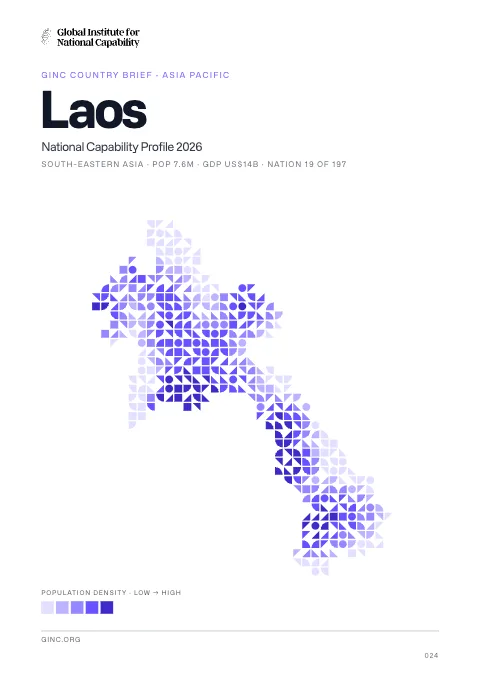
Laos is a landlocked Communist state in East and Southeast Asia, home to 6.8 million people, with its capital at Vientiane.
Contents
12 chapters
Foundations
01–03
At a glance
- Area
- 236.8Kkm²#84 World#10 E & SE Asia
- Population
- 6.8M#103 World#13 E & SE Asia
- GDP (market)
- $10.1B
- GDP (PPP)
- $20.8B#131 World#17 E & SE Asia
- GDP per capita
- $3.1K#176 World#15 E & SE Asia
The whole brief
Laos National Capability Profile 2026
Foundations · Chapter 01
Historical Context
🇱🇦 Laos’ understanding the origins and evolution of the modern nation
BackgroundBack to top ↑
Modern-day Laos has its roots in the ancient Lao kingdom of Lan Xang, established in the 14th century under King FA NGUM. For 300 years Lan Xang had influence reaching into present-day Cambodia and Thailand, as well as over all of what is now Laos. After centuries of gradual decline, Laos came under the domination of Siam (Thailand) from the late 18th century until the late 19th century when it became part of French Indochina. The Franco-Siamese Treaty of 1907 defined the current Lao border with Thailand. In 1975, the communist Pathet Lao took control of the government ending a six-century-old monarchy and instituting a strict socialist regime closely aligned to Vietnam. A gradual, limited return to private enterprise and the liberalization of foreign investment laws began in 1988. Laos became a member of ASEAN in 1997 and the WTO in 2013.
IndependenceBack to top ↑
19 July 1949 (from France)
National holidayBack to top ↑
Republic Day, 2 December (1975)
Foundations · Chapter 02
Geography
🇱🇦 Laos’ territory, resources and strategic position
Location and areaBack to top ↑
Southeastern Asia, northeast of Thailand, west of Vietnam
18 00 N, 105 00 E
Southeast Asia
slightly larger than Utah
0 km (landlocked)
none (landlocked)
Terrain and resourcesBack to top ↑
mostly rugged mountains; some plains and plateaus
timber, hydropower, gypsum, tin, gold, gemstones
3,100 sq km (2005)
Settlement and hazardsBack to top ↑
floods, droughts
landlocked; most of the country is mountainous and thickly forested; the Mekong River forms a large part of the western boundary with Thailand
OtherBack to top ↑
333.5 cu km (2011)
unexploded ordnance; deforestation; soil erosion; most of the population does not have access to potable water
Foundations · Chapter 03
Environment
🇱🇦 Laos’ environmental conditions, resources and national resilience
ClimateBack to top ↑
tropical monsoon; rainy season (May to November); dry season (December to April)
Emissions and pollutionBack to top ↑
Water, waste and foodBack to top ↑
Resources and agreementsBack to top ↑
GINC Capability Domains · Chapter 04
Critical Technology
🇱🇦 Laos’ technology frontiers and the pursuit of national advantage
Two counts are set side by side for 2015–2024: on the left, the papers researchers in Laos published; on the right, the patent families that began there and were filed in more than one country. First by capability group, then group by group with each group’s capabilities. The badge on a card is the nation’s place among all nations. Papers are from GINC Research Analytics, patent families from GINC Patents.
Research by capability group
#158 WorldPapers published, 2015–2024
Patents by capability group
International patent families, 2015–2024
No international patent families on record for 2015–2024.
Advanced Materials & ManufacturingBack to top ↑
Research
#143 WorldPapers published, 2015–2024
Patents
International patent families, 2015–2024
No international patent families on record for 2015–2024.
Energy TechnologiesBack to top ↑
Research
#161 WorldPapers published, 2015–2024
Patents
International patent families, 2015–2024
No international patent families on record for 2015–2024.
Semiconductors & Advanced ComputingBack to top ↑
- Semiconductor Design & EDA
- Advanced Semiconductor Fabrication
- Semiconductor Equipment & Materials
- Advanced Packaging & Heterogeneous Integration
- Compound & Power Semiconductors
- High-Performance & AI Computing
Artificial IntelligenceBack to top ↑
Research
#164 WorldPapers published, 2015–2024
Patents
International patent families, 2015–2024
No international patent families on record for 2015–2024.
Quantum TechnologiesBack to top ↑
Research
#111 WorldPapers published, 2015–2024
Patents
International patent families, 2015–2024
No international patent families on record for 2015–2024.
Connectivity, Cyber & Trust TechnologiesBack to top ↑
Research
#154 WorldPapers published, 2015–2024
Patents
International patent families, 2015–2024
No international patent families on record for 2015–2024.
Sensing, Timing & NavigationBack to top ↑
Research
#159 WorldPapers published, 2015–2024
Patents
International patent families, 2015–2024
No international patent families on record for 2015–2024.
Robotics & Autonomous SystemsBack to top ↑
- Advanced Robotics
- Autonomous Systems & Trusted Autonomy
- Uncrewed & Collaborative Systems
- Human-Machine Interfaces
Biotechnology & Health TechnologiesBack to top ↑
Research
#129 WorldPapers published, 2015–2024
Patents
International patent families, 2015–2024
No international patent families on record for 2015–2024.
Medicine and BioTech
Clinical research and life-science invention, drawn from the same series that drive the metric pages. Each card opens the full cross-country comparison.
Space TechnologiesBack to top ↑
- Space Launch & Reusable Systems
- Advanced Propulsion & Hypersonic Systems
- Satellite & Constellation Technologies
GINC Capability Domains · Chapter 05
Strategic Infrastructure
🇱🇦 Laos’ energy, connectivity and the material foundations of capability
Resource InfrastructureBack to top ↑
0 bbl/day (2012 est.)
0 bbl/day (2010 est.)
0 bbl/day (2010 est.)
0 bbl (1 January 2013 est.)
0 bbl/day (2010 est.)
3,391 bbl/day (2011 est.)
0 bbl/day (2010 est.)
3,160 bbl/day (2010 est.)
0 cu m (2011 est.)
0 cu m (2010 est.)
0 cu m (2011 est.)
0 cu m (2011 est.)
0 cu m (1 January 2013 est.)
refined products 540 km (2013)
Agriculture & Food InfrastructureBack to top ↑
- Irrigation & Agricultural Water
- Livestock & Veterinary
- Fisheries & Aquaculture
- Storage, Cold Chain & Markets
Energy InfrastructureBack to top ↑
- Thermal Generation
- Nuclear Generation
- Nuclear Fuel Cycle & Radioactive Waste
- Hydropower
- Renewable Generation
- Transmission & Distribution
- System Control & Dispatch
- Storage & Fuel Supply
3.217 million kW (2013 est.)
3.629 billion kWh (2010 est.)
2.4 billion kWh (2012 est.)
2.537 billion kWh (2013 est.)
1 billion kWh (2010 est.)
2.6% of total installed capacity (2010 est.)
0% of total installed capacity (2010 est.)
97.4% of total installed capacity (2010 est.)
0% of total installed capacity (2010 est.)
1.404 million Mt (2011 est.)
Water, Sanitation & Waste InfrastructureBack to top ↑
- Dams, Reservoirs & Flood Defence
- Water Supply & Treatment
- Bulk Water Transfer & Desalination
- Wastewater & Sanitation
- Solid Waste & Recycling
Advanced ManufacturingBack to top ↑
- Materials & Inputs
- Chemicals & Hazardous Process Industry
- Production Systems
- Supply Chain & Ecosystem
- Workforce & Innovation
Transport InfrastructureBack to top ↑
- Seaports & Terminals
- Air Infrastructure
- Air Navigation & Traffic Management
- Inland Waterways & Ferries
- Rail Infrastructure
- Roads & Bridges
- Logistics, Multimodal & Border Infrastructure
- Postal & Parcel
41 (2013)
4,600 km (primarily on the Mekong River and its tributaries; 2,900 additional km are intermittently navigable by craft drawing less than 0.5 m) (2012)
Communications & Digital InfrastructureBack to top ↑
- Subsea Cables & International Gateways
- Core & Backbone Networks
- Mobile & Wireless Networks
- Spectrum & Broadcasting
- Data Centres, Compute & Cloud
- Data Resources
- AI Tools & Applications
112,000 (2012)
6.492 million (2012)
300,000 (2009)
1,532 (2012)
.la
Financial InfrastructureBack to top ↑
- Currency & Reserves
- Payments & Settlement Systems
- Markets, Exchanges & Depositories
- Banks, Insurers & Systemic Institutions
Social InfrastructureBack to top ↑
- Health Infrastructure
- Public Health & Laboratories
- Medical Supply & Stockpiles
- Education & Skills Infrastructure
- Research & Scientific Facilities
- Housing, Community & Social Services
- Government & Public Administration
- Cultural, Community & Recreational Infrastructure
- Justice & Corrections
- Emergency Services & Civil Protection
- Hydrometeorology & Early Warning
Space, Aerospace & Defence InfrastructureBack to top ↑
GINC Capability Domains · Chapter 06
National Security
🇱🇦 Laos’ force, intelligence and the defence of the nation
Disputes and terrorismBack to top ↑
southeast Asian states have enhanced border surveillance to check the spread of avian flu; talks continue on completion of demarcation with Thailand but disputes remain over islands in the Mekong River; concern among Mekong River Commission members that China's construction of dams on the Mekong River and its tributaries will affect water levels; Cambodia and Vietnam are concerned about Laos' extensive upstream dam construction
Force Generation & MobilisationBack to top ↑
Lao People's Armed Forces (LPAF): Lao People's Army (LPA; includes Riverine Force), Air Force (2011)
18 years of age for compulsory or voluntary military service; conscript service obligation - minimum 18-months (2012)
NA% (2012)//0.23% of GDP (2011)//NA% (2010)
serving one of the world's least developed countries, the Lao People's Armed Forces (LPAF) is small, poorly funded, and ineffectively resourced; its mission focus is border and internal security, primarily in countering ethnic Hmong insurgent groups; together with the Lao People's Revolutionary Party and the government, the Lao People's Army (LPA) is the third pillar of state machinery, and as such is expected to suppress political and civil unrest and similar national emergencies, but the LPA also has upgraded skills to respond to avian influenza outbreaks; there is no perceived external threat to the state and the LPA maintains strong ties with the neighboring Vietnamese military (2008)
Forces under arms
Active-duty strength on the Correlates of War series, which reaches back to 1816 and so carries a nation’s whole record of mobilisation rather than its present establishment. The card opens the full cross-country comparison.
Intelligence & AssessmentBack to top ↑
- Imagery & Geospatial Intelligence
- Signals & Cyber Intelligence
- Technical & Measurement Intelligence
- Open-Source & Financial Intelligence
- Human Intelligence & Counterintelligence
- All-Source Analysis & Warning
Joint Command, Projection & SustainmentBack to top ↑
- Command, Control & Communications
- Strategic Lift & Mobility
- Expeditionary & Peace Operations
- Operational Sustainment & War Reserves
- Defence Industrial Mobilisation
- CBRN Defence
Land PowerBack to top ↑
- Combined Arms Manoeuvre
- Land Fires
- Battlefield Aviation & Uncrewed Systems
- Special Operations & Irregular Warfare
Maritime PowerBack to top ↑
- Maritime Security & Constabulary
- Sea Denial & Undersea Warfare
- Sea Control
- Amphibious & Expeditionary Operations
Air PowerBack to top ↑
- Air Sovereignty & Policing
- Control of the Air
- Air Strike & Interdiction
- Airborne ISR, Early Warning & Battle Management
Strategic Strike & Missile DefenceBack to top ↑
Space OperationsBack to top ↑
Cyber & Electromagnetic OperationsBack to top ↑
Nuclear DeterrenceBack to top ↑
GINC Capability Domains · Chapter 07
Human Capital
🇱🇦 Laos’ population, health and the skills that sustain capability
DemographyBack to top ↑
6,803,699 (July 2014 est.)
1.59% (2014 est.)
24.76 births/1,000 population (2014 est.)
7.74 deaths/1,000 population (2014 est.)
2.9 children born/woman (2014 est.)
38.4% (2005)
Migration and urbanisationBack to top ↑
-1.1 migrant(s)/1,000 population (2014 est.)
VIENTIANE (capital) 810,000 (2011)
Welfare and equityBack to top ↑
22% (2013 est.)
36.7 (2008)//34.6 (2002)
Early Childhood DevelopmentBack to top ↑
31.6% (2006)
Foundational EducationBack to top ↑
2.8% of GDP (2010)
Advanced EducationBack to top ↑
Technical & Vocational SkillsBack to top ↑
Digital & AI CompetenceBack to top ↑
Generative AI adoption
Modelled share of working-age adults using generative AI, from Microsoft telemetry scaled to each country’s 15–64 population. A measure of how fast a workforce is absorbing the technology rather than of how much of it a nation builds. The card opens the full cross-country comparison.
Lifelong Learning & ReskillingBack to top ↑
Research Talent & Knowledge CreationBack to top ↑
Population HealthBack to top ↑
470 deaths/100,000 live births (2010)
2.6% (2008)
0.3% (2012 est.)
11,500 (2012 est.)
400 (2012 est.)
Health System CapabilityBack to top ↑
2.8% of GDP (2011)
0.19 physicians/1,000 population (2009)
0.7 beds/1,000 population (2010)
GINC Capability Domains · Chapter 08
Governance and Integrity
🇱🇦 Laos’ institutions, law and the integrity of the state
State structureBack to top ↑
Communist state
16 provinces (khoueng, singular and plural) and 1 capital city* (nakhon luang, singular and plural); Attapu, Bokeo, Bolikhamxai, Champasak, Houaphan, Khammouan, Louangnamtha, Louangphabang, Oudomxai, Phongsali, Salavan, Savannakhet, Viangchan (Vientiane)*, Viangchan, Xaignabouli, Xekong, Xiangkhouang
previous 1947 (preindependence); latest promulgated 13-15 August 1991; amended 2003 (2003)
18 years of age; universal
Political Institutions & Civic ParticipationBack to top ↑
- Electoral Management & Integrity
- Legislature & Deliberative Institutions
- Citizen Participation & Civic Space
unicameral National Assembly (132 seats; members elected by popular vote from a list of candidates selected by the Lao People's Revolutionary Party to serve five-year terms)
Lao People's Revolutionary Party or LPRP [CHOUMMALI Saignason]; other parties proscribed
NA
Justice System & Fundamental RightsBack to top ↑
- Judicial Independence & Court Capability
- Access to Justice & Legal Services
- Fundamental Rights Protection
- Human Rights Institutions & Equality Bodies
civil law system similar in form to the French system
has not submitted an ICJ jurisdiction declaration; non-party state to the ICCt
Internal Security & OrderBack to top ↑
estimated opium poppy cultivation in 2008 was 1,900 hectares, about a 73% increase from 2007; estimated potential opium production in 2008 more than tripled to 17 metric tons; unsubstantiated reports of domestic methamphetamine production; growing domestic methamphetamine problem (2007)
Regulatory Governance & Strategic ControlsBack to top ↑
- Regulatory Quality & Better Regulation
- Regulatory Delivery & Independent Regulators
- Strategic Controls & Economic Security Administration
Government Effectiveness & Public AdministrationBack to top ↑
- Centre of Government & Policy Coordination
- Civil Service & Public Workforce
- Digital Government & Service Delivery
- Legal Identity & Civil Registration
- Statistical & Data Capability
Public Integrity & Anti-CorruptionBack to top ↑
Transparency, Oversight & AccountabilityBack to top ↑
- Right to Information & Open Government
- Independent Oversight & Supreme Audit
- Independent Media & Journalist Safety
National Resilience & Crisis ManagementBack to top ↑
GINC Capability Domains · Chapter 09
Information and Influence
🇱🇦 Laos’ identity, media and the projection of influence
Identity and cultureBack to top ↑
Lao (official), French, English, various ethnic languages
Buddhist 67%, Christian 1.5%, other and unspecified 31.5% (2005 census)
Lao 55%, Khmou 11%, Hmong 8%, other (over 100 minor ethnic groups) 26% (2005 census)
elephant
three horizontal bands of red (top), blue (double width), and red with a large white disk centered in the blue band; the red bands recall the blood shed for liberation; the blue band represents the Mekong River and prosperity; the white disk symbolizes the full moon against the Mekong River, but also signifies the unity of the people under the Lao People's Revolutionary Party, as well as the country's bright future
Diplomatic Statecraft & Global NetworksBack to top ↑
- Diplomatic Network & Consular Reach
- Multilateral Leadership & Norm Setting
- Agenda-Setting & Convening
- Mediation & Crisis Diplomacy
ADB, ARF, ASEAN, CP, EAS, FAO, G-77, IAEA, IBRD, ICAO, ICRM, IDA, IFAD, IFC, IFRCS, ILO, IMF, Interpol, IOC, IPU, ISO (subscriber), ITU, MIGA, NAM, OIF, OPCW, PCA, UN, UNCTAD, UNESCO, UNIDO, UNWTO, UPU, WCO, WFTU (NGOs), WHO, WIPO, WMO, WTO
Alliances & Security CooperationBack to top ↑
Development Cooperation & Global AssistanceBack to top ↑
Culture, Language & Education DiplomacyBack to top ↑
- Cultural & Language Institutes
- Creative Industries & Cultural Export Reach
- Heritage & Cultural Institutions
- Education Diplomacy & Alumni Networks
- Sports & Major Events
Diaspora & Global CommunitiesBack to top ↑
Information Environment & Strategic CommunicationBack to top ↑
- Strategic Communications & Public Diplomacy
- International Media & Broadcasting
- Information Defence & Counter-Interference
6 TV stations operating out of Vientiane - 3 government-operated and the others commercial; 17 provincial stations operating with nearly all programming relayed via satellite from the government-operated stations in Vientiane; Chinese and Vietnamese programming relayed via satellite from Lao National TV; broadcasts available from stations in Thailand and Vietnam in border areas; multi-channel satellite and cable TV systems provide access to a wide range of foreign stations; state-controlled radio with state-operated Lao National Radio (LNR) broadcasting on 5 frequencies - 1 AM, 1 SW, and 3 FM; LNR's AM and FM programs are relayed via satellite constituting a large part of the programming schedules of the provincial radio stations; Thai radio broadcasts available in border areas and transmissions of multiple international broadcasters are also accessible (2012)
GINC Capability Domains · Chapter 10
Financial Strength
🇱🇦 Laos’ fiscal depth, reserves and the capacity to act
Monetary & Currency CapabilityBack to top ↑
- Monetary Policy & Price Stability
- Exchange Rate & External Account Management
- Currency Issuance & Digital Money
6.5% (2013 est.)//4.3% (2012 est.)
kips (LAK) per US dollar -//7,875.9 (2013 est.)//8,007.3 (2012 est.)//8,258.8 (2010 est.)//8,516.04 (2009)//8,760.69 (2008)
4.3% (31 December 2010)//4% (31 December 2009)
23.2% (31 December 2013 est.)//22.3% (31 December 2012 est.)
$1.389 billion (31 December 2013 est.)//$1.154 billion (31 December 2012 est.)
$4.071 billion (31 December 2013 est.)//$3.673 billion (31 December 2012 est.)
Fiscal Capacity & Public FinanceBack to top ↑
- Revenue Mobilisation & Tax Administration
- Public Expenditure & Budget Management
- Sovereign Debt & Treasury Management
- Public Investment Management
24.6% of GDP (2013 est.)
-1.6% of GDP (2013 est.)
46.3% of GDP (2013 est.)//49.1% of GDP (2012 est.)
1 October - 30 September
Financial System Depth & AccessBack to top ↑
- Banking System Capacity
- Capital Markets Depth & Development
- Long-Term & Institutional Capital
- Financial Inclusion & Household Access
- Development & Policy Finance
$4.716 billion (31 December 2013 est.)//$4.034 billion (31 December 2012 est.)
$1.012 billion (2012 est.)//$NA (2011)
27.4% of GDP (2013 est.)//26.2% of GDP (2012 est.)//25.2% of GDP (2011 est.)
Financial Regulation & IntegrityBack to top ↑
- Prudential Regulation & Supervision
- Financial Integrity & Illicit Finance Control
- Market Conduct & Consumer Protection
- Payment & Market Infrastructure Oversight
Financial Stability & Crisis ManagementBack to top ↑
- Macroprudential & Systemic Oversight
- Crisis Management, Resolution & Deposit Insurance
- External Liquidity & Financial Safety Nets
Sovereign Capital & External Financial PowerBack to top ↑
- Official Reserves Management
- Sovereign Wealth & Public Asset Management
- Currency Internationalisation & Reserve Status
- Capital Account & Flow Management
- International Financial Centre Capability
$845.4 million (31 December 2013 est.)//$796.9 million (31 December 2012 est.)
$6.69 billion (31 December 2013 est.)//$6.288 billion (31 December 2012 est.)
GINC Capability Domains · Chapter 11
Production and Innovation
🇱🇦 Laos’ output, industry and the engine of prosperity
Economic Output & ProductivityBack to top ↑
The government of Laos, one of the few remaining one-party communist states, began decentralizing control and encouraging private enterprise in 1986. The results, starting from an extremely low base, were striking - growth averaged 6% per year from 1988-2008 except during the short-lived drop caused by the Asian financial crisis that began in 1997. Laos' growth exceeded 7% per year during 2008-13. Despite this high growth rate, Laos remains a country with an underdeveloped infrastructure, particularly in rural areas. It has a basic, but improving, road system, and limited external and internal land-line telecommunications. Electricity is available in 83 % of the country. Laos' economy is heavily dependent on capital-intensive natural resource exports. The labor force, however, still relies on agriculture, dominated by rice cultivation in lowland areas, which accounts for about 25% of GDP and 73% of total employment. Economic growth has reduced official poverty rates from 46% in 1992 to 26% in 2010. The economy also has benefited from high-profile foreign direct investment in hydropower, copper and gold mining, logging, and construction though some projects in these industries have drawn criticism for their environmental impacts. Laos gained Normal Trade Relations status with the US in 2004 and applied for Generalized System of Preferences trade benefits in 2013 after being admitted to the World Trade Organization earlier in the year. Laos is in the process of implementing a value-added tax system. Simplified investment procedures and expanded bank credits for small farmers and small entrepreneurs will improve Laos' economic prospects. The government appears committed to raising the country's profile among investors, but suffered through a fiscal crisis in 2013 brought about by public sector wage increases, fiscal mismanagement, and revenue shortfalls. The World Bank has declared that Laos' goal of graduating from the UN Development Program's list of least-developed countries by 2020 is achievable, and the country is preparing to enter the ASEAN Economic Community in 2015.
$20.78 billion (2013 est.)//$19.18 billion (2012 est.)//$17.78 billion (2011 est.)
8.3% (2013 est.)//7.9% (2012 est.)//8% (2011 est.)
$3,100 (2013 est.)//$2,900 (2012 est.)//$2,700 (2011 est.)
$10.1 billion (2013 est.)
Labour & EmploymentBack to top ↑
- Employment & Labour Force Participation
- Labour Market Institutions & Wage Setting
- Employment Services & Skills Matching
- Labour Adjustment, Transition & Formalisation
3.373 million (2013 est.)
1.9% (2010 est.)//2.5% (2009 est.)
Industrial & Sectoral BaseBack to top ↑
- Manufacturing & Advanced Industry
- Foundational & Process Industries
- Agrifood & Primary Production
- Services Economy
sweet potatoes, vegetables, corn, coffee, sugarcane, tobacco, cotton, tea, peanuts, rice; cassava (manioc, tapioca), water buffalo, pigs, cattle, poultry
mining (copper, tin, gold, gypsum); timber, electric power, agricultural processing, rubber, construction, garments, cement, tourism
11% (2013 est.)
Structural Transformation & ComplexityBack to top ↑
Business Dynamism & EntrepreneurshipBack to top ↑
- Entrepreneurship & Firm Creation
- Risk Capital & Scale-Up Finance
- Firm Growth, Exit & Renewal
- Competition & Market Contestability
Innovation & CommercialisationBack to top ↑
- Business Innovation Capability
- Research Commercialisation & Knowledge Transfer
- Intellectual Property & Intangible Assets
- Innovation Ecosystems & Clusters
Technology Adoption & DiffusionBack to top ↑
GINC Capability Domains · Chapter 12
Trade and Investment
🇱🇦 Laos’ markets, capital and the terms of global exchange
Overall tradeBack to top ↑
$10.7B of exports to 111 partners and $8.74B of imports from 77 in 2024, a surplus of $1.95B.
- Exports
- $10.7B111 partners
- Imports
- $8.74B77 partners
- Balance
- +$1.95Bsurplus
- Total trade
- $19.4B2024
ExportsBack to top ↑
Where its exports go
The largest partners in 2024, with each one's share of the nation's exports.
| Partner | Value | Share | |
|---|---|---|---|
| China | $4.16B | 39% | |
| Thailand | $3.36B | 31% | |
| United States | $845M | 7.9% | |
| Australia | $431M | 4.0% | |
| Germany | $285M | 2.7% | |
| Cambodia | $239M | 2.2% | |
| Switzerland | $195M | 1.8% | |
| Japan | $157M | 1.5% | |
| South Korea | $95.4M | 0.9% | |
| Mexico | $84.8M | 0.8% | |
| India | $77.6M | 0.7% | |
| Denmark | $73.1M | 0.7% | |
| Indonesia | $64.8M | 0.6% | |
| Hong Kong | $52.9M | 0.5% | |
| United Kingdom | $49.1M | 0.5% | |
| France | $48.5M | 0.5% | |
| Saudi Arabia | $44.8M | 0.4% | |
| Czech Republic | $41.1M | 0.4% | |
| Netherlands | $30.9M | 0.3% | |
| Belgium | $30.2M | 0.3% |
What it exports
The largest categories in 2024.
| Category | Value | Share | |
|---|---|---|---|
| Mineral fuels, oils, distillation products | $2.37B | 22% | |
| Ores slag and ash | $1.13B | 11% | |
| Electrical, electronic equipment | $975M | 9.1% | |
| Fertilizers | $845M | 7.9% | |
| Pearls, precious stones, metals, coins | $755M | 7.1% | |
| Rubbers | $573M | 5.4% | |
| Paper and paperboard, articles of pulp, paper and board | $438M | 4.1% | |
| Edible vegetables and certain roots and tubers | $409M | 3.8% | |
| Inorganic chemicals, precious metal compound, isotope | $390M | 3.6% | |
| Pulp of wood, fibrous cellulosic material, waste | $290M | 2.7% | |
| Milling products, malt, starches, inulin, wheat gluten | $289M | 2.7% | |
| Articles of apparel, not knit or crocheted | $260M | 2.4% | |
| Optical, photo, technical, medical apparatus | $259M | 2.4% | |
| Articles of apparel, knit or crocheted | $234M | 2.2% | |
| Wood and articles of wood, wood charcoal | $187M | 1.7% |
ImportsBack to top ↑
Where its imports come from
The largest partners in 2024, with each one's share of the nation's imports.
| Partner | Value | Share | |
|---|---|---|---|
| Thailand | $4.93B | 56% | |
| China | $3.19B | 36% | |
| South Korea | $105M | 1.2% | |
| Japan | $90.6M | 1.0% | |
| Singapore | $62.9M | 0.7% | |
| Taiwan | $37.4M | 0.4% | |
| Germany | $35.3M | 0.4% | |
| Belgium | $25.3M | 0.3% | |
| United States | $24.2M | 0.3% | |
| Brazil | $23.8M | 0.3% | |
| Australia | $23.1M | 0.3% | |
| Hungary | $17.7M | 0.2% | |
| Cambodia | $16.8M | 0.2% | |
| Hong Kong | $16.7M | 0.2% | |
| United Kingdom | $15.9M | 0.2% | |
| Indonesia | $15.0M | 0.2% | |
| Malaysia | $14.8M | 0.2% | |
| Italy | $13.7M | 0.2% | |
| India | $12.4M | 0.1% | |
| France | $11.0M | 0.1% |
What it imports
The largest categories in 2024.
| Category | Value | Share | |
|---|---|---|---|
| Mineral fuels, oils, distillation products | $1.49B | 17% | |
| Machinery, nuclear reactors, boilers | $1.14B | 13% | |
| Vehicles other than railway, tramway | $916M | 10% | |
| Electrical, electronic equipment | $733M | 8.4% | |
| Plastics | $322M | 3.7% | |
| Iron and steel | $289M | 3.3% | |
| Articles of iron or steel | $253M | 2.9% | |
| Sugars and sugar confectionery | $242M | 2.8% | |
| Beverages, spirits and vinegar | $216M | 2.5% | |
| Pearls, precious stones, metals, coins | $196M | 2.2% | |
| Miscellaneous chemical products | $183M | 2.1% | |
| Fertilizers | $179M | 2.0% | |
| Cereal, flour, starch, milk preparations and products | $161M | 1.8% | |
| Miscellaneous edible preparations | $137M | 1.6% | |
| Rubbers | $134M | 1.5% |
In a list, the bar runs to the largest in that list. The line is each figure’s history from 2000, drawn to its own peak: it shows the shape of the years, and the value shows the size.
External balanceBack to top ↑
-$484.3 million (2013 est.)//-$315.5 million (2012 est.)
Trade Facilitation & LogisticsBack to top ↑
Trade Policy & Market AccessBack to top ↑
- Trade Policy & Negotiation Capability
- Market Access & Agreements Network
- Trade Law & Enforcement
- Standards, Conformity & Quality Infrastructure
Digital & Services TradeBack to top ↑
- Services Trade Capability
- Digital Trade & E-Commerce
- Data Flows & Digital Trade Governance
- Tourism & Visitor Economy
Investment Attraction & ProjectionBack to top ↑
- Investment Attraction & Facilitation
- Investment Absorption & Linkages
- Outward Investment & Global Corporate Presence
$15.14 billion (31 December 2012 est.)//$12.44 billion (31 December 2011 est.)
Export Capability & SophisticationBack to top ↑
$2.313 billion (2013 est.)//$1.984 billion (2012 est.)
Thailand 34%, China 21.5%, Vietnam 12.2% (2012)
wood products, coffee, electricity, tin, copper, gold, cassava
Global Value Chain PositionBack to top ↑
- Value Chain Participation & Integration
- Value Chain Position & Upgrading
- Regional Integration & Hub Anchoring
Economic Leverage & DependenceBack to top ↑
- Strategic Supply Security
- Concentration Risk & Revenue Stabilisation
- Economic Leverage & Coercion Resistance
$3.238 billion (2013 est.)//$2.744 billion (2012 est.)
Thailand 62.1%, China 16.2%, Vietnam 7.3% (2012)
machinery and equipment, vehicles, fuel, consumer goods
Laos · you are in
Historical Context
Foundations
GINC Capability Domains
Find in this brief · Laos