
Cambodia
Cambodia is a multiparty democracy in East and Southeast Asia, home to 15 million people, with its capital at Phnom Penh.
Contents
12 chapters
Foundations
01–03
At a glance
- Area
- 181Kkm²#90 World#11 E & SE Asia
- Population
- 15.5M#68 World#11 E & SE Asia
- GDP (market)
- $15.6B
- GDP (PPP)
- $39.6B#106 World#14 E & SE Asia
- GDP per capita
- $2.6K#182 World#17 E & SE Asia
The whole brief
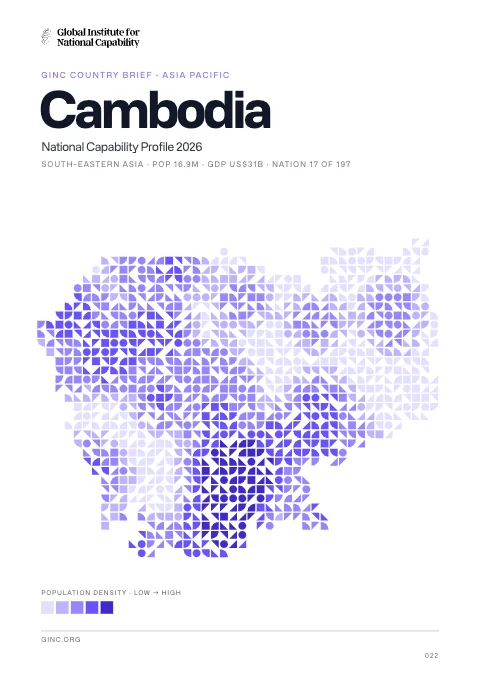
Cambodia National Capability Profile 2026
Foundations · Chapter 01
Historical Context
🇰🇭 Cambodia’s understanding the origins and evolution of the modern nation
BackgroundBack to top ↑
Most Cambodians consider themselves to be Khmers, descendants of the Angkor Empire that extended over much of Southeast Asia and reached its zenith between the 10th and 13th centuries. Attacks by the Thai and Cham (from present-day Vietnam) weakened the empire, ushering in a long period of decline. The king placed the country under French protection in 1863, and it became part of French Indochina in 1887. Following Japanese occupation in World War II, Cambodia gained full independence from France in 1953. In April 1975, after a five-year struggle, communist Khmer Rouge forces captured Phnom Penh and evacuated all cities and towns. At least 1.5 million Cambodians died from execution, forced hardships, or starvation during the Khmer Rouge regime under POL POT. A December 1978 Vietnamese invasion drove the Khmer Rouge into the countryside, began a 10-year Vietnamese occupation, and touched off almost 13 years of civil war. The 1991 Paris Peace Accords mandated democratic elections and a ceasefire, which was not fully respected by the Khmer Rouge. UN-sponsored elections in 1993 helped restore some semblance of normalcy under a coalition government. Factional fighting in 1997 ended the first coalition government, but a second round of national elections in 1998 led to the formation of another coalition government and renewed political stability. The remaining elements of the Khmer Rouge surrendered in early 1999. Some of the surviving Khmer Rouge leaders have been tried or are awaiting trial for crimes against humanity by a hybrid UN-Cambodian tribunal supported by international assistance. Elections in July 2003 were relatively peaceful, but it took one year of negotiations between contending political parties before a coalition government was formed. In October 2004, King Norodom SIHANOUK abdicated the throne and his son, Prince Norodom SIHAMONI, was selected to succeed him. Local elections were held in Cambodia in April 2007, with little of the pre-election violence that preceded prior elections. National elections in July 2008 were relatively peaceful, as were commune council elections in June 2012.
IndependenceBack to top ↑
9 November 1953 (from France)
National holidayBack to top ↑
Independence Day, 9 November (1953)
Foundations · Chapter 02
Geography
🇰🇭 Cambodia’s territory, resources and strategic position
Location and areaBack to top ↑
Southeastern Asia, bordering the Gulf of Thailand, between Thailand, Vietnam, and Laos
13 00 N, 105 00 E
Southeast Asia
slightly smaller than Oklahoma
443 km
Terrain and resourcesBack to top ↑
mostly low, flat plains; mountains in southwest and north
oil and gas, timber, gemstones, iron ore, manganese, phosphates, hydropower potential
3,536 sq km (2006)
Settlement and hazardsBack to top ↑
monsoonal rains (June to November); flooding; occasional droughts
a land of paddies and forests dominated by the Mekong River and Tonle Sap (Southeast Asia's largest freshwater lake)
OtherBack to top ↑
476.1 cu km (2011)
illegal logging activities throughout the country and strip mining for gems in the western region along the border with Thailand have resulted in habitat loss and declining biodiversity (in particular, destruction of mangrove swamps threatens natural fisheries); soil erosion; in rural areas, most of the population does not have access to potable water; declining fish stocks because of illegal fishing and overfishing
Foundations · Chapter 03
Environment
🇰🇭 Cambodia’s environmental conditions, resources and national resilience
ClimateBack to top ↑
tropical; rainy, monsoon season (May to November); dry season (December to April); little seasonal temperature variation
Emissions and pollutionBack to top ↑
Water, waste and foodBack to top ↑
Resources and agreementsBack to top ↑
GINC Capability Domains · Chapter 04
Critical Technology
🇰🇭 Cambodia’s technology frontiers and the pursuit of national advantage
Two counts are set side by side for 2015–2024: on the left, the papers researchers in Cambodia published; on the right, the patent families that began there and were filed in more than one country. First by capability group, then group by group with each group’s capabilities. The badge on a card is the nation’s place among all nations. Papers are from GINC Research Analytics, patent families from GINC Patents.
Research by capability group
#109 WorldPapers published, 2015–2024
Patents by capability group
#124 WorldInternational patent families, 2015–2024
Advanced Materials & ManufacturingBack to top ↑
Research
#123 WorldPapers published, 2015–2024
Patents
#85 WorldInternational patent families, 2015–2024
Energy TechnologiesBack to top ↑
Research
#101 WorldPapers published, 2015–2024
Patents
International patent families, 2015–2024
No international patent families on record for 2015–2024.
Semiconductors & Advanced ComputingBack to top ↑
- Semiconductor Design & EDA
- Advanced Semiconductor Fabrication
- Semiconductor Equipment & Materials
- Advanced Packaging & Heterogeneous Integration
- Compound & Power Semiconductors
- High-Performance & AI Computing
Artificial IntelligenceBack to top ↑
Research
#104 WorldPapers published, 2015–2024
Patents
International patent families, 2015–2024
No international patent families on record for 2015–2024.
Quantum TechnologiesBack to top ↑
Research
#129 WorldPapers published, 2015–2024
Patents
International patent families, 2015–2024
No international patent families on record for 2015–2024.
Connectivity, Cyber & Trust TechnologiesBack to top ↑
Research
#108 WorldPapers published, 2015–2024
Patents
International patent families, 2015–2024
No international patent families on record for 2015–2024.
Sensing, Timing & NavigationBack to top ↑
Research
#113 WorldPapers published, 2015–2024
Patents
International patent families, 2015–2024
No international patent families on record for 2015–2024.
Robotics & Autonomous SystemsBack to top ↑
Research
#115 WorldPapers published, 2015–2024
No research topic: Human-Machine Interfaces
Patents
International patent families, 2015–2024
No international patent families on record for 2015–2024.
Biotechnology & Health TechnologiesBack to top ↑
Research
#85 WorldPapers published, 2015–2024
Patents
#94 WorldInternational patent families, 2015–2024
Medicine and BioTech
Clinical research and life-science invention, drawn from the same series that drive the metric pages. Each card opens the full cross-country comparison.
Space TechnologiesBack to top ↑
- Space Launch & Reusable Systems
- Advanced Propulsion & Hypersonic Systems
- Satellite & Constellation Technologies
GINC Capability Domains · Chapter 05
Strategic Infrastructure
🇰🇭 Cambodia’s energy, connectivity and the material foundations of capability
Resource InfrastructureBack to top ↑
0.5 bbl/day (2012 est.)
0 bbl/day (2010 est.)
0 bbl/day (2010 est.)
0 bbl (1 January 2013 est.)
0 bbl/day (2010 est.)
39,350 bbl/day (2011 est.)
0 bbl/day (2010 est.)
26,250 bbl/day (2010 est.)
0 cu m (2011 est.)
0 cu m (2010 est.)
0 cu m (2011 est.)
0 cu m (2011 est.)
0 cu m (1 January 2013 est.)
Agriculture & Food InfrastructureBack to top ↑
- Irrigation & Agricultural Water
- Livestock & Veterinary
- Fisheries & Aquaculture
- Storage, Cold Chain & Markets
Energy InfrastructureBack to top ↑
- Thermal Generation
- Nuclear Generation
- Nuclear Fuel Cycle & Radioactive Waste
- Hydropower
- Renewable Generation
- Transmission & Distribution
- System Control & Dispatch
- Storage & Fuel Supply
359,900 kW (2010 est.)
1.019 billion kWh (2011 est.)
2.573 billion kWh (2011 est.)
0 kWh (2012 est.)
1.83 billion kWh (2011 est.)
94.8% of total installed capacity (2010 est.)
0% of total installed capacity (2010 est.)
3.6% of total installed capacity (2010 est.)
1.6% of total installed capacity (2010 est.)
4.39 million Mt (2011 est.)
Water, Sanitation & Waste InfrastructureBack to top ↑
- Dams, Reservoirs & Flood Defence
- Water Supply & Treatment
- Bulk Water Transfer & Desalination
- Wastewater & Sanitation
- Solid Waste & Recycling
Advanced ManufacturingBack to top ↑
- Materials & Inputs
- Chemicals & Hazardous Process Industry
- Production Systems
- Supply Chain & Ecosystem
- Workforce & Innovation
Transport InfrastructureBack to top ↑
- Seaports & Terminals
- Air Infrastructure
- Air Navigation & Traffic Management
- Inland Waterways & Ferries
- Rail Infrastructure
- Roads & Bridges
- Logistics, Multimodal & Border Infrastructure
- Postal & Parcel
16 (2013)
1 (2013)
3,700 km (mainly on Mekong River) (2012)
Communications & Digital InfrastructureBack to top ↑
- Subsea Cables & International Gateways
- Core & Backbone Networks
- Mobile & Wireless Networks
- Spectrum & Broadcasting
- Data Centres, Compute & Cloud
- Data Resources
- AI Tools & Applications
584,000 (2012)
19.1 million (2012)
78,500 (2009)
13,784 (2012)
.kh
Financial InfrastructureBack to top ↑
- Currency & Reserves
- Payments & Settlement Systems
- Markets, Exchanges & Depositories
- Banks, Insurers & Systemic Institutions
Social InfrastructureBack to top ↑
- Health Infrastructure
- Public Health & Laboratories
- Medical Supply & Stockpiles
- Education & Skills Infrastructure
- Research & Scientific Facilities
- Housing, Community & Social Services
- Government & Public Administration
- Cultural, Community & Recreational Infrastructure
- Justice & Corrections
- Emergency Services & Civil Protection
- Hydrometeorology & Early Warning
Space, Aerospace & Defence InfrastructureBack to top ↑
GINC Capability Domains · Chapter 06
National Security
🇰🇭 Cambodia’s force, intelligence and the defence of the nation
Disputes and terrorismBack to top ↑
Cambodia is concerned about Laos' extensive upstream dam construction; Cambodia and Thailand dispute sections of boundary; in 2011 Thailand and Cambodia resorted to arms in the dispute over the location of the boundary on the precipice surmounted by Preah Vihear Temple ruins, awarded to Cambodia by ICJ decision in 1962 and part of a UN World Heritage site; Cambodia accuses Vietnam of a wide variety of illicit cross-border activities; progress on a joint development area with Vietnam is hampered by an unresolved dispute over sovereignty of offshore islands
Force Generation & MobilisationBack to top ↑
Royal Cambodian Armed Forces: Royal Cambodian Army, Royal Khmer Navy, Royal Cambodian Air Force (2013)
18 is the legal minimum age for compulsory and voluntary military service (2012)
1.54% of GDP (2012)//1.5% of GDP (2011)//1.54% of GDP (2010)
Forces under arms
Active-duty strength on the Correlates of War series, which reaches back to 1816 and so carries a nation’s whole record of mobilisation rather than its present establishment. The card opens the full cross-country comparison.
Intelligence & AssessmentBack to top ↑
- Imagery & Geospatial Intelligence
- Signals & Cyber Intelligence
- Technical & Measurement Intelligence
- Open-Source & Financial Intelligence
- Human Intelligence & Counterintelligence
- All-Source Analysis & Warning
Joint Command, Projection & SustainmentBack to top ↑
- Command, Control & Communications
- Strategic Lift & Mobility
- Expeditionary & Peace Operations
- Operational Sustainment & War Reserves
- Defence Industrial Mobilisation
- CBRN Defence
Land PowerBack to top ↑
- Combined Arms Manoeuvre
- Land Fires
- Battlefield Aviation & Uncrewed Systems
- Special Operations & Irregular Warfare
Maritime PowerBack to top ↑
- Maritime Security & Constabulary
- Sea Denial & Undersea Warfare
- Sea Control
- Amphibious & Expeditionary Operations
Air PowerBack to top ↑
- Air Sovereignty & Policing
- Control of the Air
- Air Strike & Interdiction
- Airborne ISR, Early Warning & Battle Management
Strategic Strike & Missile DefenceBack to top ↑
Space OperationsBack to top ↑
Cyber & Electromagnetic OperationsBack to top ↑
Nuclear DeterrenceBack to top ↑
GINC Capability Domains · Chapter 07
Human Capital
🇰🇭 Cambodia’s population, health and the skills that sustain capability
DemographyBack to top ↑
15,458,332
1.63% (2014 est.)
24.4 births/1,000 population (2014 est.)
7.78 deaths/1,000 population (2014 est.)
2.66 children born/woman (2014 est.)
22.8
50.5% (2010/11)
Migration and urbanisationBack to top ↑
-0.32 migrant(s)/1,000 population (2014 est.)
PHNOM PENH (capital) 1.55 million (2011)
Welfare and equityBack to top ↑
20% (2012 est.)
37.9 (2008 est.)//41.9 (2004 est.)
Early Childhood DevelopmentBack to top ↑
29% (2011)
Foundational EducationBack to top ↑
2.6% of GDP (2010)
Advanced EducationBack to top ↑
Technical & Vocational SkillsBack to top ↑
Digital & AI CompetenceBack to top ↑
Generative AI adoption
Modelled share of working-age adults using generative AI, from Microsoft telemetry scaled to each country’s 15–64 population. A measure of how fast a workforce is absorbing the technology rather than of how much of it a nation builds. The card opens the full cross-country comparison.
Lifelong Learning & ReskillingBack to top ↑
Research Talent & Knowledge CreationBack to top ↑
Population HealthBack to top ↑
250 deaths/100,000 live births (2010)
2.1% (2008)
0.8% (2012 est.)
76,400 (2012 est.)
2,700 (2012 est.)
Health System CapabilityBack to top ↑
5.7% of GDP (2011)
0.23 physicians/1,000 population (2008)
0.7 beds/1,000 population (2011)
GINC Capability Domains · Chapter 08
Governance and Integrity
🇰🇭 Cambodia’s institutions, law and the integrity of the state
State structureBack to top ↑
multiparty democracy under a constitutional monarchy
23 provinces (khett, singular and plural) and 1 municipality (krong, singular and plural)
previous 1947; latest promulgated 21 September 1993; amended 1999, 2008 (2008)
18 years of age; universal
Political Institutions & Civic ParticipationBack to top ↑
- Electoral Management & Integrity
- Legislature & Deliberative Institutions
- Citizen Participation & Civic Space
bicameral, consists of the Senate (61 seats; 2 members appointed by the monarch, 2 elected by the National Assembly, and 57 elected by parliamentarians and commune councils; members serve five-year terms) and the National Assembly (123 seats; members elected by popular vote to serve five-year terms)
Cambodian People's Party or CPP [CHEA SIM]//Cambodian National Rescue Party or CNRP [SAM RANGSI also spelled SAM RAINSY]//National United Front for an Independent, Neutral, Peaceful, and Cooperative Cambodia or FUNCINPEC [KEV PUT REAKSMEI]//Nationalist Party or NP former Norodom Ranariddh Party or NRP [SAO RANY]
Cambodian Freedom Fighters or CFF//Partnership for Transparency Fund or PTF (anti-corruption organization)//Students Movement for Democracy//The Committee for Free and Fair Elections or Comfrel
Justice System & Fundamental RightsBack to top ↑
- Judicial Independence & Court Capability
- Access to Justice & Legal Services
- Fundamental Rights Protection
- Human Rights Institutions & Equality Bodies
civil law system (influenced by the UN Transitional Authority in Cambodia) customary law, Communist legal theory, and common law
accepts compulsory ICJ jurisdiction with reservations; accepts ICCt jurisdiction
Internal Security & OrderBack to top ↑
narcotics-related corruption reportedly involving some in the government, military, and police; limited methamphetamine production; vulnerable to money laundering due to its cash-based economy and porous borders
Regulatory Governance & Strategic ControlsBack to top ↑
- Regulatory Quality & Better Regulation
- Regulatory Delivery & Independent Regulators
- Strategic Controls & Economic Security Administration
Government Effectiveness & Public AdministrationBack to top ↑
- Centre of Government & Policy Coordination
- Civil Service & Public Workforce
- Digital Government & Service Delivery
- Legal Identity & Civil Registration
- Statistical & Data Capability
Public Integrity & Anti-CorruptionBack to top ↑
Transparency, Oversight & AccountabilityBack to top ↑
- Right to Information & Open Government
- Independent Oversight & Supreme Audit
- Independent Media & Journalist Safety
National Resilience & Crisis ManagementBack to top ↑
GINC Capability Domains · Chapter 09
Information and Influence
🇰🇭 Cambodia’s identity, media and the projection of influence
Identity and cultureBack to top ↑
Khmer (official) 96.3%, other 3.7% (2008 est.)
Buddhist (official) 96.9%, Muslim 1.9%, Christian 0.4%, other 0.8% (2008 est.)
Khmer 90%, Vietnamese 5%, Chinese 1%, other 4%
Angkor Wat temple; kouprey (wild ox)
three horizontal bands of blue (top), red (double width), and blue with a white three-towered temple representing Angkor Wat outlined in black in the center of the red band; red and blue are traditional Cambodian colors
Diplomatic Statecraft & Global NetworksBack to top ↑
- Diplomatic Network & Consular Reach
- Multilateral Leadership & Norm Setting
- Agenda-Setting & Convening
- Mediation & Crisis Diplomacy
ADB, ARF, ASEAN, CICA, CICA (observer), EAS, FAO, G-77, IAEA, IBRD, ICAO, ICRM, IDA, IFAD, IFC, IFRCS, ILO, IMF, IMO, Interpol, IOC, IOM, IPU, ISO (correspondent), ITU, MINUSMA, MIGA, NAM, OIF, OPCW, PCA, UN, UNCTAD, UNESCO, UNIDO, UNIFIL, UNMISS, UNWTO, UPU, WCO, WFTU (NGOs), WHO, WIPO, WMO, WTO
Alliances & Security CooperationBack to top ↑
Development Cooperation & Global AssistanceBack to top ↑
Culture, Language & Education DiplomacyBack to top ↑
- Cultural & Language Institutes
- Creative Industries & Cultural Export Reach
- Heritage & Cultural Institutions
- Education Diplomacy & Alumni Networks
- Sports & Major Events
Diaspora & Global CommunitiesBack to top ↑
Information Environment & Strategic CommunicationBack to top ↑
- Strategic Communications & Public Diplomacy
- International Media & Broadcasting
- Information Defence & Counter-Interference
mixture of state-owned, joint public-private, and privately owned broadcast media; 9 TV broadcast stations with most operating on multiple channels, including 1 state-operated station broadcasting from multiple locations, 6 stations either jointly operated or privately owned with some broadcasting from several locations, and 2 TV relay stations - one relaying a French TV station and the other relaying a Vietnamese TV station; multi-channel cable and satellite systems are available; roughly 50 radio broadcast stations - 1 state-owned broadcaster with multiple stations and a large mixture of public and private broadcasters; several international broadcasters are available (2009)
GINC Capability Domains · Chapter 10
Financial Strength
🇰🇭 Cambodia’s fiscal depth, reserves and the capacity to act
Monetary & Currency CapabilityBack to top ↑
- Monetary Policy & Price Stability
- Exchange Rate & External Account Management
- Currency Issuance & Digital Money
3.2% (2013 est.)//2.9% (2012 est.)
riels (KHR) per US dollar -//4,037.6 (2013 est.)//4,033 (2012 est.)//4,184.9 (2010 est.)//4,139 (2009)//4,070.94 (2008)
NA% (31 December 2012)//5.25% (31 December 2007)
13% (31 December 2013 est.)//12.98% (31 December 2012 est.)
$1.206 billion (31 December 2013 est.)//$995.1 million (31 December 2012 est.)
$8.373 billion (31 December 2013 est.)//$7.1 billion (31 December 2012 est.)
Fiscal Capacity & Public FinanceBack to top ↑
- Revenue Mobilisation & Tax Administration
- Public Expenditure & Budget Management
- Sovereign Debt & Treasury Management
- Public Investment Management
17.2% of GDP (2013 est.)
-2.7% of GDP (2013 est.)
NA% of GDP
calendar year
Financial System Depth & AccessBack to top ↑
- Banking System Capacity
- Capital Markets Depth & Development
- Long-Term & Institutional Capital
- Financial Inclusion & Household Access
- Development & Policy Finance
$5.705 billion (31 December 2013 est.)//$4.801 billion (31 December 2012 est.)
$NA
9.6% of GDP (2013 est.)//9.1% of GDP (2012 est.)//12% of GDP (2011 est.)
Financial Regulation & IntegrityBack to top ↑
- Prudential Regulation & Supervision
- Financial Integrity & Illicit Finance Control
- Market Conduct & Consumer Protection
- Payment & Market Infrastructure Oversight
Financial Stability & Crisis ManagementBack to top ↑
- Macroprudential & Systemic Oversight
- Crisis Management, Resolution & Deposit Insurance
- External Liquidity & Financial Safety Nets
Sovereign Capital & External Financial PowerBack to top ↑
- Official Reserves Management
- Sovereign Wealth & Public Asset Management
- Currency Internationalisation & Reserve Status
- Capital Account & Flow Management
- International Financial Centre Capability
$5.415 billion (31 December 2013 est.)//$4.938 billion (31 December 2012 est.)
$4.912 billion (31 December 2013 est.)//$4.567 billion (31 December 2012 est.)
GINC Capability Domains · Chapter 11
Production and Innovation
🇰🇭 Cambodia’s output, industry and the engine of prosperity
Economic Output & ProductivityBack to top ↑
Since 2004, garments, construction, agriculture, and tourism have driven Cambodia's growth. GDP climbed more than 7% per year between 2010 and 2013. The garment industry currently employs more about 400,000 people and accounts for about 70% of Cambodia's total exports. In 2005, exploitable oil deposits were found beneath Cambodia's territorial waters, representing a potential revenue stream for the government, if commercial extraction becomes feasible. Mining also is attracting some investor interest and the government has touted opportunities for mining bauxite, gold, iron and gems. The tourism industry has continued to grow rapidly with foreign arrivals exceeding 2 million per year since 2007 and reaching over 3 million visitors in 2012. Cambodia, nevertheless, remains one of the poorest countries in Asia and long-term economic development remains a daunting challenge, inhibited by endemic corruption, limited educational opportunities, high income inequality, and poor job prospects. Approximately 4 million people live on less than $1.25 per day, and 37% of Cambodian children under the age of 5 suffer from chronic malnutrition. More than 50% of the population is less than 25 years old. The population lacks education and productive skills, particularly in the impoverished countryside, which also lacks basic infrastructure. The Cambodian Government is working with bilateral and multilateral donors, including the Asian Development Bank, the World Bank and IMF, to address the country's many pressing needs; more than 50% of the government budget comes from donor assistance. The major economic challenge for Cambodia over the next decade will be fashioning an economic environment in which the private sector can create enough jobs to handle Cambodia's demographic imbalance.
$39.64 billion (2013 est.)//$37.04 billion (2012 est.)//$34.52 billion (2011 est.)
7% (2013 est.)//7.3% (2012 est.)//7.1% (2011 est.)
$2,600 (2013 est.)//$2,400 (2012 est.)//$2,300 (2011 est.)
$15.64 billion (2013 est.)
Labour & EmploymentBack to top ↑
- Employment & Labour Force Participation
- Labour Market Institutions & Wage Setting
- Employment Services & Skills Matching
- Labour Adjustment, Transition & Formalisation
7.9 million (2011 est.)
0% (2011 est.)//0.3% (2010 est.)
Industrial & Sectoral BaseBack to top ↑
- Manufacturing & Advanced Industry
- Foundational & Process Industries
- Agrifood & Primary Production
- Services Economy
rice, rubber, corn, vegetables, cashews, cassava (manioc, tapioca), silk
tourism, garments, construction, rice milling, fishing, wood and wood products, rubber, cement, gem mining, textiles
9.5% (2013 est.)
Structural Transformation & ComplexityBack to top ↑
Business Dynamism & EntrepreneurshipBack to top ↑
- Entrepreneurship & Firm Creation
- Risk Capital & Scale-Up Finance
- Firm Growth, Exit & Renewal
- Competition & Market Contestability
Innovation & CommercialisationBack to top ↑
- Business Innovation Capability
- Research Commercialisation & Knowledge Transfer
- Intellectual Property & Intangible Assets
- Innovation Ecosystems & Clusters
Technology Adoption & DiffusionBack to top ↑
GINC Capability Domains · Chapter 12
Trade and Investment
🇰🇭 Cambodia’s markets, capital and the terms of global exchange
Overall tradeBack to top ↑
$40.1B of exports to 168 partners and $37.0B of imports from 156 in 2024, a surplus of $3.09B.
- Exports
- $40.1B168 partners
- Imports
- $37.0B156 partners
- Balance
- +$3.09Bsurplus
- Total trade
- $77.1B2024
ExportsBack to top ↑
Where its exports go
The largest partners in 2024, with each one's share of the nation's exports.
| Partner | Value | Share | |
|---|---|---|---|
| United States | $13.5B | 34% | |
| Vietnam | $3.62B | 9.0% | |
| China | $2.35B | 5.9% | |
| Germany | $2.24B | 5.6% | |
| Japan | $2.12B | 5.3% | |
| Spain | $1.74B | 4.3% | |
| Canada | $1.65B | 4.1% | |
| France | $1.46B | 3.7% | |
| United Kingdom | $1.42B | 3.5% | |
| Thailand | $1.26B | 3.1% | |
| Poland | $902M | 2.2% | |
| Netherlands | $698M | 1.7% | |
| Singapore | $655M | 1.6% | |
| Australia | $620M | 1.5% | |
| Mexico | $561M | 1.4% | |
| South Korea | $492M | 1.2% | |
| Italy | $415M | 1.0% | |
| Switzerland | $350M | 0.9% | |
| Austria | $336M | 0.8% | |
| Czech Republic | $334M | 0.8% |
What it exports
The largest categories in 2024.
| Category | Value | Share | |
|---|---|---|---|
| Articles of apparel, knit or crocheted | $10.5B | 26% | |
| Articles of apparel, not knit or crocheted | $6.25B | 16% | |
| Articles of leather, animal gut, harness, travel good | $3.33B | 8.3% | |
| Footwear, gaiters and the like | $3.24B | 8.1% | |
| Electrical, electronic equipment | $2.85B | 7.1% | |
| Cereals | $1.90B | 4.7% | |
| Furniture, lighting signs, prefabricated buildings | $1.58B | 3.9% | |
| Rubbers | $1.57B | 3.9% | |
| Pearls, precious stones, metals, coins | $1.04B | 2.6% | |
| Edible fruits, nuts, peel of citrus fruit, melons | $820M | 2.0% | |
| Edible vegetables and certain roots and tubers | $703M | 1.8% | |
| Vehicles other than railway, tramway | $651M | 1.6% | |
| Plastics | $615M | 1.5% | |
| Toys, games, sports requisites | $513M | 1.3% | |
| Wood and articles of wood, wood charcoal | $457M | 1.1% |
ImportsBack to top ↑
Where its imports come from
The largest partners in 2024, with each one's share of the nation's imports.
| Partner | Value | Share | |
|---|---|---|---|
| China | $13.6B | 37% | |
| Thailand | $8.50B | 23% | |
| Vietnam | $4.17B | 11% | |
| Singapore | $3.24B | 8.7% | |
| Indonesia | $982M | 2.7% | |
| Malaysia | $857M | 2.3% | |
| Japan | $780M | 2.1% | |
| Taiwan | $700M | 1.9% | |
| South Korea | $693M | 1.9% | |
| Hong Kong | $467M | 1.3% | |
| United States | $308M | 0.8% | |
| Laos | $239M | 0.6% | |
| India | $204M | 0.6% | |
| Chile | $198M | 0.5% | |
| Denmark | $198M | 0.5% | |
| Germany | $185M | 0.5% | |
| Finland | $150M | 0.4% | |
| France | $129M | 0.3% | |
| Australia | $113M | 0.3% | |
| Italy | $111M | 0.3% |
What it imports
The largest categories in 2024.
| Category | Value | Share | |
|---|---|---|---|
| Pearls, precious stones, metals, coins | $5.52B | 15% | |
| Mineral fuels, oils, distillation products | $4.08B | 11% | |
| Knitted or crocheted fabric | $2.34B | 6.3% | |
| Electrical, electronic equipment | $2.25B | 6.1% | |
| Machinery, nuclear reactors, boilers | $2.18B | 5.9% | |
| Vehicles other than railway, tramway | $1.84B | 5.0% | |
| Plastics | $1.46B | 4.0% | |
| Articles of iron or steel | $903M | 2.4% | |
| Aluminum | $815M | 2.2% | |
| Paper and paperboard, articles of pulp, paper and board | $808M | 2.2% | |
| Cotton | $806M | 2.2% | |
| Manmade filaments | $649M | 1.8% | |
| Iron and steel | $646M | 1.7% | |
| Rubbers | $563M | 1.5% | |
| Beverages, spirits and vinegar | $530M | 1.4% |
In a list, the bar runs to the largest in that list. The line is each figure’s history from 2000, drawn to its own peak: it shows the shape of the years, and the value shows the size.
External balanceBack to top ↑
-$1.262 billion (2013 est.)//-$1.208 billion (2012 est.)
Trade Facilitation & LogisticsBack to top ↑
Trade Policy & Market AccessBack to top ↑
- Trade Policy & Negotiation Capability
- Market Access & Agreements Network
- Trade Law & Enforcement
- Standards, Conformity & Quality Infrastructure
Digital & Services TradeBack to top ↑
- Services Trade Capability
- Digital Trade & E-Commerce
- Data Flows & Digital Trade Governance
- Tourism & Visitor Economy
Investment Attraction & ProjectionBack to top ↑
- Investment Attraction & Facilitation
- Investment Absorption & Linkages
- Outward Investment & Global Corporate Presence
Export Capability & SophisticationBack to top ↑
$6.781 billion (2013 est.)//$6.016 billion (2012 est.)
US 32.6%, UK 8.3%, Germany 7.7%, Canada 7.7%, Singapore 6.6%, Vietnam 5.7%, Japan 4.7% (2012)
clothing, timber, rubber, rice, fish, tobacco, footwear
Global Value Chain PositionBack to top ↑
- Value Chain Participation & Integration
- Value Chain Position & Upgrading
- Regional Integration & Hub Anchoring
Economic Leverage & DependenceBack to top ↑
- Strategic Supply Security
- Concentration Risk & Revenue Stabilisation
- Economic Leverage & Coercion Resistance
$8.895 billion (2013 est.)//$7.965 billion (2012 est.)
Thailand 27.1%, Vietnam 20.3%, China 19.5%, Singapore 7.1%, Hong Kong 5.8%, South Korea 4.3% (2012)
petroleum products, cigarettes, gold, construction materials, machinery, motor vehicles, pharmaceutical products
Cambodia · you are in
Historical Context
Foundations
GINC Capability Domains
Find in this brief · Cambodia