
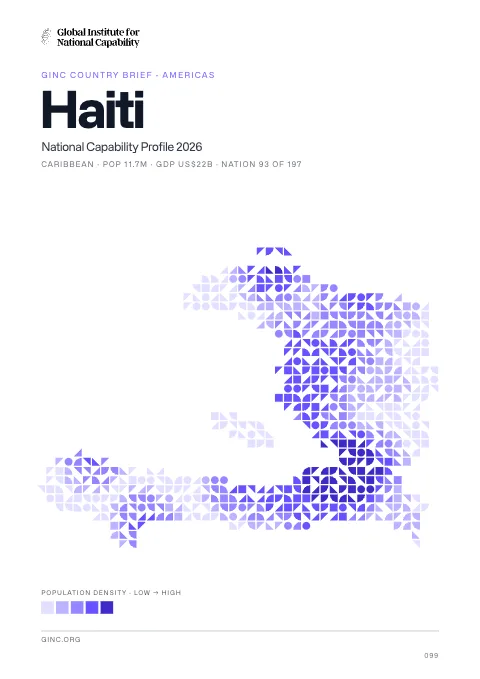
Haiti
Haiti is a republic in Central America and the Caribbean, home to 10.0 million people, with its capital at Port-au-Prince.
Contents
12 chapters
Foundations
01–03
At a glance
- Area
- 27.8Kkm²#147 World#8 C. America
- Population
- 10M#88 World#4 C. America
- GDP (market)
- $8.3B
- GDP (PPP)
- $13.4B#147 World#12 C. America
- GDP per capita
- $1.3K#211 World#31 C. America
The whole brief
Haiti National Capability Profile 2026
Foundations · Chapter 01
Historical Context
🇭🇹 Haiti’s understanding the origins and evolution of the modern nation
BackgroundBack to top ↑
The native Taino - who inhabited the island of Hispaniola when it was discovered by Christopher COLUMBUS in 1492 - were virtually annihilated by Spanish settlers within 25 years. In the early 17th century, the French established a presence on Hispaniola. In 1697, Spain ceded to the French the western third of the island, which later became Haiti. The French colony, based on forestry and sugar-related industries, became one of the wealthiest in the Caribbean but only through the heavy importation of African slaves and considerable environmental degradation. In the late 18th century, Haiti's nearly half million slaves revolted under Toussaint L'OUVERTURE. After a prolonged struggle, Haiti became the first post-colonial black-led nation in the world, declaring its independence in 1804. Currently the poorest country in the Western Hemisphere, Haiti has experienced political instability for most of its history. After an armed rebellion led to the forced resignation and exile of President Jean-Bertrand ARISTIDE in February 2004, an interim government took office to organize new elections under the auspices of the United Nations. Continued instability and technical delays prompted repeated postponements, but Haiti inaugurated a democratically elected president and parliament in May of 2006. This was followed by contested elections in 2010 that resulted in the election of Haiti's current President, Michel MARTELLY. A massive magnitude 7.0 earthquake struck Haiti in January 2010 with an epicenter about 25 km (15 mi) west of the capital, Port-au-Prince. Estimates are that over 300,000 people were killed and some 1.5 million left homeless. The earthquake was assessed as the worst in this region over the last 200 years.
IndependenceBack to top ↑
1 January 1804 (from France)
National holidayBack to top ↑
Independence Day, 1 January (1804)
Foundations · Chapter 02
Geography
🇭🇹 Haiti’s territory, resources and strategic position
Location and areaBack to top ↑
Caribbean, western one-third of the island of Hispaniola, between the Caribbean Sea and the North Atlantic Ocean, west of the Dominican Republic
19 00 N, 72 25 W
Central America and the Caribbean
slightly smaller than Maryland
1,771 km
Terrain and resourcesBack to top ↑
mostly rough and mountainous
bauxite, copper, calcium carbonate, gold, marble, hydropower
970 sq km (2009)
Settlement and hazardsBack to top ↑
lies in the middle of the hurricane belt and subject to severe storms from June to October; occasional flooding and earthquakes; periodic droughts
shares island of Hispaniola with Dominican Republic (western one-third is Haiti, eastern two-thirds is the Dominican Republic)
OtherBack to top ↑
14.03 cu km (2011)
extensive deforestation (much of the remaining forested land is being cleared for agriculture and used as fuel); soil erosion; inadequate supplies of potable water
Foundations · Chapter 03
Environment
🇭🇹 Haiti’s environmental conditions, resources and national resilience
ClimateBack to top ↑
tropical; semiarid where mountains in east cut off trade winds
Emissions and pollutionBack to top ↑
Water, waste and foodBack to top ↑
Resources and agreementsBack to top ↑
GINC Capability Domains · Chapter 04
Critical Technology
🇭🇹 Haiti’s technology frontiers and the pursuit of national advantage
Two counts are set side by side for 2015–2024: on the left, the papers researchers in Haiti published; on the right, the patent families that began there and were filed in more than one country. First by capability group, then group by group with each group’s capabilities. The badge on a card is the nation’s place among all nations. Papers are from GINC Research Analytics, patent families from GINC Patents.
Research by capability group
#194 WorldPapers published, 2015–2024
Patents by capability group
International patent families, 2015–2024
No international patent families on record for 2015–2024.
Advanced Materials & ManufacturingBack to top ↑
- Structural & Composite Materials
- Functional Materials & Coatings
- Nanomaterials & Metamaterials
- Superconducting, Magnetic & Photonic Materials
- Energetic Materials
- Additive & Precision Manufacturing
- Advanced Chemical & Process Manufacturing
Energy TechnologiesBack to top ↑
- Batteries & Energy Storage
- Hydrogen, Ammonia & Sustainable Fuels
- Next-Generation Solar & Renewables
- Advanced Nuclear & Fusion
- Directed Energy Technologies
Semiconductors & Advanced ComputingBack to top ↑
- Semiconductor Design & EDA
- Advanced Semiconductor Fabrication
- Semiconductor Equipment & Materials
- Advanced Packaging & Heterogeneous Integration
- Compound & Power Semiconductors
- High-Performance & AI Computing
Artificial IntelligenceBack to top ↑
Research
#182 WorldPapers published, 2015–2024
Patents
International patent families, 2015–2024
No international patent families on record for 2015–2024.
Quantum TechnologiesBack to top ↑
Connectivity, Cyber & Trust TechnologiesBack to top ↑
- Advanced Optical Communication & Photonics
- Advanced Wireless Communication
- Resilient & Infrastructure-Independent Networks
- Protective Cybersecurity Technologies
- Privacy, Identity & Trust Technologies
Sensing, Timing & NavigationBack to top ↑
Research
#159 WorldPapers published, 2015–2024
Patents
International patent families, 2015–2024
No international patent families on record for 2015–2024.
Robotics & Autonomous SystemsBack to top ↑
Research
#160 WorldPapers published, 2015–2024
No research topic: Human-Machine Interfaces
Patents
International patent families, 2015–2024
No international patent families on record for 2015–2024.
Biotechnology & Health TechnologiesBack to top ↑
Research
#181 WorldPapers published, 2015–2024
Patents
International patent families, 2015–2024
No international patent families on record for 2015–2024.
Medicine and BioTech
Clinical research and life-science invention, drawn from the same series that drive the metric pages. Each card opens the full cross-country comparison.
Space TechnologiesBack to top ↑
- Space Launch & Reusable Systems
- Advanced Propulsion & Hypersonic Systems
- Satellite & Constellation Technologies
GINC Capability Domains · Chapter 05
Strategic Infrastructure
🇭🇹 Haiti’s energy, connectivity and the material foundations of capability
Resource InfrastructureBack to top ↑
0 bbl/day (2012 est.)
0 bbl/day (2010 est.)
0 bbl/day (2010 est.)
0 bbl (1 January 2013 est.)
0 bbl/day (2011 est.)
14,000 bbl/day (2011 est.)
0 bbl/day (2012 est.)
15,130 bbl/day (2011 est.)
0 cu m (2011 est.)
0 cu m (2010 est.)
0 cu m (2011 est.)
0 cu m (2011 est.)
0 cu m (1 January 2013 est.)
Agriculture & Food InfrastructureBack to top ↑
- Irrigation & Agricultural Water
- Livestock & Veterinary
- Fisheries & Aquaculture
- Storage, Cold Chain & Markets
Energy InfrastructureBack to top ↑
- Thermal Generation
- Nuclear Generation
- Nuclear Fuel Cycle & Radioactive Waste
- Hydropower
- Renewable Generation
- Transmission & Distribution
- System Control & Dispatch
- Storage & Fuel Supply
130,000 kW (2012 est.)
726 million kWh (2012 est.)
208.5 million kWh (2012 est.)
0 kWh (2012 est.)
0 kWh (2012 est.)
79% of total installed capacity (2011 est.)
0% of total installed capacity (2011 est.)
21% of total installed capacity (2011 est.)
0% of total installed capacity (2011 est.)
2.103 million Mt (2011 est.)
Water, Sanitation & Waste InfrastructureBack to top ↑
- Dams, Reservoirs & Flood Defence
- Water Supply & Treatment
- Bulk Water Transfer & Desalination
- Wastewater & Sanitation
- Solid Waste & Recycling
Advanced ManufacturingBack to top ↑
- Materials & Inputs
- Chemicals & Hazardous Process Industry
- Production Systems
- Supply Chain & Ecosystem
- Workforce & Innovation
Transport InfrastructureBack to top ↑
- Seaports & Terminals
- Air Infrastructure
- Air Navigation & Traffic Management
- Inland Waterways & Ferries
- Rail Infrastructure
- Roads & Bridges
- Logistics, Multimodal & Border Infrastructure
- Postal & Parcel
14 (2013)
Communications & Digital InfrastructureBack to top ↑
- Subsea Cables & International Gateways
- Core & Backbone Networks
- Mobile & Wireless Networks
- Spectrum & Broadcasting
- Data Centres, Compute & Cloud
- Data Resources
- AI Tools & Applications
50,000 (2012)
6.095 million (2012)
1 million (2009)
555 (2012)
.ht
Financial InfrastructureBack to top ↑
- Currency & Reserves
- Payments & Settlement Systems
- Markets, Exchanges & Depositories
- Banks, Insurers & Systemic Institutions
Social InfrastructureBack to top ↑
- Health Infrastructure
- Public Health & Laboratories
- Medical Supply & Stockpiles
- Education & Skills Infrastructure
- Research & Scientific Facilities
- Housing, Community & Social Services
- Government & Public Administration
- Cultural, Community & Recreational Infrastructure
- Justice & Corrections
- Emergency Services & Civil Protection
- Hydrometeorology & Early Warning
Space, Aerospace & Defence InfrastructureBack to top ↑
GINC Capability Domains · Chapter 06
National Security
🇭🇹 Haiti’s force, intelligence and the defence of the nation
Disputes and terrorismBack to top ↑
since 2004, peacekeepers from the UN Stabilization Mission in Haiti have assisted in maintaining civil order in Haiti; the mission currently includes 6,685 military, 2,607 police, and 443 civilian personnel; despite efforts to control illegal migration, Haitians cross into the Dominican Republic and sail to neighboring countries; Haiti claims US-administered Navassa Island
Force Generation & MobilisationBack to top ↑
no regular military forces - small Coast Guard; a Ministry of National Defense established May 2012; the regular Haitian Armed Forces (FAdH) - Army, Navy, and Air Force - have been demobilized but still exist on paper until or unless they are constitutionally abolished (2011)
Forces under arms
Active-duty strength on the Correlates of War series, which reaches back to 1816 and so carries a nation’s whole record of mobilisation rather than its present establishment. The card opens the full cross-country comparison.
Intelligence & AssessmentBack to top ↑
- Imagery & Geospatial Intelligence
- Signals & Cyber Intelligence
- Technical & Measurement Intelligence
- Open-Source & Financial Intelligence
- Human Intelligence & Counterintelligence
- All-Source Analysis & Warning
Joint Command, Projection & SustainmentBack to top ↑
- Command, Control & Communications
- Strategic Lift & Mobility
- Expeditionary & Peace Operations
- Operational Sustainment & War Reserves
- Defence Industrial Mobilisation
- CBRN Defence
Land PowerBack to top ↑
- Combined Arms Manoeuvre
- Land Fires
- Battlefield Aviation & Uncrewed Systems
- Special Operations & Irregular Warfare
Maritime PowerBack to top ↑
- Maritime Security & Constabulary
- Sea Denial & Undersea Warfare
- Sea Control
- Amphibious & Expeditionary Operations
Air PowerBack to top ↑
- Air Sovereignty & Policing
- Control of the Air
- Air Strike & Interdiction
- Airborne ISR, Early Warning & Battle Management
Strategic Strike & Missile DefenceBack to top ↑
Space OperationsBack to top ↑
Cyber & Electromagnetic OperationsBack to top ↑
Nuclear DeterrenceBack to top ↑
GINC Capability Domains · Chapter 07
Human Capital
🇭🇹 Haiti’s population, health and the skills that sustain capability
DemographyBack to top ↑
9,996,731
1.08%
22.83 births/1,000 population (2014 est.)
7.91 deaths/1,000 population (2014 est.)
2.79 children born/woman (2014 est.)
22.7
34.5% (2012)
Migration and urbanisationBack to top ↑
-4.12 migrant(s)/1,000 population (2014 est.)
PORT-AU-PRINCE (capital) 2.207 million (2011)
Welfare and equityBack to top ↑
80% (2003 est.)
59.2 (2001)
DisplacementBack to top ↑
Early Childhood DevelopmentBack to top ↑
18.9% (2006)
Foundational EducationBack to top ↑
NA
Advanced EducationBack to top ↑
Technical & Vocational SkillsBack to top ↑
Digital & AI CompetenceBack to top ↑
Generative AI adoption
Modelled share of working-age adults using generative AI, from Microsoft telemetry scaled to each country’s 15–64 population. A measure of how fast a workforce is absorbing the technology rather than of how much of it a nation builds. The card opens the full cross-country comparison.
Lifelong Learning & ReskillingBack to top ↑
Research Talent & Knowledge CreationBack to top ↑
Population HealthBack to top ↑
350 deaths/100,000 live births (2010)
7.9% (2008)
2.1% (2012 est.)
146,000 (2012 est.)
7,500 (2012 est.)
Health System CapabilityBack to top ↑
7.9% of GDP (2011)
0.25 physicians/1,000 population (1998)
1.3 beds/1,000 population (2007)
GINC Capability Domains · Chapter 08
Governance and Integrity
🇭🇹 Haiti’s institutions, law and the integrity of the state
State structureBack to top ↑
republic
10 departments (departements, singular - departement); Artibonite, Centre, Grand'Anse, Nippes, Nord, Nord-Est, Nord-Ouest, Ouest, Sud, Sud-Est
many previous (23 total); latest adopted 10 March 1987; amended 2012 (2013)
18 years of age; universal
Political Institutions & Civic ParticipationBack to top ↑
- Electoral Management & Integrity
- Legislature & Deliberative Institutions
- Citizen Participation & Civic Space
bicameral National Assembly or Assemblee Nationale consists of the Senate (30 seats; members elected by popular vote to serve six-year terms; one-third elected every two years) and the Chamber of Deputies (99 seats; members elected by popular vote to serve four-year terms);
Assembly of Progressive National Democrats or RDNP [Mirlande MANIGAT]//Christian and Citizen For Haiti's Reconstruction or ACCRHA [Chavannes JEUNE]//Convention for Democratic Unity or KID [Evans PAUL]//Cooperative Action to Rebuild Haiti or KONBA [Jean William JEANTY]//December 16 Platform or Platfom 16 Desanm [Dr. Gerard BLOT]//Democratic Alliance or ALYANS [Evans PAUL] (coalition composed of KID and PPRH)//Democratic Centers's National Council or CONACED [Osner FEVRY]//Democratic Movement for the Liberation of Haiti-Revolutionary Party of Haiti or MODELH-PRDH//Effort and Solidarity to Create an Alternative for the People or ESKAMP [Joseph JASME]//Fanmi Lavalas or FL [Jean-Bertrand ARISTIDE]//For Us All or PONT [Jean-Marie CHERESTAL]//Grouping of Citizens for Hope or RESPE [Charles-Henri BAKER]//Haiti in Action or AAA [Youri LATORTUE]//Haitians for Haiti [Yvon NEPTUNE]//Independent Movement for National Reconstruction or MIRN [Luc FLEURINORD]//Konbit Pou refe Ayiti or KONBIT//Lavni Organization or LAVNI [Yves CRISTALIN]//Liberal Party of Haiti or PLH [Jean Andre VICTOR]//Liberation Platform or PLATFORME LIBERATION//Love Haiti or Renmen Ayiti [Jean-Henry CEANT and Camille LEBLANC]//Merging of Haitian Social Democratics or FUSION [Edmonde Supplice BEAUZILE] (coalition of Ayiti Capable, Haitian National Revolutionary Party, and National Congress of Democratic Movements)//Mobilization for National Development or MDN [Hubert de RONCERAY]//National Front for the Reconstruction of Haiti or FRN [Guy PHILIPPE]//New Christian Movement for a New Haiti or MOCHRENA [Luc MESADIEU]//Peasant's Response or Repons Peyizan [Michel MARTELLY]//Platform Alternative for Progress and Democracy or ALTENATIV [Victor BENOIT and Evans PAUL]//Platform of Haitian Patriots or PLAPH [Dejean BELISAIRE and Himmler REBU]//Popular Party for the Renewal of Haiti or PPRH [Claude ROMAIN]//Rally or RASAMBLE//Respect or RESPE//Socialist Action Movement or MAS//Strength in Unity or Ansanm Nou Fo [Leslie VOLTAIRE]//Struggling People's Organization or OPL [Sauveur PIERRE-ETIENNE]//Union [Chavannes JEUNE]//Union of Haitian Citizens for Democracy, Development, and Education or UCADDE [Jeantel JOSEPH]//Union of Nationalist and Progressive Haitians or UNPH [Edouard FRANCISQUE]//Unity or Inite [Levaillant LOUIS-JEUNE] (coalition that includes Front for Hope or L'ESPWA)//Vigilance or Veye Yo [Lavarice GAUDIN]//Youth for People's Power or JPP [Rene CIVIL]
Autonomous Organizations of Haitian Workers or CATH [Fignole ST-CYR]//Confederation of Haitian Workers or CTH//Economic Forum of the Private Sector or EF [Reginald BOULOS]//Federation of Workers Trade Unions or FOS//General Organization of Independent Haitian Workers [Patrick NUMAS]//Grand-Anse Resistance Committee, or KOREGA//The Haitian Association of Industries or ADIH [Georges SASSINE]//National Popular Assembly or APN//Papaye Peasants Movement or MPP [Chavannes JEAN-BAPTISTE]//Popular Organizations Gathering Power or PROP//Protestant Federation of Haiti//Roman Catholic Church
Justice System & Fundamental RightsBack to top ↑
- Judicial Independence & Court Capability
- Access to Justice & Legal Services
- Fundamental Rights Protection
- Human Rights Institutions & Equality Bodies
civil law system strongly influenced by Napoleonic Code
accepts compulsory ICJ jurisdiction; non-party state to the ICCt
Internal Security & OrderBack to top ↑
Caribbean transshipment point for cocaine en route to the US and Europe; substantial bulk cash smuggling activity; Colombian narcotics traffickers favor Haiti for illicit financial transactions; pervasive corruption; significant consumer of cannabis
Regulatory Governance & Strategic ControlsBack to top ↑
- Regulatory Quality & Better Regulation
- Regulatory Delivery & Independent Regulators
- Strategic Controls & Economic Security Administration
Government Effectiveness & Public AdministrationBack to top ↑
- Centre of Government & Policy Coordination
- Civil Service & Public Workforce
- Digital Government & Service Delivery
- Legal Identity & Civil Registration
- Statistical & Data Capability
Public Integrity & Anti-CorruptionBack to top ↑
Transparency, Oversight & AccountabilityBack to top ↑
- Right to Information & Open Government
- Independent Oversight & Supreme Audit
- Independent Media & Journalist Safety
National Resilience & Crisis ManagementBack to top ↑
GINC Capability Domains · Chapter 09
Information and Influence
🇭🇹 Haiti’s identity, media and the projection of influence
Identity and cultureBack to top ↑
French (official), Creole (official)
Roman Catholic 80%, Protestant 16% (Baptist 10%, Pentecostal 4%, Adventist 1%, other 1%), none 1%, other 3%
black 95%, mulatto and white 5%
Hispaniolan trogon (bird)
two equal horizontal bands of blue (top) and red with a centered white rectangle bearing the coat of arms, which contains a palm tree flanked by flags and two cannons above a scroll bearing the motto L'UNION FAIT LA FORCE (Union Makes Strength); the colors are taken from the French Tricolor and represent the union of blacks and mulattoes
Diplomatic Statecraft & Global NetworksBack to top ↑
- Diplomatic Network & Consular Reach
- Multilateral Leadership & Norm Setting
- Agenda-Setting & Convening
- Mediation & Crisis Diplomacy
ACP, AOSIS, Caricom, CD, CDB, CELAC, FAO, G-77, IADB, IAEA, IBRD, ICAO, ICRM, IDA, IFAD, IFC, IFRCS, ILO, IMF, IMO, Interpol, IOC, IOM, IPU, ITSO, ITU, ITUC (NGOs), LAES, MIGA, NAM, OAS, OIF, OPANAL, OPCW, PCA, Petrocaribe, UN, UNCTAD, UNESCO, UNIDO, Union Latina, UNWTO, UPU, WCO, WFTU (NGOs), WHO, WIPO, WMO, WTO
Alliances & Security CooperationBack to top ↑
Development Cooperation & Global AssistanceBack to top ↑
Culture, Language & Education DiplomacyBack to top ↑
- Cultural & Language Institutes
- Creative Industries & Cultural Export Reach
- Heritage & Cultural Institutions
- Education Diplomacy & Alumni Networks
- Sports & Major Events
Diaspora & Global CommunitiesBack to top ↑
Information Environment & Strategic CommunicationBack to top ↑
- Strategic Communications & Public Diplomacy
- International Media & Broadcasting
- Information Defence & Counter-Interference
several TV stations, including 1 government-owned; cable TV subscription service available; government-owned radio network; more than 250 private and community radio stations with about 50 FM stations in Port-au-Prince alone (2007)
GINC Capability Domains · Chapter 10
Financial Strength
🇭🇹 Haiti’s fiscal depth, reserves and the capacity to act
Monetary & Currency CapabilityBack to top ↑
- Monetary Policy & Price Stability
- Exchange Rate & External Account Management
- Currency Issuance & Digital Money
6.3% (2013 est.)//6.3% (2012 est.)
gourdes (HTG) per US dollar -//43.53 (2013 est.)//41.95 (2012 est.)//39.8 (2010 est.)//42.02 (2009)//39.216 (2008)
9.2% (31 December 2013 est.)//8.93% (31 December 2012 est.)
$1.151 billion (31 December 2013 est.)//$1.107 billion (31 December 2012 est.)
$3.509 billion (31 October 2012 est.)//$3.43 billion (31 December 2011 est.)
Fiscal Capacity & Public FinanceBack to top ↑
- Revenue Mobilisation & Tax Administration
- Public Expenditure & Budget Management
- Sovereign Debt & Treasury Management
- Public Investment Management
24% of GDP (2013 est.)
-5.4% of GDP (2013 est.)
1 October - 30 September
Financial System Depth & AccessBack to top ↑
- Banking System Capacity
- Capital Markets Depth & Development
- Long-Term & Institutional Capital
- Financial Inclusion & Household Access
- Development & Policy Finance
$1.725 billion (31 December 2013 est.)//$1.515 billion (31 December 2012 est.)
$NA
3.7% of GDP (2011 est.)
Financial Regulation & IntegrityBack to top ↑
- Prudential Regulation & Supervision
- Financial Integrity & Illicit Finance Control
- Market Conduct & Consumer Protection
- Payment & Market Infrastructure Oversight
Financial Stability & Crisis ManagementBack to top ↑
- Macroprudential & Systemic Oversight
- Crisis Management, Resolution & Deposit Insurance
- External Liquidity & Financial Safety Nets
Sovereign Capital & External Financial PowerBack to top ↑
- Official Reserves Management
- Sovereign Wealth & Public Asset Management
- Currency Internationalisation & Reserve Status
- Capital Account & Flow Management
- International Financial Centre Capability
$1.335 billion (31 December 2013 est.)//$1.287 billion (31 December 2012 est.)
$1.118 billion (31 December 2013 est.)//$957.6 million (31 December 2012 est.)
GINC Capability Domains · Chapter 11
Production and Innovation
🇭🇹 Haiti’s output, industry and the engine of prosperity
Economic Output & ProductivityBack to top ↑
Haiti is a free market economy that enjoys the advantages of low labor costs and tariff-free access to the US for many of its exports. Poverty, corruption, vulnerability to natural disasters, and low levels of education for much of the population are among Haiti's most serious impediments to economic growth. Haiti's economy suffered a severe setback in January 2010 when a 7.0 magnitude earthquake destroyed much of its capital city, Port-au-Prince, and neighboring areas. Currently the poorest country in the Western Hemisphere with 80% of the population living under the poverty line and 54% in abject poverty, the earthquake further inflicted $7.8 billion in damage and caused the country's GDP to contract. In 2011, the Haitian economy began recovering from the earthquake. However, two hurricanes adversely affected agricultural output and the low public capital spending slowed the recovery in 2012. Two-fifths of all Haitians depend on the agricultural sector, mainly small-scale subsistence farming, and remain vulnerable to damage from frequent natural disasters, exacerbated by the country's widespread deforestation. US economic engagement under the Caribbean Basin Trade Preference Agreement (CBTPA) and the 2008 Haitian Hemispheric Opportunity through Partnership Encouragement (HOPE II) Act helped increase apparel exports and investment by providing duty-free access to the US. Congress voted in 2010 to extend the CBTPA and HOPE II until 2020 under the Haiti Economic Lift Program (HELP) Act; the apparel sector accounts for about 90% of Haitian exports and nearly one-twentieth of GDP. Remittances are the primary source of foreign exchange, equaling one-fifth of GDP and representing more than five times the earnings from exports in 2012. Haiti suffers from a lack of investment, partly because of weak infrastructure such as access to electricity. Haiti's outstanding external debt was cancelled by donor countries following the 2010 earthquake, but has since risen to $1.1 billion as of December 2013. The government relies on formal international economic assistance for fiscal sustainability, with over half of its annual budget coming from outside sources. The MARTELLY administration in 2011 launched a campaign aimed at drawing foreign investment into Haiti as a means for sustainable development. To that end, the MARTELLY government in 2012 created a Commission for Commercial Code Reform, effected reforms to the justice sector, and inaugurated the Caracol industrial park in Haiti's north coast. In 2012, private investment exceeded donor assistance for the first time since the 2010 earthquake.
$13.42 billion (2013 est.)//$12.98 billion (2012 est.)//$12.62 billion (2011 est.)
3.4% (2013 est.)//2.8% (2012 est.)//5.6% (2011 est.)
$1,300 (2013 est.)//$1,200 (2012 est.)//$1,200 (2011 est.)
$8.287 billion (2013 est.)
Labour & EmploymentBack to top ↑
- Employment & Labour Force Participation
- Labour Market Institutions & Wage Setting
- Employment Services & Skills Matching
- Labour Adjustment, Transition & Formalisation
4.81 million
40.6% (2010 est.)
Industrial & Sectoral BaseBack to top ↑
- Manufacturing & Advanced Industry
- Foundational & Process Industries
- Agrifood & Primary Production
- Services Economy
coffee, mangoes, cocoa, sugarcane, rice, corn, sorghum; wood, vetiver
textiles, sugar refining, flour milling, cement, light assembly using imported parts
6% (2013 est.)
Structural Transformation & ComplexityBack to top ↑
Business Dynamism & EntrepreneurshipBack to top ↑
- Entrepreneurship & Firm Creation
- Risk Capital & Scale-Up Finance
- Firm Growth, Exit & Renewal
- Competition & Market Contestability
Innovation & CommercialisationBack to top ↑
- Business Innovation Capability
- Research Commercialisation & Knowledge Transfer
- Intellectual Property & Intangible Assets
- Innovation Ecosystems & Clusters
Technology Adoption & DiffusionBack to top ↑
GINC Capability Domains · Chapter 12
Trade and Investment
🇭🇹 Haiti’s markets, capital and the terms of global exchange
Overall tradeBack to top ↑
$815M of exports to 104 partners and $3.41B of imports from 83 in 2024, a deficit of $2.60B.
- Exports
- $815M104 partners
- Imports
- $3.41B83 partners
- Balance
- −$2.60Bdeficit
- Total trade
- $4.23B2024
ExportsBack to top ↑
Where its exports go
The largest partners in 2024, with each one's share of the nation's exports.
| Partner | Value | Share | |
|---|---|---|---|
| United States | $637M | 78% | |
| Canada | $37.2M | 4.6% | |
| Mexico | $21.2M | 2.6% | |
| France | $20.8M | 2.5% | |
| Dominican Republic | $14.5M | 1.8% | |
| Malaysia | $10.9M | 1.3% | |
| India | $10.1M | 1.2% | |
| Switzerland | $7.71M | 0.9% | |
| Spain | $7.09M | 0.9% | |
| China | $6.10M | 0.7% | |
| United Kingdom | $6.07M | 0.7% | |
| Taiwan | $5.31M | 0.7% | |
| Sri Lanka | $4.11M | 0.5% | |
| Thailand | $3.37M | 0.4% | |
| Germany | $2.92M | 0.4% | |
| Japan | $2.38M | 0.3% | |
| Australia | $1.51M | 0.2% | |
| Brazil | $1.47M | 0.2% | |
| Netherlands | $1.44M | 0.2% | |
| South Korea | $1.31M | 0.2% |
What it exports
The largest categories in 2024.
| Category | Value | Share | |
|---|---|---|---|
| Articles of apparel, knit or crocheted | $529M | 65% | |
| Articles of apparel, not knit or crocheted | $131M | 16% | |
| Essential oils, perfumes, cosmetics, toiletries | $47.0M | 5.8% | |
| Headgear and parts thereof | $22.0M | 2.7% | |
| Cocoa and cocoa preparations | $14.9M | 1.8% | |
| Iron and steel | $8.95M | 1.1% | |
| Other made textile articles, sets, worn clothing | $8.93M | 1.1% | |
| Beverages, spirits and vinegar | $8.17M | 1.0% | |
| Miscellaneous chemical products | $5.95M | 0.7% | |
| Copper | $5.82M | 0.7% | |
| Machinery, nuclear reactors, boilers | $5.38M | 0.7% | |
| Toys, games, sports requisites | $4.59M | 0.6% | |
| Fish, crustaceans, molluscs, aquatics invertebrates | $3.57M | 0.4% | |
| Electrical, electronic equipment | $2.14M | 0.3% | |
| Aluminum | $1.86M | 0.2% |
ImportsBack to top ↑
Where its imports come from
The largest partners in 2024, with each one's share of the nation's imports.
| Partner | Value | Share | |
|---|---|---|---|
| United States | $1.13B | 33% | |
| Dominican Republic | $896M | 26% | |
| China | $450M | 13% | |
| Indonesia | $109M | 3.2% | |
| India | $87.2M | 2.6% | |
| Brazil | $79.3M | 2.3% | |
| Pakistan | $77.6M | 2.3% | |
| Canada | $68.6M | 2.0% | |
| Peru | $53.7M | 1.6% | |
| Colombia | $45.7M | 1.3% | |
| Turkey | $44.6M | 1.3% | |
| France | $38.9M | 1.1% | |
| Malaysia | $35.3M | 1.0% | |
| Netherlands | $31.5M | 0.9% | |
| Germany | $25.9M | 0.8% | |
| Guatemala | $23.4M | 0.7% | |
| Nicaragua | $22.8M | 0.7% | |
| Honduras | $21.3M | 0.6% | |
| Taiwan | $19.4M | 0.6% | |
| South Korea | $17.8M | 0.5% |
What it imports
The largest categories in 2024.
| Category | Value | Share | |
|---|---|---|---|
| Mineral fuels, oils, distillation products | $505M | 15% | |
| Cereals | $454M | 13% | |
| Animal, vegetable fats and oils, cleavage products | $185M | 5.4% | |
| Plastics | $174M | 5.1% | |
| Cereal, flour, starch, milk preparations and products | $153M | 4.5% | |
| Sugars and sugar confectionery | $147M | 4.3% | |
| Articles of apparel, knit or crocheted | $129M | 3.8% | |
| Electrical, electronic equipment | $129M | 3.8% | |
| Cotton | $123M | 3.6% | |
| Meat and edible meat offal | $108M | 3.2% | |
| Salt, sulphur, earth, stone, plaster, lime and cement | $89.4M | 2.6% | |
| Milling products, malt, starches, inulin, wheat gluten | $85.0M | 2.5% | |
| Paper and paperboard, articles of pulp, paper and board | $78.8M | 2.3% | |
| Iron and steel | $77.5M | 2.3% | |
| Machinery, nuclear reactors, boilers | $73.3M | 2.2% |
In a list, the bar runs to the largest in that list. The line is each figure’s history from 2000, drawn to its own peak: it shows the shape of the years, and the value shows the size.
External balanceBack to top ↑
-$1.278 billion (2013 est.)//-$1.358 billion (2012 est.)
Trade Facilitation & LogisticsBack to top ↑
Trade Policy & Market AccessBack to top ↑
- Trade Policy & Negotiation Capability
- Market Access & Agreements Network
- Trade Law & Enforcement
- Standards, Conformity & Quality Infrastructure
Digital & Services TradeBack to top ↑
- Services Trade Capability
- Digital Trade & E-Commerce
- Data Flows & Digital Trade Governance
- Tourism & Visitor Economy
Investment Attraction & ProjectionBack to top ↑
- Investment Attraction & Facilitation
- Investment Absorption & Linkages
- Outward Investment & Global Corporate Presence
$1.123 billion (31 December 2013 est.)//$963.1 million (31 December 2012 est.)
Export Capability & SophisticationBack to top ↑
$876.8 million (2013 est.)//$785 million (2012 est.)
US 81.7% (2012)
apparel, manufactures, oils, cocoa, mangoes, coffee
Global Value Chain PositionBack to top ↑
- Value Chain Participation & Integration
- Value Chain Position & Upgrading
- Regional Integration & Hub Anchoring
Economic Leverage & DependenceBack to top ↑
- Strategic Supply Security
- Concentration Risk & Revenue Stabilisation
- Economic Leverage & Coercion Resistance
$2.697 billion (2013 est.)//$2.679 billion (2012 est.)
Dominican Republic 34.5%, US 26.2%, Netherlands Antilles 9.4%, China 7% (2012)
food, manufactured goods, machinery and transport equipment, fuels, raw materials
Haiti · you are in
Historical Context
Foundations
GINC Capability Domains
Find in this brief · Haiti