
Lesotho
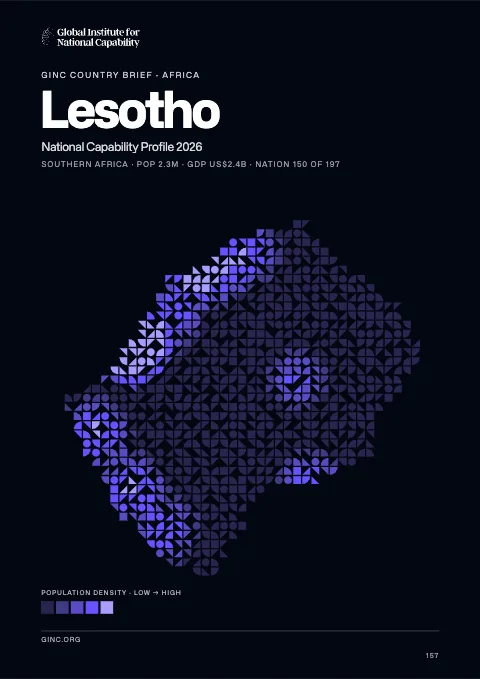
Lesotho is a landlocked parliamentary constitutional monarchy in Africa, home to 1.9 million people, with its capital at Maseru.
Contents
12 chapters
Foundations
01–03
At a glance
- Area
- 30.4Kkm²#141 World#44 Africa
- Population
- 1.9M#148 World#43 Africa
- GDP (market)
- $2.5B
- GDP (PPP)
- $4.3B#175 World#45 Africa
- GDP per capita
- $2.2K#190 World#25 Africa
The whole brief
Lesotho National Capability Profile 2026
Foundations · Chapter 01
Historical Context
🇱🇸 Lesotho’s understanding the origins and evolution of the modern nation
BackgroundBack to top ↑
Basutoland was renamed the Kingdom of Lesotho upon independence from the UK in 1966. The Basuto National Party ruled the country during its first two decades. King MOSHOESHOE was exiled in 1990, but returned to Lesotho in 1992 and was reinstated in 1995 and subsequently succeeded by his son, King LETSIE III, in 1996. Constitutional government was restored in 1993 after seven years of military rule. In 1998, violent protests and a military mutiny following a contentious election prompted a brief but bloody intervention by South African and Batswana military forces under the aegis of the Southern African Development Community. Subsequent constitutional reforms restored relative political stability. Peaceful parliamentary elections were held in 2002, but the National Assembly elections of February 2007 were hotly contested and aggrieved parties disputed how the electoral law was applied to award proportional seats in the Assembly. In May 2012, competitive elections involving 18 parties saw Prime Minister Motsoahae Thomas THABANE form a coalition government - the first in the country's history - that ousted the 14-year incumbent, Pakalitha MOSISILI, who peacefully transferred power the following month.
IndependenceBack to top ↑
4 October 1966 (from the UK)
National holidayBack to top ↑
Independence Day, 4 October (1966)
Foundations · Chapter 02
Geography
🇱🇸 Lesotho’s territory, resources and strategic position
Location and areaBack to top ↑
Southern Africa, an enclave of South Africa
29 30 S, 28 30 E
Africa
slightly smaller than Maryland
0 km (landlocked)
none (landlocked)
Terrain and resourcesBack to top ↑
mostly highland with plateaus, hills, and mountains
water, agricultural and grazing land, diamonds, sand, clay, building stone
26.37 sq km (2003)
Settlement and hazardsBack to top ↑
periodic droughts
landlocked, completely surrounded by South Africa; mountainous, more than 80% of the country is 1,800 m above sea level
OtherBack to top ↑
3.02 cu km (2011)
population pressure forcing settlement in marginal areas results in overgrazing, severe soil erosion, and soil exhaustion; desertification; Highlands Water Project controls, stores, and redirects water to South Africa
Foundations · Chapter 03
Environment
🇱🇸 Lesotho’s environmental conditions, resources and national resilience
ClimateBack to top ↑
temperate; cool to cold, dry winters; hot, wet summers
Emissions and pollutionBack to top ↑
Water, waste and foodBack to top ↑
Resources and agreementsBack to top ↑
GINC Capability Domains · Chapter 04
Critical Technology
🇱🇸 Lesotho’s technology frontiers and the pursuit of national advantage
Two counts are set side by side for 2015–2024: on the left, the papers researchers in Lesotho published; on the right, the patent families that began there and were filed in more than one country. First by capability group, then group by group with each group’s capabilities. The badge on a card is the nation’s place among all nations. Papers are from GINC Research Analytics, patent families from GINC Patents.
Research by capability group
#169 WorldPapers published, 2015–2024
Patents by capability group
International patent families, 2015–2024
No international patent families on record for 2015–2024.
Advanced Materials & ManufacturingBack to top ↑
Research
#143 WorldPapers published, 2015–2024
Patents
International patent families, 2015–2024
No international patent families on record for 2015–2024.
Energy TechnologiesBack to top ↑
Research
#161 WorldPapers published, 2015–2024
Patents
International patent families, 2015–2024
No international patent families on record for 2015–2024.
Semiconductors & Advanced ComputingBack to top ↑
Research
#128 WorldPapers published, 2015–2024
No research topic: Semiconductor Design & EDA · Advanced Semiconductor Fabrication · Semiconductor Equipment & Materials · Advanced Packaging & Heterogeneous Integration
Patents
International patent families, 2015–2024
No international patent families on record for 2015–2024.
Artificial IntelligenceBack to top ↑
Research
#153 WorldPapers published, 2015–2024
Patents
International patent families, 2015–2024
No international patent families on record for 2015–2024.
Quantum TechnologiesBack to top ↑
Research
#111 WorldPapers published, 2015–2024
Patents
International patent families, 2015–2024
No international patent families on record for 2015–2024.
Connectivity, Cyber & Trust TechnologiesBack to top ↑
Research
#168 WorldPapers published, 2015–2024
Patents
International patent families, 2015–2024
No international patent families on record for 2015–2024.
Sensing, Timing & NavigationBack to top ↑
- Precision Timing & Atomic Clocks
- Resilient Positioning & Navigation
- Advanced Imaging & Photonic Sensing
- Radar & Radiofrequency Sensing
- Acoustic & Undersea Sensing
Robotics & Autonomous SystemsBack to top ↑
- Advanced Robotics
- Autonomous Systems & Trusted Autonomy
- Uncrewed & Collaborative Systems
- Human-Machine Interfaces
Biotechnology & Health TechnologiesBack to top ↑
Research
#181 WorldPapers published, 2015–2024
Patents
International patent families, 2015–2024
No international patent families on record for 2015–2024.
Medicine and BioTech
Clinical research and life-science invention, drawn from the same series that drive the metric pages. Each card opens the full cross-country comparison.
Space TechnologiesBack to top ↑
- Space Launch & Reusable Systems
- Advanced Propulsion & Hypersonic Systems
- Satellite & Constellation Technologies
GINC Capability Domains · Chapter 05
Strategic Infrastructure
🇱🇸 Lesotho’s energy, connectivity and the material foundations of capability
Resource InfrastructureBack to top ↑
0 bbl/day (2012 est.)
0 bbl/day (2010 est.)
0 bbl/day (2010 est.)
0 bbl (1 January 2013 est.)
0 bbl/day (2010 est.)
1,777 bbl/day (2011 est.)
0 bbl/day (2010 est.)
3,711 bbl/day (2010 est.)
0 cu m (2011 est.)
0 cu m (2010 est.)
0 cu m (2011 est.)
0 cu m (2011 est.)
0 cu m (1 January 2013 est.)
Agriculture & Food InfrastructureBack to top ↑
- Irrigation & Agricultural Water
- Livestock & Veterinary
- Fisheries & Aquaculture
- Storage, Cold Chain & Markets
Energy InfrastructureBack to top ↑
- Thermal Generation
- Nuclear Generation
- Nuclear Fuel Cycle & Radioactive Waste
- Hydropower
- Renewable Generation
- Transmission & Distribution
- System Control & Dispatch
- Storage & Fuel Supply
76,000 kW (2010 est.)
200 million kWh (2010 est.)
307 million kWh (2010 est.)
0 kWh (2012 est.)
247 million kWh (2011 est.)
0% of total installed capacity (2010 est.)
0% of total installed capacity (2010 est.)
100% of total installed capacity (2010 est.)
0% of total installed capacity (2010 est.)
445,600 Mt (2011 est.)
Water, Sanitation & Waste InfrastructureBack to top ↑
- Dams, Reservoirs & Flood Defence
- Water Supply & Treatment
- Bulk Water Transfer & Desalination
- Wastewater & Sanitation
- Solid Waste & Recycling
Advanced ManufacturingBack to top ↑
- Materials & Inputs
- Chemicals & Hazardous Process Industry
- Production Systems
- Supply Chain & Ecosystem
- Workforce & Innovation
Transport InfrastructureBack to top ↑
- Seaports & Terminals
- Air Infrastructure
- Air Navigation & Traffic Management
- Inland Waterways & Ferries
- Rail Infrastructure
- Roads & Bridges
- Logistics, Multimodal & Border Infrastructure
- Postal & Parcel
24 (2013)
Communications & Digital InfrastructureBack to top ↑
- Subsea Cables & International Gateways
- Core & Backbone Networks
- Mobile & Wireless Networks
- Spectrum & Broadcasting
- Data Centres, Compute & Cloud
- Data Resources
- AI Tools & Applications
43,100 (2012)
1.312 million (2012)
76,800 (2009)
11,030 (2012)
.ls
Financial InfrastructureBack to top ↑
- Currency & Reserves
- Payments & Settlement Systems
- Markets, Exchanges & Depositories
- Banks, Insurers & Systemic Institutions
Social InfrastructureBack to top ↑
- Health Infrastructure
- Public Health & Laboratories
- Medical Supply & Stockpiles
- Education & Skills Infrastructure
- Research & Scientific Facilities
- Housing, Community & Social Services
- Government & Public Administration
- Cultural, Community & Recreational Infrastructure
- Justice & Corrections
- Emergency Services & Civil Protection
- Hydrometeorology & Early Warning
Space, Aerospace & Defence InfrastructureBack to top ↑
GINC Capability Domains · Chapter 06
National Security
🇱🇸 Lesotho’s force, intelligence and the defence of the nation
Disputes and terrorismBack to top ↑
South Africa has placed military units to assist police operations along the border of Lesotho, Zimbabwe, and Mozambique to control smuggling, poaching, and illegal migration
Force Generation & MobilisationBack to top ↑
Lesotho Defense Force (LDF): Army (includes Air Wing) (2012)
18-24 years of age for voluntary military service; no conscription; women serve as commissioned officers (2012)
1.94% of GDP (2012)//2.3% of GDP (2011)//1.94% of GDP (2010)
Lesotho's declared policy is maintenance of its independent sovereignty and preservation of internal security; in practice, external security is guaranteed by South Africa; restructuring of the Lesotho Defense Force (LDF) and Ministry of Defense and Public Service over the past five years has focused on subordinating the defense apparatus to civilian control and restoring the LDF's cohesion; the restructuring has considerably improved capabilities and professionalism, but the LDF is disproportionately large for a small, poor country; the government has outlined a reduction to a planned 1,500-man strength, but these plans have met with vociferous resistance from the political opposition and from inside the LDF (2008)
Forces under arms
Active-duty strength on the Correlates of War series, which reaches back to 1816 and so carries a nation’s whole record of mobilisation rather than its present establishment. The card opens the full cross-country comparison.
Intelligence & AssessmentBack to top ↑
- Imagery & Geospatial Intelligence
- Signals & Cyber Intelligence
- Technical & Measurement Intelligence
- Open-Source & Financial Intelligence
- Human Intelligence & Counterintelligence
- All-Source Analysis & Warning
Joint Command, Projection & SustainmentBack to top ↑
- Command, Control & Communications
- Strategic Lift & Mobility
- Expeditionary & Peace Operations
- Operational Sustainment & War Reserves
- Defence Industrial Mobilisation
- CBRN Defence
Land PowerBack to top ↑
- Combined Arms Manoeuvre
- Land Fires
- Battlefield Aviation & Uncrewed Systems
- Special Operations & Irregular Warfare
Maritime PowerBack to top ↑
- Maritime Security & Constabulary
- Sea Denial & Undersea Warfare
- Sea Control
- Amphibious & Expeditionary Operations
Air PowerBack to top ↑
- Air Sovereignty & Policing
- Control of the Air
- Air Strike & Interdiction
- Airborne ISR, Early Warning & Battle Management
Strategic Strike & Missile DefenceBack to top ↑
Space OperationsBack to top ↑
Cyber & Electromagnetic OperationsBack to top ↑
Nuclear DeterrenceBack to top ↑
GINC Capability Domains · Chapter 07
Human Capital
🇱🇸 Lesotho’s population, health and the skills that sustain capability
DemographyBack to top ↑
1,942,008
0.34% (2014 est.)
25.92 births/1,000 population (2014 est.)
14.91 deaths/1,000 population (2014 est.)
2.78 children born/woman (2014 est.)
21.2
47% (2009/10)
Migration and urbanisationBack to top ↑
-7.62 migrant(s)/1,000 population (2014 est.)
MASERU (capital) 239,000 (2011)
Welfare and equityBack to top ↑
49% (1999)
63.2 (1995)//56 (1986-87)
Early Childhood DevelopmentBack to top ↑
13.5% (2010)
Foundational EducationBack to top ↑
13% of GDP (2008)
Advanced EducationBack to top ↑
Technical & Vocational SkillsBack to top ↑
Digital & AI CompetenceBack to top ↑
Generative AI adoption
Modelled share of working-age adults using generative AI, from Microsoft telemetry scaled to each country’s 15–64 population. A measure of how fast a workforce is absorbing the technology rather than of how much of it a nation builds. The card opens the full cross-country comparison.
Lifelong Learning & ReskillingBack to top ↑
Research Talent & Knowledge CreationBack to top ↑
Population HealthBack to top ↑
620 deaths/100,000 live births (2010)
14.6% (2008)
23.1% (2012 est.)
358,700 (2012 est.)
15,500 (2012 est.)
Health System CapabilityBack to top ↑
12.8% of GDP (2011)
0.05 physicians/1,000 population (2003)
1.3 beds/1,000 population (2006)
GINC Capability Domains · Chapter 08
Governance and Integrity
🇱🇸 Lesotho’s institutions, law and the integrity of the state
State structureBack to top ↑
parliamentary constitutional monarchy
10 districts; Berea, Butha-Buthe, Leribe, Mafeteng, Maseru, Mohale's Hoek, Mokhotlong, Qacha's Nek, Quthing, Thaba-Tseka
previous 1959, 1967; latest adopted 2 April 1993 (effectively restoring the 1967 version); amended 2001 (2013)
18 years of age; universal
Political Institutions & Civic ParticipationBack to top ↑
- Electoral Management & Integrity
- Legislature & Deliberative Institutions
- Citizen Participation & Civic Space
bicameral Parliament consists of the Senate (33 members - 22 principal chiefs and 11 other members appointed by the ruling party) and the Assembly (120 seats, 80 by popular vote and 40 by proportional vote; members elected by popular vote to serve five-year terms)
Pakalitha Mosisili All Basotho Convention or ABC [Motsoahae Thomas THABANE]//Basotho Batho Democratic Party or BBDP [Geremane RAMATHEBANE]//Basotho Congress Party or BCP [Thulo MAHLAKENG]//Basotho Democratic National Party or BDNP [Thabang NYEOE]//Basotho National Party or BNP [Thesele MASERIBANE]//Democratic Congress or DC [Pakalitha MOSISILI]//Lesotho Congress for Democracy or LCD [Mothetjoa METSING]//Lesotho Peoples Congress or LPC [Kelebone MAOPE]//Lesotho Workers Party or LWP [Macaefa BILLY]//Marematlou Freedom Party or MFP [Vincent MALEBO]//National Independent Party or NIP [Kimetso MATHABA]//
Media Institute of Southern Africa, Lesotho chapter [Tsebo MATŠASA] (pushes for media freedom)
Justice System & Fundamental RightsBack to top ↑
- Judicial Independence & Court Capability
- Access to Justice & Legal Services
- Fundamental Rights Protection
- Human Rights Institutions & Equality Bodies
mixed legal system of English common law and Roman-Dutch law; judicial review of legislative acts in High Court and Court of Appeal
accepts compulsory ICJ jurisdiction with reservations; accepts ICCt jurisdiction
Internal Security & OrderBack to top ↑
Regulatory Governance & Strategic ControlsBack to top ↑
- Regulatory Quality & Better Regulation
- Regulatory Delivery & Independent Regulators
- Strategic Controls & Economic Security Administration
Government Effectiveness & Public AdministrationBack to top ↑
- Centre of Government & Policy Coordination
- Civil Service & Public Workforce
- Digital Government & Service Delivery
- Legal Identity & Civil Registration
- Statistical & Data Capability
Public Integrity & Anti-CorruptionBack to top ↑
Transparency, Oversight & AccountabilityBack to top ↑
- Right to Information & Open Government
- Independent Oversight & Supreme Audit
- Independent Media & Journalist Safety
National Resilience & Crisis ManagementBack to top ↑
GINC Capability Domains · Chapter 09
Information and Influence
🇱🇸 Lesotho’s identity, media and the projection of influence
Identity and cultureBack to top ↑
Sesotho (official) (southern Sotho), English (official), Zulu, Xhosa
Christian 80%, indigenous beliefs 20%
Sotho 99.7%, Europeans, Asians, and other 0.3%,
Basotho hat
three horizontal stripes of blue (top), white, and green in the proportions of 3:4:3; the colors represent rain, peace, and prosperity respectively; centered in the white stripe is a black Basotho hat representing the indigenous people; the flag was unfurled in October 2006 to celebrate 40 years of independence
Diplomatic Statecraft & Global NetworksBack to top ↑
- Diplomatic Network & Consular Reach
- Multilateral Leadership & Norm Setting
- Agenda-Setting & Convening
- Mediation & Crisis Diplomacy
ACP, AfDB, AU, C, CD, FAO, G-77, IAEA, IBRD, ICAO, ICRM, IDA, IFAD, IFC, IFRCS, ILO, IMF, Interpol, IOC, IOM, IPU, ISO (correspondent), ITU, MIGA, NAM, OPCW, SACU, SADC, UN, UNAMID, UNCTAD, UNESCO, UNHCR, UNIDO, UNWTO, UPU, WCO, WFTU (NGOs), WHO, WIPO, WMO, WTO
Alliances & Security CooperationBack to top ↑
Development Cooperation & Global AssistanceBack to top ↑
Culture, Language & Education DiplomacyBack to top ↑
- Cultural & Language Institutes
- Creative Industries & Cultural Export Reach
- Heritage & Cultural Institutions
- Education Diplomacy & Alumni Networks
- Sports & Major Events
Diaspora & Global CommunitiesBack to top ↑
Information Environment & Strategic CommunicationBack to top ↑
- Strategic Communications & Public Diplomacy
- International Media & Broadcasting
- Information Defence & Counter-Interference
1 state-owned TV station and 2 state-owned radio stations; government controls most private broadcast media; satellite TV subscription service available; transmissions of multiple international broadcasters obtainable (2008)
GINC Capability Domains · Chapter 10
Financial Strength
🇱🇸 Lesotho’s fiscal depth, reserves and the capacity to act
Monetary & Currency CapabilityBack to top ↑
- Monetary Policy & Price Stability
- Exchange Rate & External Account Management
- Currency Issuance & Digital Money
5% (2013 est.)//6.1% (2012 est.)
maloti (LSL) per US dollar -//9.575 (2013 est.)//8.2 (2012 est.)//7.32 (2010 est.)//8.47 (2009)//7.75 (2008)
9.36% (31 December 2012 est.)//10% (31 December 2010 est.)
10% (31 December 2013 est.)//10.12% (31 December 2012 est.)
$425.1 million (31 December 2013 est.)//$408.9 million (31 December 2012 est.)
$903.4 million (31 December 2013 est.)//$840.9 million (31 December 2012 est.)
Fiscal Capacity & Public FinanceBack to top ↑
- Revenue Mobilisation & Tax Administration
- Public Expenditure & Budget Management
- Sovereign Debt & Treasury Management
- Public Investment Management
59.5% of GDP (2013 est.)
-0.9% of GDP (2013 est.)
NA
1 April - 31 March
Financial System Depth & AccessBack to top ↑
- Banking System Capacity
- Capital Markets Depth & Development
- Long-Term & Institutional Capital
- Financial Inclusion & Household Access
- Development & Policy Finance
$85,420 (31 December 2013 est.)//$75,280 (31 December 2012 est.)
11.4% of GDP (2013 est.)//7.8% of GDP (2012 est.)//7.8% of GDP (2011 est.)
Financial Regulation & IntegrityBack to top ↑
- Prudential Regulation & Supervision
- Financial Integrity & Illicit Finance Control
- Market Conduct & Consumer Protection
- Payment & Market Infrastructure Oversight
Financial Stability & Crisis ManagementBack to top ↑
- Macroprudential & Systemic Oversight
- Crisis Management, Resolution & Deposit Insurance
- External Liquidity & Financial Safety Nets
Sovereign Capital & External Financial PowerBack to top ↑
- Official Reserves Management
- Sovereign Wealth & Public Asset Management
- Currency Internationalisation & Reserve Status
- Capital Account & Flow Management
- International Financial Centre Capability
$857.9 million (31 December 2013 est.)//$749.4 million (31 December 2012 est.)
$794 million (31 December 2013 est.)//$779.8 million (31 December 2012 est.)
GINC Capability Domains · Chapter 11
Production and Innovation
🇱🇸 Lesotho’s output, industry and the engine of prosperity
Economic Output & ProductivityBack to top ↑
Small, mountainous, and completely landlocked by South Africa, Lesotho is a least developed country in which about three-fourths of the people live in rural areas and engage in subsistence agriculture. Lesotho produces less than 20% of the nation's demand for food. Rain-fed agriculture is vulnerable to weather and climate variability; an estimated 725,500 people will require food assistance in 2012/13. The distribution of income in Lesotho remains inequitable. Lesotho relies on South Africa for much of its economic activity. Lesotho imports 90% of the goods it consumes from South Africa, including most agricultural inputs. Households depend heavily on remittances from family members working in South Africa, in mines, on farms and as domestic workers, though mining employment has declined substantially since the 1990s. Government revenue depends heavily on transfers from South Africa. Customs duties from the Southern Africa Customs Union accounted for 44% of government revenue in 2012. The South African Government also pays royalties for water transferred to South Africa from a dam and reservoir system in Lesotho. However, the government continues to strengthen its tax system to reduce dependency on customs duties and other transfers. Access to credit remains a problem for the private sector. The government maintains a large presence in the economy - government consumption accounted for 39% of GDP in 2013 and the government remains Lesotho's largest employer. Lesotho's largest private employer is the textile and garment industry - approximately 36,000 Basotho, mainly women, work in factories producing garments for export to South Africa and the US. Diamond mining in Lesotho has grown in recent years and may contribute 8.5% to GDP by 2015, according to current forecasts. Lesotho's $362.5 million Millennium Challenge Account Compact, which focused on strengthening the healthcare system, developing the private sector, and providing access to improved water supplies and sanitation facilities, will end in September 2013. Despite the 2008/09 global economic crisis, the economy has had strong, but declining growth since 2010.
$4.265 billion (2013 est.)//$4.096 billion (2012 est.)//$3.918 billion (2011 est.)
4.1% (2013 est.)//4.5% (2012 est.)//5.7% (2011 est.)
$2,200 (2013 est.)//$2,200 (2012 est.)//$2,100 (2011 est.)
$2.457 billion (2013 est.)
Labour & EmploymentBack to top ↑
- Employment & Labour Force Participation
- Labour Market Institutions & Wage Setting
- Employment Services & Skills Matching
- Labour Adjustment, Transition & Formalisation
874,200 (2013 est.)
25% (2008 est.)//45% (2002 est.)
Industrial & Sectoral BaseBack to top ↑
- Manufacturing & Advanced Industry
- Foundational & Process Industries
- Agrifood & Primary Production
- Services Economy
corn, wheat, pulses, sorghum, barley; livestock
food, beverages, textiles, apparel assembly, handicrafts, construction, tourism
4.3% (2013 est.)
Structural Transformation & ComplexityBack to top ↑
Business Dynamism & EntrepreneurshipBack to top ↑
- Entrepreneurship & Firm Creation
- Risk Capital & Scale-Up Finance
- Firm Growth, Exit & Renewal
- Competition & Market Contestability
Innovation & CommercialisationBack to top ↑
- Business Innovation Capability
- Research Commercialisation & Knowledge Transfer
- Intellectual Property & Intangible Assets
- Innovation Ecosystems & Clusters
Technology Adoption & DiffusionBack to top ↑
GINC Capability Domains · Chapter 12
Trade and Investment
🇱🇸 Lesotho’s markets, capital and the terms of global exchange
Overall tradeBack to top ↑
$1.07B of exports to 111 partners and $1.88B of imports from 99 in 2024, a deficit of $811M.
- Exports
- $1.07B111 partners
- Imports
- $1.88B99 partners
- Balance
- −$811Mdeficit
- Total trade
- $2.94B2024
ExportsBack to top ↑
Where its exports go
The largest partners in 2024, with each one's share of the nation's exports.
| Partner | Value | Share | |
|---|---|---|---|
| South Africa | $394M | 37% | |
| Belgium | $275M | 26% | |
| United States | $256M | 24% | |
| India | $45.9M | 4.3% | |
| China | $29.3M | 2.8% | |
| Canada | $9.50M | 0.9% | |
| Germany | $8.66M | 0.8% | |
| France | $7.32M | 0.7% | |
| Eswatini | $6.53M | 0.6% | |
| Mexico | $5.58M | 0.5% | |
| United Kingdom | $4.42M | 0.4% | |
| Egypt | $4.38M | 0.4% | |
| Botswana | $2.78M | 0.3% | |
| Czech Republic | $1.99M | 0.2% | |
| Namibia | $1.94M | 0.2% | |
| Vietnam | $1.32M | 0.1% | |
| Australia | $1.15M | 0.1% | |
| United Arab Emirates | $1.13M | 0.1% | |
| Taiwan | $946K | <0.1% | |
| Netherlands | $775K | <0.1% |
What it exports
The largest categories in 2024.
| Category | Value | Share | |
|---|---|---|---|
| Pearls, precious stones, metals, coins | $415M | 39% | |
| Articles of apparel, knit or crocheted | $190M | 18% | |
| Articles of apparel, not knit or crocheted | $144M | 13% | |
| Wool, animal hair, horsehair yarn and fabric | $69.3M | 6.5% | |
| Electrical, electronic equipment | $47.3M | 4.4% | |
| Other made textile articles, sets, worn clothing | $36.8M | 3.5% | |
| Cotton | $30.8M | 2.9% | |
| Machinery, nuclear reactors, boilers | $24.0M | 2.2% | |
| Milling products, malt, starches, inulin, wheat gluten | $23.9M | 2.2% | |
| Beverages, spirits and vinegar | $17.8M | 1.7% | |
| Vehicles other than railway, tramway | $13.2M | 1.2% | |
| Fish, crustaceans, molluscs, aquatics invertebrates | $8.53M | 0.8% | |
| Footwear, gaiters and the like | $8.28M | 0.8% | |
| Oil seed, oleaginous fruits, grain, seed, fruits | $4.05M | 0.4% | |
| Edible fruits, nuts, peel of citrus fruit, melons | $3.32M | 0.3% |
ImportsBack to top ↑
Where its imports come from
The largest partners in 2024, with each one's share of the nation's imports.
| Partner | Value | Share | |
|---|---|---|---|
| South Africa | $1.46B | 78% | |
| China | $200M | 11% | |
| Taiwan | $61.4M | 3.3% | |
| India | $27.9M | 1.5% | |
| Japan | $19.8M | 1.1% | |
| Mozambique | $10.8M | 0.6% | |
| Zambia | $9.88M | 0.5% | |
| Hong Kong | $8.98M | 0.5% | |
| Botswana | $8.92M | 0.5% | |
| United States | $8.59M | 0.5% | |
| Germany | $7.11M | 0.4% | |
| Zimbabwe | $6.63M | 0.4% | |
| Netherlands | $5.62M | 0.3% | |
| Vietnam | $3.70M | 0.2% | |
| United Kingdom | $3.46M | 0.2% | |
| Eswatini | $3.41M | 0.2% | |
| Belgium | $2.91M | 0.2% | |
| Uganda | $2.82M | 0.2% | |
| Pakistan | $2.31M | 0.1% | |
| Italy | $1.81M | <0.1% |
What it imports
The largest categories in 2024.
| Category | Value | Share | |
|---|---|---|---|
| Mineral fuels, oils, distillation products | $276M | 15% | |
| Machinery, nuclear reactors, boilers | $163M | 8.7% | |
| Electrical, electronic equipment | $112M | 6.0% | |
| Vehicles other than railway, tramway | $111M | 5.9% | |
| Knitted or crocheted fabric | $97.8M | 5.2% | |
| Articles of iron or steel | $67.4M | 3.6% | |
| Cereals | $61.4M | 3.3% | |
| Milling products, malt, starches, inulin, wheat gluten | $59.6M | 3.2% | |
| Plastics | $54.2M | 2.9% | |
| Beverages, spirits and vinegar | $51.9M | 2.8% | |
| Meat and edible meat offal | $47.7M | 2.5% | |
| Cotton | $46.4M | 2.5% | |
| Pharmaceutical products | $33.4M | 1.8% | |
| Paper and paperboard, articles of pulp, paper and board | $32.5M | 1.7% | |
| Iron and steel | $29.4M | 1.6% |
In a list, the bar runs to the largest in that list. The line is each figure’s history from 2000, drawn to its own peak: it shows the shape of the years, and the value shows the size.
External balanceBack to top ↑
-$518.4 million (2013 est.)//-$587.4 million (2012 est.)
Trade Facilitation & LogisticsBack to top ↑
Trade Policy & Market AccessBack to top ↑
- Trade Policy & Negotiation Capability
- Market Access & Agreements Network
- Trade Law & Enforcement
- Standards, Conformity & Quality Infrastructure
Digital & Services TradeBack to top ↑
- Services Trade Capability
- Digital Trade & E-Commerce
- Data Flows & Digital Trade Governance
- Tourism & Visitor Economy
Investment Attraction & ProjectionBack to top ↑
- Investment Attraction & Facilitation
- Investment Absorption & Linkages
- Outward Investment & Global Corporate Presence
$635.7 million (31 December 2013 est.)//$398 million (31 December 2012 est.)
Export Capability & SophisticationBack to top ↑
$941.2 million (2013 est.)//$972.4 million (2012 est.)
manufactures (clothing, footwear), wool and mohair, food and live animals, electricity, water, diamonds
Global Value Chain PositionBack to top ↑
- Value Chain Participation & Integration
- Value Chain Position & Upgrading
- Regional Integration & Hub Anchoring
Economic Leverage & DependenceBack to top ↑
- Strategic Supply Security
- Concentration Risk & Revenue Stabilisation
- Economic Leverage & Coercion Resistance
$2.148 billion (2013 est.)//$2.239 billion (2012 est.)
food; building materials, vehicles, machinery, medicines, petroleum products
Lesotho · you are in
Historical Context
Foundations
GINC Capability Domains
Find in this brief · Lesotho