
Maldives
Maldives is a republic in South Asia, home to 394,000 people, with its capital at Male.
Contents
12 chapters
Foundations
01–03
At a glance
- Area
- 298km²#206 World#7 South Asia
- Population
- 393.6K#176 World#7 South Asia
- GDP (market)
- $2.3B
- GDP (PPP)
- $3.1B#183 World#7 South Asia
- GDP per capita
- $9.1K#126 World#1 South Asia
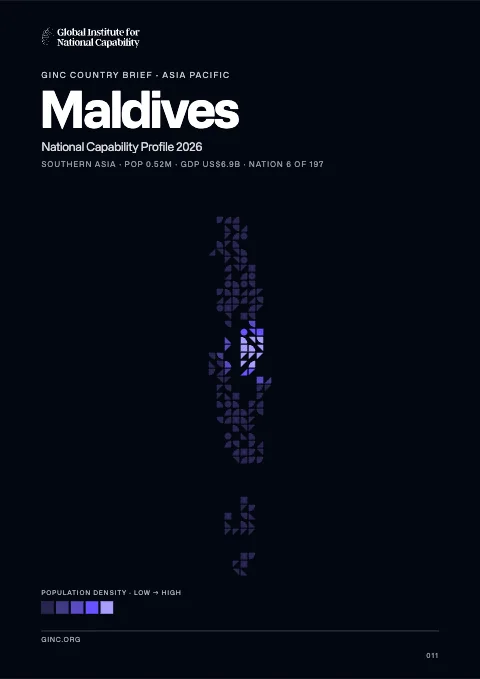
The whole brief
Maldives National Capability Profile 2026
Foundations · Chapter 01
Historical Context
🇲🇻 the Maldives’ understanding the origins and evolution of the modern nation
BackgroundBack to top ↑
A sultanate since the 12th century, the Maldives became a British protectorate in 1887. It became a republic in 1968, three years after independence. President Maumoon Abdul GAYOOM dominated the islands' political scene for 30 years, elected to six successive terms by single-party referendums. Following political demonstrations in the capital Male in August 2003, the president and his government pledged to embark upon a process of liberalization and democratic reforms, including a more representative political system and expanded political freedoms. Progress was sluggish, however, and many promised reforms were slow to be realized. Nonetheless, political parties were legalized in 2005. In June 2008, a constituent assembly - termed the "Special Majlis" - finalized a new constitution, which was ratified by the president in August. The first-ever presidential elections under a multi-candidate, multi-party system were held in October 2008. GAYOOM was defeated in a runoff poll by Mohamed NASHEED, a political activist who had been jailed several years earlier by the former regime. President NASHEED faced a number of challenges including strengthening democracy and combating poverty and drug abuse. In early February 2012, after several weeks of street protests following his sacking of a top judge, NASHEED resigned the presidency and handed over power to Vice President Mohammed WAHEED Hassan Maniku. In mid-2012, a Commission of National Inquiry was set by the government to probe events leading up to NASHEED's resignation. Though the commission found no evidence of a coup, the report recommended the need to strengthen the country's democratic institutions to avert similar events in the future, and to further investigate alleged police misconduct during the crisis. Maldivian officials have played a prominent role in international climate change discussions (due to the islands' low elevation and the threat from sea-level rise) on the UN Human Rights Council and in other international forums, as well as in encouraging regional cooperation, especially between India and Pakistan.
IndependenceBack to top ↑
26 July 1965 (from the UK)
National holidayBack to top ↑
Independence Day, 26 July (1965)
Foundations · Chapter 02
Geography
🇲🇻 the Maldives’ territory, resources and strategic position
Location and areaBack to top ↑
Southern Asia, group of atolls in the Indian Ocean, south-southwest of India
3 15 N, 73 00 E
Asia
about 1.7 times the size of Washington, DC
0 km
644 km
measured from claimed archipelagic straight baselines
Terrain and resourcesBack to top ↑
flat, with white sandy beaches
fish
0 sq km NA (2003)
Settlement and hazardsBack to top ↑
tsunamis; low elevation of islands makes them sensitive to sea level rise
smallest Asian country; archipelago of 1,190 coral islands grouped into 26 atolls (200 inhabited islands, plus 80 islands with tourist resorts); strategic location astride and along major sea lanes in Indian Ocean
OtherBack to top ↑
0.03 cu km (2011)
depletion of freshwater aquifers threatens water supplies; global warming and sea level rise; coral reef bleaching
Foundations · Chapter 03
Environment
🇲🇻 the Maldives’ environmental conditions, resources and national resilience
ClimateBack to top ↑
tropical; hot, humid; dry, northeast monsoon (November to March); rainy, southwest monsoon (June to August)
Emissions and pollutionBack to top ↑
Water, waste and foodBack to top ↑
Resources and agreementsBack to top ↑
GINC Capability Domains · Chapter 04
Critical Technology
🇲🇻 the Maldives’ technology frontiers and the pursuit of national advantage
Two counts are set side by side for 2015–2024: on the left, the papers researchers in the Maldives published; on the right, the patent families that began there and were filed in more than one country. First by capability group, then group by group with each group’s capabilities. The badge on a card is the nation’s place among all nations. Papers are from GINC Research Analytics, patent families from GINC Patents.
Research by capability group
#152 WorldPapers published, 2015–2024
Patents by capability group
International patent families, 2015–2024
No international patent families on record for 2015–2024.
Advanced Materials & ManufacturingBack to top ↑
Research
#115 WorldPapers published, 2015–2024
Patents
International patent families, 2015–2024
No international patent families on record for 2015–2024.
Energy TechnologiesBack to top ↑
Research
#112 WorldPapers published, 2015–2024
Patents
International patent families, 2015–2024
No international patent families on record for 2015–2024.
Semiconductors & Advanced ComputingBack to top ↑
Research
#128 WorldPapers published, 2015–2024
No research topic: Semiconductor Design & EDA · Advanced Semiconductor Fabrication · Semiconductor Equipment & Materials · Advanced Packaging & Heterogeneous Integration
Patents
International patent families, 2015–2024
No international patent families on record for 2015–2024.
Artificial IntelligenceBack to top ↑
Research
#155 WorldPapers published, 2015–2024
Patents
International patent families, 2015–2024
No international patent families on record for 2015–2024.
Quantum TechnologiesBack to top ↑
Connectivity, Cyber & Trust TechnologiesBack to top ↑
Research
#149 WorldPapers published, 2015–2024
Patents
International patent families, 2015–2024
No international patent families on record for 2015–2024.
Sensing, Timing & NavigationBack to top ↑
Research
#159 WorldPapers published, 2015–2024
Patents
International patent families, 2015–2024
No international patent families on record for 2015–2024.
Robotics & Autonomous SystemsBack to top ↑
Research
#160 WorldPapers published, 2015–2024
No research topic: Human-Machine Interfaces
Patents
International patent families, 2015–2024
No international patent families on record for 2015–2024.
Biotechnology & Health TechnologiesBack to top ↑
Research
#158 WorldPapers published, 2015–2024
Patents
International patent families, 2015–2024
No international patent families on record for 2015–2024.
Space TechnologiesBack to top ↑
- Space Launch & Reusable Systems
- Advanced Propulsion & Hypersonic Systems
- Satellite & Constellation Technologies
GINC Capability Domains · Chapter 05
Strategic Infrastructure
🇲🇻 the Maldives’ energy, connectivity and the material foundations of capability
Resource InfrastructureBack to top ↑
0 bbl/day (2012 est.)
0 bbl/day (2012 est.)
0 bbl/day (2012 est.)
0 bbl (1 January 2013 est.)
0 bbl/day (2012 est.)
6,875 bbl/day (2011 est.)
0 bbl/day (2009 est.)
6,088 bbl/day (2012 est.)
0 cu m (2012 est.)
0 cu m (2012 est.)
0 cu m (2012 est.)
0 cu m (2012 est.)
0 cu m (1 January 2013 est.)
Agriculture & Food InfrastructureBack to top ↑
- Irrigation & Agricultural Water
- Livestock & Veterinary
- Fisheries & Aquaculture
- Storage, Cold Chain & Markets
Energy InfrastructureBack to top ↑
- Thermal Generation
- Nuclear Generation
- Nuclear Fuel Cycle & Radioactive Waste
- Hydropower
- Renewable Generation
- Transmission & Distribution
- System Control & Dispatch
- Storage & Fuel Supply
62,080 kW (2010 est.)
301.1 million kWh (2010 est.)
280 million kWh (2010 est.)
0 kWh (2012 est.)
0 kWh (2012 est.)
99.9% of total installed capacity (2010 est.)
0% of total installed capacity (2010 est.)
0% of total installed capacity (2010 est.)
0.1% of total installed capacity (2010 est.)
1.071 million Mt (2011 est.)
Water, Sanitation & Waste InfrastructureBack to top ↑
- Dams, Reservoirs & Flood Defence
- Water Supply & Treatment
- Bulk Water Transfer & Desalination
- Wastewater & Sanitation
- Solid Waste & Recycling
Advanced ManufacturingBack to top ↑
- Materials & Inputs
- Chemicals & Hazardous Process Industry
- Production Systems
- Supply Chain & Ecosystem
- Workforce & Innovation
Transport InfrastructureBack to top ↑
- Seaports & Terminals
- Air Infrastructure
- Air Navigation & Traffic Management
- Inland Waterways & Ferries
- Rail Infrastructure
- Roads & Bridges
- Logistics, Multimodal & Border Infrastructure
- Postal & Parcel
9 (2013)
Communications & Digital InfrastructureBack to top ↑
- Subsea Cables & International Gateways
- Core & Backbone Networks
- Mobile & Wireless Networks
- Spectrum & Broadcasting
- Data Centres, Compute & Cloud
- Data Resources
- AI Tools & Applications
23,140 (2012)
560,000 (2012)
86,400 (2009)
3,296 (2012)
.mv
Financial InfrastructureBack to top ↑
- Currency & Reserves
- Payments & Settlement Systems
- Markets, Exchanges & Depositories
- Banks, Insurers & Systemic Institutions
Social InfrastructureBack to top ↑
- Health Infrastructure
- Public Health & Laboratories
- Medical Supply & Stockpiles
- Education & Skills Infrastructure
- Research & Scientific Facilities
- Housing, Community & Social Services
- Government & Public Administration
- Cultural, Community & Recreational Infrastructure
- Justice & Corrections
- Emergency Services & Civil Protection
- Hydrometeorology & Early Warning
Space, Aerospace & Defence InfrastructureBack to top ↑
GINC Capability Domains · Chapter 06
National Security
🇲🇻 the Maldives’ force, intelligence and the defence of the nation
Disputes and terrorismBack to top ↑
none
Force Generation & MobilisationBack to top ↑
Maldives National Defense Force (MNDF): Marine Corps, Security Protection Group, Coast Guard (2010)
18-28 years of age for voluntary service; no conscription; 10th grade or equivalent education required; must not be a member of a political party (2012)
the Maldives National Defense Force (MNDF), with its small size and with little serviceable equipment, is inadequate to prevent external aggression and is primarily tasked to reinforce the Maldives Police Service (MPS) and ensure security in the exclusive economic zone (2008)
Forces under arms
Active-duty strength on the Correlates of War series, which reaches back to 1816 and so carries a nation’s whole record of mobilisation rather than its present establishment. The card opens the full cross-country comparison.
Intelligence & AssessmentBack to top ↑
- Imagery & Geospatial Intelligence
- Signals & Cyber Intelligence
- Technical & Measurement Intelligence
- Open-Source & Financial Intelligence
- Human Intelligence & Counterintelligence
- All-Source Analysis & Warning
Joint Command, Projection & SustainmentBack to top ↑
- Command, Control & Communications
- Strategic Lift & Mobility
- Expeditionary & Peace Operations
- Operational Sustainment & War Reserves
- Defence Industrial Mobilisation
- CBRN Defence
Land PowerBack to top ↑
- Combined Arms Manoeuvre
- Land Fires
- Battlefield Aviation & Uncrewed Systems
- Special Operations & Irregular Warfare
Maritime PowerBack to top ↑
- Maritime Security & Constabulary
- Sea Denial & Undersea Warfare
- Sea Control
- Amphibious & Expeditionary Operations
Air PowerBack to top ↑
- Air Sovereignty & Policing
- Control of the Air
- Air Strike & Interdiction
- Airborne ISR, Early Warning & Battle Management
Strategic Strike & Missile DefenceBack to top ↑
Space OperationsBack to top ↑
Cyber & Electromagnetic OperationsBack to top ↑
Nuclear DeterrenceBack to top ↑
GINC Capability Domains · Chapter 07
Human Capital
🇲🇻 the Maldives’ population, health and the skills that sustain capability
DemographyBack to top ↑
393,595 (July 2014 est.)
-0.09% (2014 est.)
15.59 births/1,000 population (2014 est.)
3.84 deaths/1,000 population (2014 est.)
1.76 children born/woman (2014 est.)
23.9
34.7% (2009)
Migration and urbanisationBack to top ↑
-12.67 migrant(s)/1,000 population (2014 est.)
MALE (capital) 132,000 (2011)
Welfare and equityBack to top ↑
16% (2008)
37.4 (2004)
Early Childhood DevelopmentBack to top ↑
17.8% (2009)
Foundational EducationBack to top ↑
6.8% of GDP (2011)
Advanced EducationBack to top ↑
Technical & Vocational SkillsBack to top ↑
Digital & AI CompetenceBack to top ↑
Lifelong Learning & ReskillingBack to top ↑
Research Talent & Knowledge CreationBack to top ↑
Population HealthBack to top ↑
60 deaths/100,000 live births (2010)
12.9% (2008)
0.1% (2012 est.)
NA
fewer than 100 (2009 est.)
Health System CapabilityBack to top ↑
8.5% of GDP (2011)
1.6 physicians/1,000 population (2007)
4.3 beds/1,000 population (2009)
GINC Capability Domains · Chapter 08
Governance and Integrity
🇲🇻 the Maldives’ institutions, law and the integrity of the state
State structureBack to top ↑
republic
7 provinces and 1 municipality*; Dhekunu (South), Maale*, Mathi Dhekunu (Upper South), Mathi Uthuru (Upper North), Medhu (Central), Medhu Dhekunu (South Central), Medhu Uthuru (North Central), Uthuru (North)
many previous; latest ratified 7 August 2008 (2010)
18 years of age; universal
Political Institutions & Civic ParticipationBack to top ↑
- Electoral Management & Integrity
- Legislature & Deliberative Institutions
- Citizen Participation & Civic Space
unicameral Parliament or People's Majlis (85 seats; members elected by direct vote to serve 5-year terms); note - the Elections Commission in December 2013 increased the number of seats to 85 from 77
Justice System & Fundamental RightsBack to top ↑
- Judicial Independence & Court Capability
- Access to Justice & Legal Services
- Fundamental Rights Protection
- Human Rights Institutions & Equality Bodies
Islamic religious legal system with English common law influences, primarily in commercial matters
has not submitted an ICJ jurisdiction declaration; non-party state to the ICCt
Internal Security & OrderBack to top ↑
Regulatory Governance & Strategic ControlsBack to top ↑
- Regulatory Quality & Better Regulation
- Regulatory Delivery & Independent Regulators
- Strategic Controls & Economic Security Administration
Government Effectiveness & Public AdministrationBack to top ↑
- Centre of Government & Policy Coordination
- Civil Service & Public Workforce
- Digital Government & Service Delivery
- Legal Identity & Civil Registration
- Statistical & Data Capability
Public Integrity & Anti-CorruptionBack to top ↑
Transparency, Oversight & AccountabilityBack to top ↑
- Right to Information & Open Government
- Independent Oversight & Supreme Audit
- Independent Media & Journalist Safety
National Resilience & Crisis ManagementBack to top ↑
GINC Capability Domains · Chapter 09
Information and Influence
🇲🇻 the Maldives’ identity, media and the projection of influence
Identity and cultureBack to top ↑
Dhivehi (official, dialect of Sinhala, script derived from Arabic), English (spoken by most government officials)
Sunni Muslim (official)
South Indians, Sinhalese, Arabs
coconut palm, yellowfin tuna
red with a large green rectangle in the center bearing a vertical white crescent moon; the closed side of the crescent is on the hoist side of the flag; red recalls those who have sacrificed their lives in defense of their country, the green rectangle represents peace and prosperity, and the white crescent signifies Islam
Diplomatic Statecraft & Global NetworksBack to top ↑
- Diplomatic Network & Consular Reach
- Multilateral Leadership & Norm Setting
- Agenda-Setting & Convening
- Mediation & Crisis Diplomacy
ADB, AOSIS, C, CP, FAO, G-77, IBRD, ICAO, ICC (NGOs), IDA, IDB, IFAD, IFC, IFRCS, ILO, IMF, IMO, Interpol, IOC, IOM, IPU, ITU, MIGA, NAM, OIC, OPCW, SAARC, SACEP, UN, UNCTAD, UNESCO, UNIDO, UNWTO, UPU, WCO, WHO, WIPO, WMO, WTO
the US does not have an embassy in Maldives; the US Ambassador to Sri Lanka, currently Ambassador Michele J. SISON, is accredited to Maldives and makes periodic visits
Alliances & Security CooperationBack to top ↑
Development Cooperation & Global AssistanceBack to top ↑
Culture, Language & Education DiplomacyBack to top ↑
- Cultural & Language Institutes
- Creative Industries & Cultural Export Reach
- Heritage & Cultural Institutions
- Education Diplomacy & Alumni Networks
- Sports & Major Events
Diaspora & Global CommunitiesBack to top ↑
Information Environment & Strategic CommunicationBack to top ↑
- Strategic Communications & Public Diplomacy
- International Media & Broadcasting
- Information Defence & Counter-Interference
state-owned radio and TV monopoly until recently; state-owned TV operates 2 channels; 3 privately owned TV stations; state owns Voice of Maldives and operates both an entertainment and a music-based station; 5 privately owned radio stations (2012)
GINC Capability Domains · Chapter 10
Financial Strength
🇲🇻 the Maldives’ fiscal depth, reserves and the capacity to act
Monetary & Currency CapabilityBack to top ↑
- Monetary Policy & Price Stability
- Exchange Rate & External Account Management
- Currency Issuance & Digital Money
5.1% (2012 est.)//16.7% (2011 est.)
rufiyaa (MVR) per US dollar -//15.365 (2011)//14.602 (2011)//12.8 (2008)//12.8 (2007)
7% (31 December 2012 est.)//6.96% (31 December 2011 est.)
10.5% (31 December 2012 est.)//10.2% (31 December 2011 est.)
$547.1 million (31 December 2012 est.)//$531.4 million (31 December 2011 est.)
$1.298 billion (31 December 2012 est.)//$1.237 billion (31 December 2011 est.)
Fiscal Capacity & Public FinanceBack to top ↑
- Revenue Mobilisation & Tax Administration
- Public Expenditure & Budget Management
- Sovereign Debt & Treasury Management
- Public Investment Management
28.1% of GDP (2012 est.)
-12.3% of GDP (2012 est.)
calendar year
Financial System Depth & AccessBack to top ↑
- Banking System Capacity
- Capital Markets Depth & Development
- Long-Term & Institutional Capital
- Financial Inclusion & Household Access
- Development & Policy Finance
$1.559 billion (31 December 2012 est.)//$1.601 billion (31 December 2011 est.)
$555 million (31 December 2011 est.)
Financial Regulation & IntegrityBack to top ↑
- Prudential Regulation & Supervision
- Financial Integrity & Illicit Finance Control
- Market Conduct & Consumer Protection
- Payment & Market Infrastructure Oversight
Financial Stability & Crisis ManagementBack to top ↑
- Macroprudential & Systemic Oversight
- Crisis Management, Resolution & Deposit Insurance
- External Liquidity & Financial Safety Nets
Sovereign Capital & External Financial PowerBack to top ↑
- Official Reserves Management
- Sovereign Wealth & Public Asset Management
- Currency Internationalisation & Reserve Status
- Capital Account & Flow Management
- International Financial Centre Capability
$356 million (30 November 2012 est.)//$326 million (30 November 2011 est.)
$890.8 million (2012 est.)//$684.2 million (2011 est.)
GINC Capability Domains · Chapter 11
Production and Innovation
🇲🇻 the Maldives’ output, industry and the engine of prosperity
Economic Output & ProductivityBack to top ↑
Tourism, Maldives' largest economic activity, accounts for nearly 30% of GDP and more than 60% of foreign exchange receipts. Fishing is the second leading sector, but the fish catch has dropped sharply in recent years. Agriculture and manufacturing continue to play a lesser role in the economy, constrained by the limited availability of cultivable land and the shortage of domestic labor. Lower than expected tourist arrivals and fish exports, combined with high government spending on social needs, subsidies, and civil servant salaries contributed to a balance of payments crisis, which was temporarily eased with a $79.3 million IMF Stand-By agreement. However, after the first two disbursements, the IMF withheld subsequent disbursements due to concerns over Maldives' growing budget deficit, and the government has been seeking other sources of budgetary support ever since. A new Goods and Services Tax (GST) on tourism introduced in January 2011, on general goods and services in October 2011, and a new Business Profit Tax introduced in July 2011 have provided a boost to revenue. In recent years, gross foreign reserves have hovered around $300 million, sufficient to finance about two to three months of imports. Diversifying the economy beyond tourism and fishing, reforming public finance, increasing employment opportunities, and combating corruption, cronyism, and a growing drug problem are other near-term challenges facing the government. Over the longer term Maldivian authorities worry about the impact of erosion and possible global warming on their low-lying country; 80% of the area is 1 meter or less above sea level.
$3.073 billion (2013 est.)//$2.97 billion (2012 est.)//$2.945 billion (2011 est.)
3.5% (2013 est.)//0.9% (2012 est.)//6.5% (2011 est.)
$9,100 (2013 est.)//$9,000 (2012 est.)//$9,000 (2011 est.)
$2.27 billion (2013 est.)
Labour & EmploymentBack to top ↑
- Employment & Labour Force Participation
- Labour Market Institutions & Wage Setting
- Employment Services & Skills Matching
- Labour Adjustment, Transition & Formalisation
159,700 (2012)
28% (2012 est.)//14.5% (2010 est.)
Industrial & Sectoral BaseBack to top ↑
- Manufacturing & Advanced Industry
- Foundational & Process Industries
- Agrifood & Primary Production
- Services Economy
coconuts, corn, sweet potatoes; fish
tourism, fish processing, shipping, boat building, coconut processing, woven mats, rope, handicrafts, coral and sand mining
14% (2012 est.)
Structural Transformation & ComplexityBack to top ↑
Business Dynamism & EntrepreneurshipBack to top ↑
- Entrepreneurship & Firm Creation
- Risk Capital & Scale-Up Finance
- Firm Growth, Exit & Renewal
- Competition & Market Contestability
Innovation & CommercialisationBack to top ↑
- Business Innovation Capability
- Research Commercialisation & Knowledge Transfer
- Intellectual Property & Intangible Assets
- Innovation Ecosystems & Clusters
Technology Adoption & DiffusionBack to top ↑
GINC Capability Domains · Chapter 12
Trade and Investment
🇲🇻 the Maldives’ markets, capital and the terms of global exchange
Overall tradeBack to top ↑
$270M of exports to 86 partners and $4.25B of imports from 191 in 2024, a deficit of $3.98B.
- Exports
- $270M86 partners
- Imports
- $4.25B191 partners
- Balance
- −$3.98Bdeficit
- Total trade
- $4.52B2024
ExportsBack to top ↑
Where its exports go
The largest partners in 2024, with each one's share of the nation's exports.
| Partner | Value | Share | |
|---|---|---|---|
| India | $92.0M | 34% | |
| Thailand | $48.2M | 18% | |
| United Kingdom | $21.5M | 8.0% | |
| Singapore | $16.3M | 6.0% | |
| Germany | $15.8M | 5.9% | |
| Mauritius | $15.4M | 5.7% | |
| France | $9.29M | 3.4% | |
| Switzerland | $6.41M | 2.4% | |
| United States | $4.90M | 1.8% | |
| Hong Kong | $4.31M | 1.6% | |
| Sri Lanka | $4.10M | 1.5% | |
| Japan | $4.00M | 1.5% | |
| Vietnam | $3.34M | 1.2% | |
| Bangladesh | $3.08M | 1.1% | |
| Netherlands | $3.00M | 1.1% | |
| Austria | $2.71M | 1.0% | |
| Taiwan | $2.43M | 0.9% | |
| Italy | $1.96M | 0.7% | |
| Spain | $1.83M | 0.7% | |
| Saudi Arabia | $1.64M | 0.6% |
What it exports
The largest categories in 2024.
| Category | Value | Share | |
|---|---|---|---|
| Fish, crustaceans, molluscs, aquatics invertebrates | $94.1M | 35% | |
| Aircraft, spacecraft | $79.1M | 29% | |
| Meat, fish and seafood preparations | $41.5M | 15% | |
| Mineral fuels, oils, distillation products | $30.1M | 11% | |
| Iron and steel | $7.53M | 2.8% | |
| Residues, wastes of food industry, animal fodder | $3.97M | 1.5% | |
| Machinery, nuclear reactors, boilers | $3.21M | 1.2% | |
| Copper | $3.18M | 1.2% | |
| Aluminum | $1.01M | 0.4% | |
| Optical, photo, technical, medical apparatus | $976K | 0.4% | |
| Ships, boats, and other floating structures | $953K | 0.4% | |
| Electrical, electronic equipment | $862K | 0.3% | |
| Miscellaneous chemical products | $728K | 0.3% | |
| Paper and paperboard, articles of pulp, paper and board | $523K | 0.2% | |
| Vehicles other than railway, tramway | $460K | 0.2% |
ImportsBack to top ↑
Where its imports come from
The largest partners in 2024, with each one's share of the nation's imports.
| Partner | Value | Share | |
|---|---|---|---|
| India | $936M | 22% | |
| China | $716M | 17% | |
| United Arab Emirates | $545M | 13% | |
| Oman | $280M | 6.6% | |
| Malaysia | $208M | 4.9% | |
| Sri Lanka | $162M | 3.8% | |
| Singapore | $149M | 3.5% | |
| United States | $144M | 3.4% | |
| Thailand | $112M | 2.6% | |
| France | $99.6M | 2.3% | |
| Japan | $72.9M | 1.7% | |
| Italy | $67.8M | 1.6% | |
| Indonesia | $65.5M | 1.5% | |
| Australia | $60.5M | 1.4% | |
| Turkey | $54.6M | 1.3% | |
| Germany | $53.8M | 1.3% | |
| United Kingdom | $43.6M | 1.0% | |
| Brazil | $37.7M | 0.9% | |
| Ireland | $37.1M | 0.9% | |
| Netherlands | $33.7M | 0.8% |
What it imports
The largest categories in 2024.
| Category | Value | Share | |
|---|---|---|---|
| Mineral fuels, oils, distillation products | $766M | 18% | |
| Machinery, nuclear reactors, boilers | $398M | 9.4% | |
| Ships, boats, and other floating structures | $381M | 9.0% | |
| Electrical, electronic equipment | $331M | 7.8% | |
| Aircraft, spacecraft | $239M | 5.6% | |
| Salt, sulphur, earth, stone, plaster, lime and cement | $133M | 3.1% | |
| Plastics | $110M | 2.6% | |
| Furniture, lighting signs, prefabricated buildings | $109M | 2.6% | |
| Dairy products, eggs, honey, edible products | $106M | 2.5% | |
| Iron and steel | $102M | 2.4% | |
| Articles of iron or steel | $98.4M | 2.3% | |
| Meat and edible meat offal | $95.7M | 2.2% | |
| Wood and articles of wood, wood charcoal | $91.8M | 2.2% | |
| Edible fruits, nuts, peel of citrus fruit, melons | $82.3M | 1.9% | |
| Edible vegetables and certain roots and tubers | $79.6M | 1.9% |
In a list, the bar runs to the largest in that list. The line is each figure’s history from 2000, drawn to its own peak: it shows the shape of the years, and the value shows the size.
External balanceBack to top ↑
-$600 million (2012 est.)//$437 million (2011 est.)
Trade Facilitation & LogisticsBack to top ↑
Trade Policy & Market AccessBack to top ↑
- Trade Policy & Negotiation Capability
- Market Access & Agreements Network
- Trade Law & Enforcement
- Standards, Conformity & Quality Infrastructure
Digital & Services TradeBack to top ↑
- Services Trade Capability
- Digital Trade & E-Commerce
- Data Flows & Digital Trade Governance
- Tourism & Visitor Economy
Investment Attraction & ProjectionBack to top ↑
- Investment Attraction & Facilitation
- Investment Absorption & Linkages
- Outward Investment & Global Corporate Presence
Export Capability & SophisticationBack to top ↑
$283 million (2012 est.)//$316 million (2011 est.)
France 18.9%, Thailand 15.8%, UK 11.4%, US 9.4%, Sri Lanka 8.6%, Italy 8.1%, Germany 6.4% (2012)
fish
Global Value Chain PositionBack to top ↑
- Value Chain Participation & Integration
- Value Chain Position & Upgrading
- Regional Integration & Hub Anchoring
Economic Leverage & DependenceBack to top ↑
- Strategic Supply Security
- Concentration Risk & Revenue Stabilisation
- Economic Leverage & Coercion Resistance
$1.406 billion (2012 est.)//$1.314 billion (2011 est.)
Singapore 21.7%, UAE 20.9%, India 9.6%, Malaysia 7.6%, China 6%, Thailand 5.6%, Sri Lanka 4% (2012)
petroleum products, clothing, intermediate and capital goods
Maldives · you are in
Historical Context
Foundations
GINC Capability Domains
Find in this brief · Maldives