
Cuba
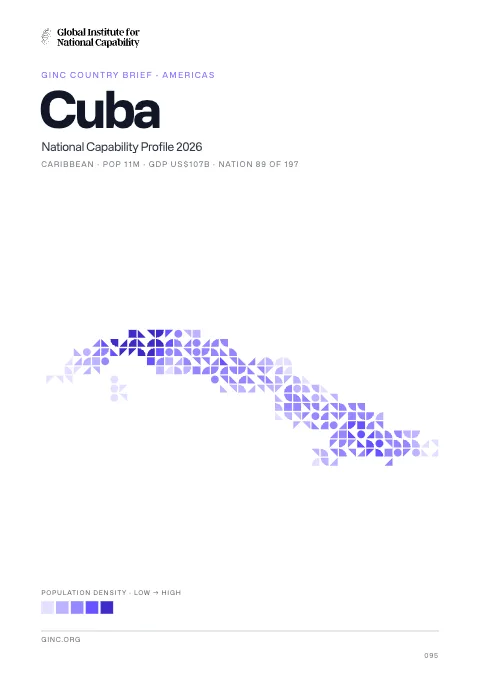
Cuba is a Communist state in Central America and the Caribbean, home to 11 million people, with its capital at Havana.
Contents
12 chapters
Foundations
01–03
At a glance
- Area
- 110.9Kkm²#106 World#3 C. America
- Population
- 11M#77 World#2 C. America
- GDP (market)
- $72.3B
- GDP (PPP)
- $121B#67 World#1 C. America
- GDP per capita
- $10.2K#119 World#22 C. America
The whole brief
Cuba National Capability Profile 2026
Foundations · Chapter 01
Historical Context
🇨🇺 Cuba’s understanding the origins and evolution of the modern nation
BackgroundBack to top ↑
The native Amerindian population of Cuba began to decline after the European discovery of the island by Christopher COLUMBUS in 1492 and following its development as a Spanish colony during the next several centuries. Large numbers of African slaves were imported to work the coffee and sugar plantations, and Havana became the launching point for the annual treasure fleets bound for Spain from Mexico and Peru. Spanish rule eventually provoked an independence movement and occasional rebellions that were harshly suppressed. US intervention during the Spanish-American War in 1898 assisted the Cubans in overthrowing Spanish rule. Subsequently, the 1901 Platt Amendment to the Cuban constitution authorized the US to intevene in Cuba in the event of instability. The Treaty of Paris established Cuban independence from the US in 1902 after which the island experienced a string of governments mostly dominated by the military and corrupt politicians. Fidel CASTRO led a rebel army to victory in 1959; his iron rule held the subsequent regime together for nearly five decades. He stepped down as president in February 2008 in favor of his younger brother Raul CASTRO. Cuba's communist revolution, with Soviet support, was exported throughout Latin America and Africa during the 1960s, 1970s, and 1980s. The country faced a severe economic downturn in 1990 following the withdrawal of former Soviet subsidies worth $4-6 billion annually. Cuba at times portrays the US embargo, in place since 1961, as the source if its difficulties. Illicit migration to the US - using homemade rafts, alien smugglers, air flights, or via the US's southwest border - is a continuing problem. The US Coast Guard interdicted 1,357 Cuban nationals attempting to cross the Straits of Florida in 2013. Also in 2013, 14,251 Cuban migrants presented themselves at various land border ports of entry through out the US.
IndependenceBack to top ↑
20 May 1902 (from Spain 10 December 1898; administered by the US from 1898 to 1902); not acknowledged by the Cuban Government as a day of independence
National holidayBack to top ↑
Triumph of the Revolution, 1 January (1959)
Foundations · Chapter 02
Geography
🇨🇺 Cuba’s territory, resources and strategic position
Location and areaBack to top ↑
Caribbean, island between the Caribbean Sea and the North Atlantic Ocean, 150 km south of Key West, Florida
21 30 N, 80 00 W
Central America and the Caribbean
slightly smaller than Pennsylvania
3,735 km
Terrain and resourcesBack to top ↑
mostly flat to rolling plains, with rugged hills and mountains in the southeast
cobalt, nickel, iron ore, chromium, copper, salt, timber, silica, petroleum, arable land
8,703 sq km (2003)
Settlement and hazardsBack to top ↑
the east coast is subject to hurricanes from August to November (in general, the country averages about one hurricane every other year); droughts are common
largest country in Caribbean and westernmost island of the Greater Antilles
OtherBack to top ↑
38.12 cu km (2011)
air and water pollution; biodiversity loss; deforestation
Foundations · Chapter 03
Environment
🇨🇺 Cuba’s environmental conditions, resources and national resilience
ClimateBack to top ↑
tropical; moderated by trade winds; dry season (November to April); rainy season (May to October)
Emissions and pollutionBack to top ↑
Water, waste and foodBack to top ↑
Resources and agreementsBack to top ↑
GINC Capability Domains · Chapter 04
Critical Technology
🇨🇺 Cuba’s technology frontiers and the pursuit of national advantage
Two counts are set side by side for 2015–2024: on the left, the papers researchers in Cuba published; on the right, the patent families that began there and were filed in more than one country. First by capability group, then group by group with each group’s capabilities. The badge on a card is the nation’s place among all nations. Papers are from GINC Research Analytics, patent families from GINC Patents.
Research by capability group
#86 WorldPapers published, 2015–2024
354
204
188
60
29
25
14
7
4
0
Patents by capability group
#72 WorldInternational patent families, 2015–2024
Advanced Materials & ManufacturingBack to top ↑
Research
#77 WorldPapers published, 2015–2024
Patents
#85 WorldInternational patent families, 2015–2024
Energy TechnologiesBack to top ↑
Research
#89 WorldPapers published, 2015–2024
Patents
#84 WorldInternational patent families, 2015–2024
Semiconductors & Advanced ComputingBack to top ↑
Research
#106 WorldPapers published, 2015–2024
No research topic: Semiconductor Design & EDA · Advanced Semiconductor Fabrication · Semiconductor Equipment & Materials · Advanced Packaging & Heterogeneous Integration
Patents
International patent families, 2015–2024
No international patent families on record for 2015–2024.
Artificial IntelligenceBack to top ↑
Research
#90 WorldPapers published, 2015–2024
Patents
International patent families, 2015–2024
No international patent families on record for 2015–2024.
Quantum TechnologiesBack to top ↑
Research
#111 WorldPapers published, 2015–2024
Patents
International patent families, 2015–2024
No international patent families on record for 2015–2024.
Connectivity, Cyber & Trust TechnologiesBack to top ↑
Research
#121 WorldPapers published, 2015–2024
Patents
International patent families, 2015–2024
No international patent families on record for 2015–2024.
Sensing, Timing & NavigationBack to top ↑
Research
#87 WorldPapers published, 2015–2024
Patents
International patent families, 2015–2024
No international patent families on record for 2015–2024.
Robotics & Autonomous SystemsBack to top ↑
Research
#107 WorldPapers published, 2015–2024
No research topic: Human-Machine Interfaces
Patents
International patent families, 2015–2024
No international patent families on record for 2015–2024.
Biotechnology & Health TechnologiesBack to top ↑
Research
#60 WorldPapers published, 2015–2024
Patents
#45 WorldInternational patent families, 2015–2024
Medicine and BioTech
Clinical research and life-science invention, drawn from the same series that drive the metric pages. Each card opens the full cross-country comparison.
Space TechnologiesBack to top ↑
- Space Launch & Reusable Systems
- Advanced Propulsion & Hypersonic Systems
- Satellite & Constellation Technologies
GINC Capability Domains · Chapter 05
Strategic Infrastructure
🇨🇺 Cuba’s energy, connectivity and the material foundations of capability
Resource InfrastructureBack to top ↑
50,800 bbl/day (2012 est.)
83,000 bbl/day (2012 est.)
165,000 bbl/day (2012 est.)
124 million bbl (1 January 2013 est.)
100,600 bbl/day (2010 est.)
150,200 bbl/day (2011 est.)
11,320 bbl/day (2010 est.)
4,877 bbl/day (2010 est.)
1.03 billion cu m (2012 est.)
1.03 billion cu m (2012 est.)
0 cu m (2012 est.)
0 cu m (2012 est.)
70.79 billion cu m (1 January 2013 est.)
gas 41 km; oil 230 km (2013)
Agriculture & Food InfrastructureBack to top ↑
- Irrigation & Agricultural Water
- Livestock & Veterinary
- Fisheries & Aquaculture
- Storage, Cold Chain & Markets
Energy InfrastructureBack to top ↑
- Thermal Generation
- Nuclear Generation
- Nuclear Fuel Cycle & Radioactive Waste
- Hydropower
- Renewable Generation
- Transmission & Distribution
- System Control & Dispatch
- Storage & Fuel Supply
5.914 million kW (2011 est.)
17.8 billion kWh (2011 est.)
13.64 billion kWh (2010 est.)
0 kWh (2012 est.)
0 kWh (2012 est.)
99.3% of total installed capacity (2011 est.)
0% of total installed capacity (2011 est.)
0.6% of total installed capacity (2011 est.)
0.1% of total installed capacity (2011 est.)
28.41 million Mt (2011 est.)
Water, Sanitation & Waste InfrastructureBack to top ↑
- Dams, Reservoirs & Flood Defence
- Water Supply & Treatment
- Bulk Water Transfer & Desalination
- Wastewater & Sanitation
- Solid Waste & Recycling
Advanced ManufacturingBack to top ↑
- Materials & Inputs
- Chemicals & Hazardous Process Industry
- Production Systems
- Supply Chain & Ecosystem
- Workforce & Innovation
Transport InfrastructureBack to top ↑
- Seaports & Terminals
- Air Infrastructure
- Air Navigation & Traffic Management
- Inland Waterways & Ferries
- Rail Infrastructure
- Roads & Bridges
- Logistics, Multimodal & Border Infrastructure
- Postal & Parcel
133 (2013)
240 km (almost all navigable inland waterways are near the mouths of rivers) (2011)
Communications & Digital InfrastructureBack to top ↑
- Subsea Cables & International Gateways
- Core & Backbone Networks
- Mobile & Wireless Networks
- Spectrum & Broadcasting
- Data Centres, Compute & Cloud
- Data Resources
- AI Tools & Applications
1.217 million (2012)
1.682 million (2012)
1.606 million
3,244 (2012)
.cu
Financial InfrastructureBack to top ↑
- Currency & Reserves
- Payments & Settlement Systems
- Markets, Exchanges & Depositories
- Banks, Insurers & Systemic Institutions
Social InfrastructureBack to top ↑
- Health Infrastructure
- Public Health & Laboratories
- Medical Supply & Stockpiles
- Education & Skills Infrastructure
- Research & Scientific Facilities
- Housing, Community & Social Services
- Government & Public Administration
- Cultural, Community & Recreational Infrastructure
- Justice & Corrections
- Emergency Services & Civil Protection
- Hydrometeorology & Early Warning
Space, Aerospace & Defence InfrastructureBack to top ↑
GINC Capability Domains · Chapter 06
National Security
🇨🇺 Cuba’s force, intelligence and the defence of the nation
Disputes and terrorismBack to top ↑
US Naval Base at Guantanamo Bay is leased to US and only mutual agreement or US abandonment of the facility can terminate the lease
Force Generation & MobilisationBack to top ↑
Revolutionary Armed Forces (Fuerzas Armadas Revolucionarias, FAR): Revolutionary Army (Ejercito Revolucionario, ER, includes Territorial Militia Troops (Milicia de Tropas de Territoriales, MTT)); Revolutionary Navy (Marina de Guerra Revolucionaria, MGR, includes Marine Corps); Revolutionary Air and Air Defense Forces (Defensas Anti-Aereas y Fuerza Aerea Revolucionaria, DAAFAR), Youth Labor Army (Ejercito Juvenil del Trabajo, EJT) (2013)
17-28 years of age for compulsory military service; 2-year service obligation; both sexes subject to military service (2012)
the collapse of the Soviet Union deprived the Cuban military of its major economic and logistic support and had a significant impact on the state of Cuban equipment; the army remains well trained and professional in nature; the lack of replacement parts for its existing equipment has increasingly affected operational capabilities (2013)
Forces under arms
Active-duty strength on the Correlates of War series, which reaches back to 1816 and so carries a nation’s whole record of mobilisation rather than its present establishment. The card opens the full cross-country comparison.
Intelligence & AssessmentBack to top ↑
- Imagery & Geospatial Intelligence
- Signals & Cyber Intelligence
- Technical & Measurement Intelligence
- Open-Source & Financial Intelligence
- Human Intelligence & Counterintelligence
- All-Source Analysis & Warning
Joint Command, Projection & SustainmentBack to top ↑
- Command, Control & Communications
- Strategic Lift & Mobility
- Expeditionary & Peace Operations
- Operational Sustainment & War Reserves
- Defence Industrial Mobilisation
- CBRN Defence
Land PowerBack to top ↑
- Combined Arms Manoeuvre
- Land Fires
- Battlefield Aviation & Uncrewed Systems
- Special Operations & Irregular Warfare
Maritime PowerBack to top ↑
- Maritime Security & Constabulary
- Sea Denial & Undersea Warfare
- Sea Control
- Amphibious & Expeditionary Operations
Air PowerBack to top ↑
- Air Sovereignty & Policing
- Control of the Air
- Air Strike & Interdiction
- Airborne ISR, Early Warning & Battle Management
Strategic Strike & Missile DefenceBack to top ↑
Space OperationsBack to top ↑
Cyber & Electromagnetic OperationsBack to top ↑
Nuclear DeterrenceBack to top ↑
GINC Capability Domains · Chapter 07
Human Capital
🇨🇺 Cuba’s population, health and the skills that sustain capability
DemographyBack to top ↑
11,047,251 (July 2014 est.)
-0.14% (2014 est.)
9.9 births/1,000 population (2014 est.)
7.64 deaths/1,000 population (2014 est.)
1.46 children born/woman (2014 est.)
74.3% (2011)
illicit emigration is a continuing problem; Cubans attempt to depart the island and enter the US using homemade rafts, alien smugglers, direct flights, or falsified visas; Cubans also use non-maritime routes to enter the US including direct flights to Miami and over-land via the southwest border
Migration and urbanisationBack to top ↑
-3.64 migrant(s)/1,000 population (2014 est.)
HAVANA (capital) 2.116 million (2011)
Welfare and equityBack to top ↑
NA%
Early Childhood DevelopmentBack to top ↑
3.4% (2000)
Foundational EducationBack to top ↑
12.8% of GDP (2010)
Advanced EducationBack to top ↑
Technical & Vocational SkillsBack to top ↑
Digital & AI CompetenceBack to top ↑
Generative AI adoption
Modelled share of working-age adults using generative AI, from Microsoft telemetry scaled to each country’s 15–64 population. A measure of how fast a workforce is absorbing the technology rather than of how much of it a nation builds. The card opens the full cross-country comparison.
Lifelong Learning & ReskillingBack to top ↑
Research Talent & Knowledge CreationBack to top ↑
Population HealthBack to top ↑
73 deaths/100,000 live births (2010)
21.5% (2008)
0.1% (2012 est.)
4,700 (2012 est.)
fewer than 100 (2009 est.)
Health System CapabilityBack to top ↑
10% of GDP (2011)
6.72 physicians/1,000 population (2010)
5.1 beds/1,000 population (2011)
GINC Capability Domains · Chapter 08
Governance and Integrity
🇨🇺 Cuba’s institutions, law and the integrity of the state
State structureBack to top ↑
Communist state
15 provinces (provincias, singular - provincia) and 1 special municipality* (municipio especial); Artemisa, Camaguey, Ciego de Avila, Cienfuegos, Granma, Guantanamo, Holguin, Isla de la Juventud*, La Habana, Las Tunas, Matanzas, Mayabeque, Pinar del Rio, Sancti Spiritus, Santiago de Cuba, Villa Clara
several previous; latest adopted by referendum 15 February 1976, effective 24 February 1976; amended 1978, 1992, 2002 (2010)
16 years of age; universal
Political Institutions & Civic ParticipationBack to top ↑
- Electoral Management & Integrity
- Legislature & Deliberative Institutions
- Citizen Participation & Civic Space
unicameral National Assembly of People's Power or Asamblea Nacional del Poder Popular (number of seats in the National Assembly is based on population and currently exceeds 600; members elected directly from slates approved by special candidacy commissions to serve five-year terms)
Cuban Communist Party or PCC [Raul CASTRO Ruz, first secretary]
Damas de Blanco//National Association of Small Farmers//Patriotic Union of Cuba//political dissidents and bloggers//The Cuban Commission for Human Rights and National Reconciliation
Justice System & Fundamental RightsBack to top ↑
- Judicial Independence & Court Capability
- Access to Justice & Legal Services
- Fundamental Rights Protection
- Human Rights Institutions & Equality Bodies
civil law system based on Spanish civil code
has not submitted an ICJ jurisdiction declaration; non-party state to the ICCt
Internal Security & OrderBack to top ↑
territorial waters and air space serve as transshipment zone for US- and European-bound drugs; established the death penalty for certain drug-related crimes in 1999 (2008)
Regulatory Governance & Strategic ControlsBack to top ↑
- Regulatory Quality & Better Regulation
- Regulatory Delivery & Independent Regulators
- Strategic Controls & Economic Security Administration
Government Effectiveness & Public AdministrationBack to top ↑
- Centre of Government & Policy Coordination
- Civil Service & Public Workforce
- Digital Government & Service Delivery
- Legal Identity & Civil Registration
- Statistical & Data Capability
Public Integrity & Anti-CorruptionBack to top ↑
Transparency, Oversight & AccountabilityBack to top ↑
- Right to Information & Open Government
- Independent Oversight & Supreme Audit
- Independent Media & Journalist Safety
National Resilience & Crisis ManagementBack to top ↑
GINC Capability Domains · Chapter 09
Information and Influence
🇨🇺 Cuba’s identity, media and the projection of influence
Identity and cultureBack to top ↑
Spanish (official)
nominally Roman Catholic 85%, Protestant, Jehovah's Witnesses, Jewish, Santeria
white 64.1%, mestizo 26.6%, black 9.3% (2012 est.)
five equal horizontal bands of blue (top, center, and bottom) alternating with white; a red equilateral triangle based on the hoist side bears a white, five-pointed star in the center; the blue bands refer to the three old divisions of the island: central, occidental, and oriental; the white bands describe the purity of the independence ideal; the triangle symbolizes liberty, equality, and fraternity, while the red color stands for the blood shed in the independence struggle; the white star, called La Estrella Solitaria (the Lone Star) lights the way to freedom and was taken from the flag of Texas
Diplomatic Statecraft & Global NetworksBack to top ↑
- Diplomatic Network & Consular Reach
- Multilateral Leadership & Norm Setting
- Agenda-Setting & Convening
- Mediation & Crisis Diplomacy
ACP, ALBA, AOSIS, CELAC, FAO, G-77, IAEA, ICAO, ICC (national committees), ICRM, IFAD, IFRCS, IHO, ILO, IMO, IMSO, Interpol, IOC, IOM (observer), IPU, ISO, ITSO, ITU, LAES, LAIA, NAM, OAS (excluded from formal participation since 1962), OPANAL, OPCW, PCA, Petrocaribe, UN, UNCTAD, UNESCO, UNIDO, Union Latina, UNWTO, UPU, WCO, WFTU (NGOs), WHO, WIPO, WMO, WTO
none; note - the Cuban Interests Section of the Embassy of Switzerland is headed by Jose R. CABANAS Rodriguez (since October 2012); address: Cuban Interests Section, Swiss Embassy, 2630 16th Street NW, Washington, DC 20009; telephone: [1] (202) 797-8518; FAX: [1] (202) 986-7283
none; note - the United States Interests Section of the Embassy of Switzerland is headed by John P. CAULFIELD (since September 2011); address: USINT, Swiss Embassy, Calzada between L and M Streets, Vedado, Havana; telephone: [53] (7) 839-4100; FAX: [53] (7) 839-4247; protecting power in Cuba is Switzerland
Alliances & Security CooperationBack to top ↑
Development Cooperation & Global AssistanceBack to top ↑
Culture, Language & Education DiplomacyBack to top ↑
- Cultural & Language Institutes
- Creative Industries & Cultural Export Reach
- Heritage & Cultural Institutions
- Education Diplomacy & Alumni Networks
- Sports & Major Events
Diaspora & Global CommunitiesBack to top ↑
Information Environment & Strategic CommunicationBack to top ↑
- Strategic Communications & Public Diplomacy
- International Media & Broadcasting
- Information Defence & Counter-Interference
government owns and controls all broadcast media with private ownership of electronic media prohibited; government operates 4 national TV networks and many local TV stations; government operates 6 national radio networks, an international station, and many local radio stations; Radio-TV Marti is beamed from the US (2007)
GINC Capability Domains · Chapter 10
Financial Strength
🇨🇺 Cuba’s fiscal depth, reserves and the capacity to act
Monetary & Currency CapabilityBack to top ↑
- Monetary Policy & Price Stability
- Exchange Rate & External Account Management
- Currency Issuance & Digital Money
6% (2013 est.)//5.5% (2012 est.)
Cuban pesos (CUP) per US dollar -//1 (2013 est.)//1 (2012 est.)//0.9259 (2010 est.)//0.9259 (2009)//0.9259 (2008)
NA%
NA%
$11.21 billion (31 December 2013 est.)//$10.97 billion (31 December 2012 est.)
$24.63 billion (31 December 2013 est.)//$24.08 billion (31 December 2012 est.)
Fiscal Capacity & Public FinanceBack to top ↑
- Revenue Mobilisation & Tax Administration
- Public Expenditure & Budget Management
- Sovereign Debt & Treasury Management
- Public Investment Management
65.9% of GDP (2013 est.)
-3.7% of GDP (2013 est.)
35.9% of GDP (2013 est.)//35.8% of GDP (2012 est.)
calendar year
Financial System Depth & AccessBack to top ↑
- Banking System Capacity
- Capital Markets Depth & Development
- Long-Term & Institutional Capital
- Financial Inclusion & Household Access
- Development & Policy Finance
$NA
13.4% of GDP (2013 est.)//11.1% of GDP (2012 est.)//11.7% of GDP (2011 est.)
Financial Regulation & IntegrityBack to top ↑
- Prudential Regulation & Supervision
- Financial Integrity & Illicit Finance Control
- Market Conduct & Consumer Protection
- Payment & Market Infrastructure Oversight
Financial Stability & Crisis ManagementBack to top ↑
- Macroprudential & Systemic Oversight
- Crisis Management, Resolution & Deposit Insurance
- External Liquidity & Financial Safety Nets
Sovereign Capital & External Financial PowerBack to top ↑
- Official Reserves Management
- Sovereign Wealth & Public Asset Management
- Currency Internationalisation & Reserve Status
- Capital Account & Flow Management
- International Financial Centre Capability
$4.993 billion (31 December 2013 est.)//$4.693 billion (31 December 2012 est.)
$23.44 billion (31 December 2013 est.)//$22.51 billion (31 December 2012 est.)
GINC Capability Domains · Chapter 11
Production and Innovation
🇨🇺 Cuba’s output, industry and the engine of prosperity
Economic Output & ProductivityBack to top ↑
The government continues to balance the need for loosening its socialist economic system against a desire for firm political control. The government in April 2011 held the first Cuban Communist Party Congress in almost 13 years, during which leaders approved a plan for wide-ranging economic changes. Since then, the Cuban government has slowly and incrementally implemented limited economic reforms, including allowing Cubans to buy electronic appliances and cell phones, stay in hotels, and buy and sell used cars. The Cuban government also opened up some retail services to "self-employment," leading to the rise of so-called "cuentapropistas" or entrepreneurs. Recent moves include permitting the private ownership and sale of real estate and new vehicles, allowing private farmers to sell agricultural goods directly to hotels, and expanding categories of self-employment. Despite these reforms, the average Cuban's standard of living remains at a lower level than before the collapse of the Soviet Union and the resulting downturn of the 1990s. Since late 2000, Venezuela has been providing oil on preferential terms, and it currently supplies over 100,000 barrels per day of petroleum products. Cuba has been paying for the oil, in part, with the services of Cuban personnel in Venezuela, including some 30,000 medical professionals.
$121 billion (2012 est.)//$117.3 billion (2011 est.)//$114.1 billion (2010 est.)
3.1% (2012 est.)//2.8% (2011 est.)//2.4% (2010 est.)
$10,200 (2010 est.)//$10,000 (2009 est.)//$10,000 (2008 est.)
$72.3 billion (2012 est.)
Labour & EmploymentBack to top ↑
- Employment & Labour Force Participation
- Labour Market Institutions & Wage Setting
- Employment Services & Skills Matching
- Labour Adjustment, Transition & Formalisation
5.233 million
4.3% (2013 est.)//3.8% (2012 est.)
Industrial & Sectoral BaseBack to top ↑
- Manufacturing & Advanced Industry
- Foundational & Process Industries
- Agrifood & Primary Production
- Services Economy
sugar, tobacco, citrus, coffee, rice, potatoes, beans; livestock
petroleum, nickel, cobalt, pharmaceuticals, tobacco, construction, steel, cement, agricultural machinery, sugar
2.6% (2013 est.)
Structural Transformation & ComplexityBack to top ↑
Business Dynamism & EntrepreneurshipBack to top ↑
- Entrepreneurship & Firm Creation
- Risk Capital & Scale-Up Finance
- Firm Growth, Exit & Renewal
- Competition & Market Contestability
Innovation & CommercialisationBack to top ↑
- Business Innovation Capability
- Research Commercialisation & Knowledge Transfer
- Intellectual Property & Intangible Assets
- Innovation Ecosystems & Clusters
Technology Adoption & DiffusionBack to top ↑
GINC Capability Domains · Chapter 12
Trade and Investment
🇨🇺 Cuba’s markets, capital and the terms of global exchange
Overall tradeBack to top ↑
$992M of exports to 118 partners and $3.74B of imports from 97 in 2024, a deficit of $2.74B.
- Exports
- $992M118 partners
- Imports
- $3.74B97 partners
- Balance
- −$2.74Bdeficit
- Total trade
- $4.73B2024
ExportsBack to top ↑
Where its exports go
The largest partners in 2024, with each one's share of the nation's exports.
| Partner | Value | Share | |
|---|---|---|---|
| China | $270M | 27% | |
| Spain | $109M | 11% | |
| Germany | $68.2M | 6.9% | |
| Macao | $57.1M | 5.8% | |
| Switzerland | $49.9M | 5.0% | |
| Hong Kong | $48.2M | 4.9% | |
| Cyprus | $45.6M | 4.6% | |
| Netherlands | $39.0M | 3.9% | |
| Belgium | $25.7M | 2.6% | |
| United Kingdom | $20.8M | 2.1% | |
| Canada | $20.7M | 2.1% | |
| Turkey | $16.1M | 1.6% | |
| Portugal | $15.9M | 1.6% | |
| Italy | $15.9M | 1.6% | |
| France | $14.4M | 1.4% | |
| Japan | $13.1M | 1.3% | |
| Taiwan | $12.1M | 1.2% | |
| Greece | $11.6M | 1.2% | |
| Australia | $9.59M | 1.0% | |
| Slovenia | $9.43M | 1.0% |
What it exports
The largest categories in 2024.
| Category | Value | Share | |
|---|---|---|---|
| Tobacco and manufactures tobacco substitutes | $428M | 43% | |
| Ores slag and ash | $162M | 16% | |
| Nickel | $97.4M | 9.8% | |
| Beverages, spirits and vinegar | $75.4M | 7.6% | |
| Fish, crustaceans, molluscs, aquatics invertebrates | $54.7M | 5.5% | |
| Wood and articles of wood, wood charcoal | $49.1M | 5.0% | |
| Copper | $24.3M | 2.5% | |
| Pharmaceutical products | $14.2M | 1.4% | |
| Aluminum | $14.0M | 1.4% | |
| Dairy products, eggs, honey, edible products | $13.8M | 1.4% | |
| Mineral fuels, oils, distillation products | $9.95M | 1.0% | |
| Works of art, collectors' pieces and antiques | $8.33M | 0.8% | |
| Cocoa and cocoa preparations | $6.23M | 0.6% | |
| Coffee, tea, mate and spices | $4.93M | 0.5% | |
| Iron and steel | $4.32M | 0.4% |
ImportsBack to top ↑
Where its imports come from
The largest partners in 2024, with each one's share of the nation's imports.
| Partner | Value | Share | |
|---|---|---|---|
| Spain | $835M | 22% | |
| China | $644M | 17% | |
| United States | $519M | 14% | |
| Brazil | $277M | 7.4% | |
| Italy | $201M | 5.4% | |
| Canada | $194M | 5.2% | |
| Netherlands | $145M | 3.9% | |
| Turkey | $123M | 3.3% | |
| Germany | $110M | 2.9% | |
| Dominican Republic | $81.2M | 2.2% | |
| Mexico | $63.7M | 1.7% | |
| Colombia | $58.6M | 1.6% | |
| Guyana | $57.0M | 1.5% | |
| Belgium | $50.3M | 1.3% | |
| Costa Rica | $39.7M | 1.1% | |
| Poland | $36.2M | 1.0% | |
| Portugal | $30.7M | 0.8% | |
| France | $29.6M | 0.8% | |
| South Korea | $20.2M | 0.5% | |
| Peru | $15.3M | 0.4% |
What it imports
The largest categories in 2024.
| Category | Value | Share | |
|---|---|---|---|
| Meat and edible meat offal | $458M | 12% | |
| Machinery, nuclear reactors, boilers | $429M | 11% | |
| Electrical, electronic equipment | $345M | 9.2% | |
| Beverages, spirits and vinegar | $241M | 6.5% | |
| Vehicles other than railway, tramway | $213M | 5.7% | |
| Cereals | $173M | 4.6% | |
| Dairy products, eggs, honey, edible products | $149M | 4.0% | |
| Plastics | $125M | 3.3% | |
| Meat, fish and seafood preparations | $97.5M | 2.6% | |
| Cereal, flour, starch, milk preparations and products | $92.0M | 2.5% | |
| Animal, vegetable fats and oils, cleavage products | $88.4M | 2.4% | |
| Articles of iron or steel | $84.7M | 2.3% | |
| Mineral fuels, oils, distillation products | $74.0M | 2.0% | |
| Pharmaceutical products | $68.8M | 1.8% | |
| Milling products, malt, starches, inulin, wheat gluten | $68.5M | 1.8% |
In a list, the bar runs to the largest in that list. The line is each figure’s history from 2000, drawn to its own peak: it shows the shape of the years, and the value shows the size.
External balanceBack to top ↑
$289.8 million (2013 est.)//-$134.4 million (2012 est.)
Trade Facilitation & LogisticsBack to top ↑
Trade Policy & Market AccessBack to top ↑
- Trade Policy & Negotiation Capability
- Market Access & Agreements Network
- Trade Law & Enforcement
- Standards, Conformity & Quality Infrastructure
Digital & Services TradeBack to top ↑
- Services Trade Capability
- Digital Trade & E-Commerce
- Data Flows & Digital Trade Governance
- Tourism & Visitor Economy
Investment Attraction & ProjectionBack to top ↑
- Investment Attraction & Facilitation
- Investment Absorption & Linkages
- Outward Investment & Global Corporate Presence
$NA
$4.138 billion (2006 est.)
Export Capability & SophisticationBack to top ↑
$6.252 billion (2013 est.)//$5.972 billion (2012 est.)
Canada 17.7%, China 16.9%, Venezuela 12.5%, Netherlands 9%, Spain 5.9% (2012)
petroleum, nickel, medical products, sugar, tobacco, fish, citrus, coffee
Global Value Chain PositionBack to top ↑
- Value Chain Participation & Integration
- Value Chain Position & Upgrading
- Regional Integration & Hub Anchoring
Economic Leverage & DependenceBack to top ↑
- Strategic Supply Security
- Concentration Risk & Revenue Stabilisation
- Economic Leverage & Coercion Resistance
$13.6 billion (2013 est.)//$13.72 billion (2012 est.)
Venezuela 38.3%, China 10.8%, Spain 8.9%, Brazil 5.2%, US 4.3% (2012)
petroleum, food, machinery and equipment, chemicals
Cuba · you are in
Historical Context
Foundations
GINC Capability Domains
Find in this brief · Cuba